





Gold is down roughly 13% over the past 30 days and has now shed approximately 25% from its record high of $5,594.92 set at the end of January. Bitcoin is up around 7% over the same window, having peaked near +15% around March 17 before pulling back to current levels. The macro environment remains unchanged, with the same geopolitical shock. Two assets are moving in opposite directions, and that divergence tells the story.
How the Iran Conflict Broke the Traditional Safe Haven Trade
The Iran conflict did not create this problem for gold. It revealed one that was already forming. When the war began on February 28, the crisis playbook looked intact. Gold was near its highs, silver was trading around $117, and institutional demand for safe haven assets was running exactly as expected. Then the second-order effects kicked in. A disrupted Strait of Hormuz does not just create geopolitical tension. It creates an energy supply shock, which in turn feeds inflation.
Inflation shifts rate expectations higher. Higher real yields make non-yielding assets expensive to hold relative to alternatives, and no major asset carries more sensitivity to that dynamic than gold. The conflict that was supposed to be gold’s moment became the mechanism that undermined its core investment case. That is not a subtle irony. It is a significant structural problem for precious metals as long as the rate outlook stays elevated.
Monday’s Price Action Made It Visible
Monday’s session illustrated exactly how fast that unwind can move. Spot gold fell more than 5% in early London trading to $4,262.50, with futures dipping nearly 10% before a partial recovery to $4,412 after Trump announced a postponement of strikes on Iranian energy infrastructure following what he described as productive talks. Silver hit a year-to-date low of $63.76, roughly half its February 28 level. Platinum futures dropped 9.7% to $1,780.20 and palladium fell 4.7% to $1,377.50. This decline was not an isolated weakness in gold. The entire precious metals complex repriced simultaneously, which points to a structural shift in how institutional capital is treating the safe haven trade, not just a single day of volatility.
Why Bitcoin Did Not Follow
Bitcoin did not participate in that repricing. The reason is not that Bitcoin is immune to macro pressure. It is that Bitcoin and gold are now responding to macro stress through different transmission mechanisms. Gold’s sensitivity to real yields is direct and well-documented. When rate expectations rise, gold’s opportunity cost rises with them, and institutional allocators who hold gold as a yield-alternative hedge reduce exposure accordingly. Bitcoin does not carry that same century-old positioning in institutional portfolio construction. Its holder base, its demand structure through ETF flows and derivatives markets, and its correlation patterns operate on a different set of inputs. The Iran-driven rate repricing has not hit Bitcoin through the same channel it hit gold, and over 30 days that difference has been measurable.
The Limits of the Decoupling Argument
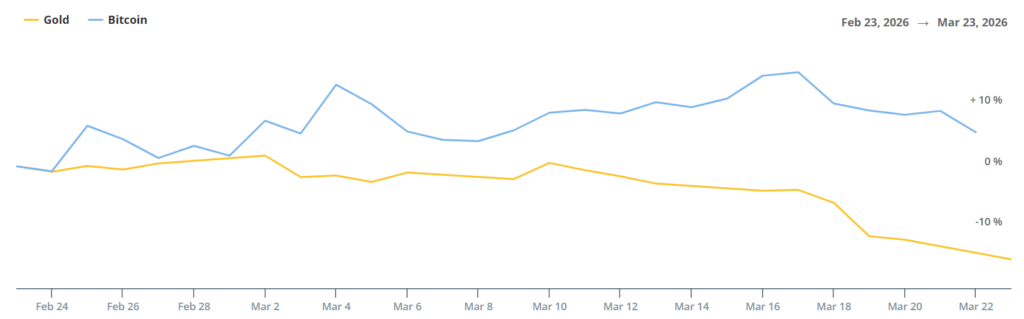
The important qualifier is that this decoupling has limits. Crypto’s correlation with U.S. risk assets rises sharply when macro deterioration reaches a certain threshold. Bitcoin ETF AUM near $95.3 billion and derivatives open interest around $386 billion mean institutional positioning is large enough that a genuine risk-off equity selloff would pull Bitcoin lower regardless of how it is performing relative to gold. The slightly negative funding rates in perpetuals suggest leverage has already been reduced, which limits cascade liquidation risk on the downside but also confirms that conviction on the upside is not running high. The 30-day outperformance versus gold is real. It does not make Bitcoin a safe haven by definition. It makes Bitcoin something more specific: an asset that responds to this particular macro shock differently than gold does, and that difference is becoming harder to attribute to noise.
What to Watch Over the Next 60 Days
The forward question is whether institutional capital starts treating that difference as an allocation signal. The mechanics for it now exist. Bitcoin ETF AUM at $95.3 billion gives allocators a regulated, accessible vehicle to express a Bitcoin position without the custody friction that historically kept large funds away. If portfolio managers are reducing gold exposure because the rate environment has changed the yield-alternative argument, Bitcoin is on the shortlist in a way it was not before the ETF approvals.
Bitcoin ETF inflows running alongside gold ETF outflows would confirm that institutional allocators are making an explicit substitution. That pattern has not emerged clearly yet, but the conditions that would produce it are all present right now. One month does not rewrite decades of portfolio construction orthodoxy. What it does is plant a question in the minds of allocators watching gold underperform during the exact scenario it was built to handle. That question tends to find its way into the next allocation review.


