




- Bitcoin price faces the biggest slump in 10 days, following an upbeat week, as crypto sentiment sours.
- S&P Global downgraded USDT’s Dollar-Peg rating, raising concerns about the key industry player’s reliance on BTC and gold reserves.
- BitMEX Founder Arthur Hayes also warned markets, but Tether CEO fights back against the pessimism.
- U.S. PMIs, Fed’s favorite inflation gauge, and Fed Chair pick will entertain traders ahead of next week’s FOMC.
Bitcoin (BTC) faces the biggest daily slump in 10 days, down 4.0% intraday to $86,700 early Monday, as cryptocurrency sentiment dwindles following an upbeat week.
What Went Wrong with BTC?
The BTC dropped to $85,600 amid the initial trading hours, posting its four-day losing streak following the first weekly gain in five, as the market’s mood turns cautious on mixed industry news and ahead of the key U.S. data week.
Bitcoin’s pullback raised doubts about the crypto major’s previous weekly recovery as the latest price slump joins a sustained fall in the BTC’s market capitalization (market cap) and gains support from the upbeat trading volume. According to Santiment, Bitcoin’s daily trading volume rallies to a three-day high of $60.65 billion, while the market cap slides to the lowest since November 22, close to $1.71 trillion by press time.
Also read: Cryptocurrency Weekly Price Prediction: Is BTC, ETH, and XRP’s Rebound Reliable?
Key Catalysts behind Bitcoin Weakness
Bitcoin’s latest weakness stems from multiple catalysts, ranging from the financial market’s cautious mood ahead of this week’s key U.S. data to industry news from Tether, not to forget concerns about the institutional demand for BTC.
Starting with the broad catalysts, Bitcoin price rose over 4.0% last week while posting its first weekly gain in five as increasing odds of the U.S. Federal Reserve’s (Fed) December rate cut joined optimism surrounding the Ukraine-Russia peace.
However, the market turns jittery ahead of this week’s top-tier data, like the ISM PMIs for November, the Core PCE Price Index, also known as the Fed’s preferred inflation gauge, for September, and a few employment clues.
The scheduled data becomes more important as the Fed officials are on the pre-FOMC blackout period, meaning they’re not supposed to speak about anything on monetary policy in their public appearances before December 10.
Moving onto Tether turmoil, the world’s largest stablecoin issuer, Tether, came under scrutiny after global rating agency S&P cut the USDT’s Dollar-Peg rating to 5.0, the lowest stability grade. The rating giant cited exposure to high-risk assets and structural weaknesses as the key factors for taking this step.
On the same line were comments from BitMEX co-founder Arthur Hayes, who warned about Tether’s financial stability, if prices of Bitcoin and Gold slump, as the USDT issuer relies heavily on these assets.
However, Tether CEO Paolo Ardoino offered additional data to fight back against the S&P’s rating cut and restore the market’s confidence in the world’s largest stablecoin, USDT. The Tether leader signalled the S&P made a mistake while also adding, “Some influencers are either bad at math or have the incentive to push our competitors.”
Apart from Tether’s Ardoino, former lead digital asset analyst at Citibank, Joseph Ayoub, also countered the market’s fears. That said, ex-Citi analyst Joseph Ayoub said, “Tether has excess assets beyond what it reports, has an extremely lucrative business that generates billions of dollars in interest income with only 150 employees, and is better collateralized than traditional banks.”
Apart from the Tether woes, an unconvincing increase in the U.S. spot BTC Exchange Traded Fund (ETF) inflows also grabbed the Bitcoin seller’s attention. That said, data from the SoSoValue signalled that the spot BTC ETFs reported a three-day inflow pattern, following a downbeat start, during the Thanksgiving holiday-shortened week. However, the Black Friday’s short trading session and CME woes ended the week with softer daily inflows of $71.37 million. Still, the spot BTC ETFs marked the first weekly inflow after a four-week outflow, worth $70.05 million by the end of Friday.
Meanwhile, the mixed performance of BTC buying from retail traders and whales also challenges sentiment surrounding the crypto major.
Crypto Rover shares analysis of the BTC holding for retail, wallets with less than 10K BTC, and whales, wallets with over 10,000 BTC, suggesting a mixed performance.
That said, Crypto Rover cited a huge whale buying to counter the latest decline in prices.
On the other hand, the analysis also cites inaction from the retail traders.
Technical Analysis
On a technical side, Bitcoin’s upside break of a two-week resistance line, now support, joined upbeat conditions of the 14-day Relative Strength Index (RSI) and the Moving Average Convergence Divergence (MACD) momentum indicator to lure the buyers. However, its reversal from the 21-day key Exponential Moving Averages (EMAs) keeps the BTC sellers hopeful.
Bitcoin Price: Daily Chart Highlights Seller’s Dominance
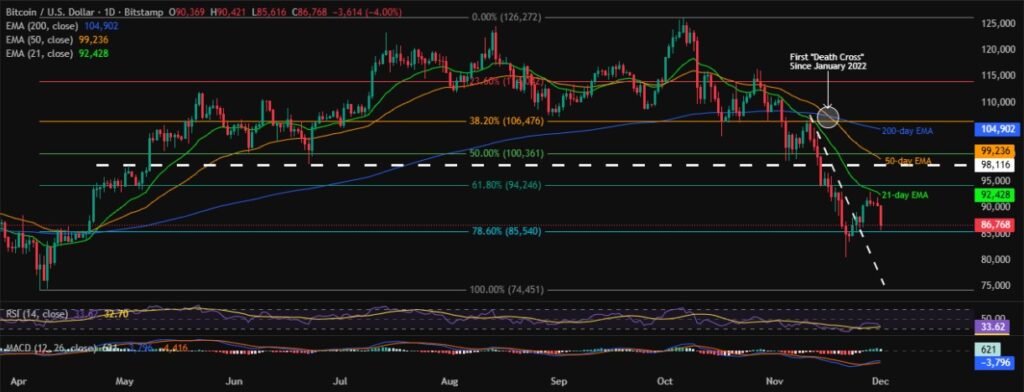
Bitcoin’s U-turn from the 21-day EMA joins a sustained trading below the horizontal support from May, now resistance, to lure the sellers. However, the RSI’s upbeat conditions, recovering from the 30.00 oversold limit, and bullish signals from the MACD (green histograms), join the upside break of a short-term resistance line to test the downside bias.
Adding strength to the downside bias is the first “Death Cross” since January 2022, a bearish moving average crossover wherein the 50-day Exponential Moving Average (EMA) crosses the 200-day EMA from above.
This highlights the 78.6% Fibonacci retracement level of BTC’s rise from April to October 2025, close to $85,500 as we write, as an immediate support for the sellers to watch.
Below that, the previous resistance line from November 11, now support around $80,600, will be a decisive level to follow as a downside break of the same could direct prices to the monthly bottom of $80,537 and then to April’s yearly low of $74,434.
Alternatively, Bitcoin price recovery may initially aim for the 21-day EMA hurdle of $92,414, but the upside remains elusive below the $98,000 hurdle, comprising a multi-month previous horizontal support. That said, the 61.8% Fibonacci retracement level near $94,250, also known as the “Golden Fibonacci Ratio”, can guard the BTC’s immediate upside.
Meanwhile, the $100K, the 50-day EMA of $99,230, and the 200-day EMA around $104,900 could test the BTC bulls before giving them control.
What Next?
Looking forward, a slew of catalysts stand tall to justify the BTC’s latest weakness, as well as challenge the crypto major during December, which in turn suggests the likelihood of Bitcoin’s further weakness in prices.
Among them, the market’s lack of confidence in BTC, evident from the mixed institutional signals and Tether news, garners major attention. Additionally, a potential U.S. Dollar rebound, despite strong hopes of the Fed’s December rate cut, might also exert additional downside pressure on the Bitcoin price.
Even in a case of the risk-on mood, backed by upbeat U.S. data, the Bitcoin buyers will have strong upside hurdles to cross before retaking control.
Hence, the crypto major looks set for further weakness, after posting a two-month downtrend, even if the room towards the south appears to be limited.
Also read: Crypto Digest: Bitcoin Dips to 87K as OPEC+ Signals Caution and Global Data Softens


