





Bitcoin trades with a market cap of approximately $2.38 trillion and BTC dominance sitting at 58.4%, the asset has become deeply embedded in the same macro plumbing that moves equities, crude oil, and sovereign bonds. Monday’s Asian session offered a compressed but instructive picture of exactly how that plumbing works under stress.
The Oil Signal Matters More Than It Appears
WTI crude futures fell toward $111 per barrel on Monday after briefly spiking to $115.50, pulled back by reports of a potential 45-day truce between the United States and Iran. That 4-dollar intraday reversal carries a message for Bitcoin traders that goes beyond oil markets. Over the past 30 days, Middle East escalation, particularly US strikes, Houthi activity, and threats to the Strait of Hormuz, has been the primary mechanism pushing BTC from the mid-$70,000 range down into the mid-$60,000s on headline days. It is structural; higher oil prices raise near-term CPI risk, which complicates Federal Reserve easing odds, which increases the discount rate applied to non-yielding assets, including Bitcoin.
The ceasefire report on Monday provided a temporary reprieve, but it did not bring resolution. WTI at $111 per barrel remains elevated by historical standards, and the inflation pressure that crude prices above $100 generate does not dissipate with a diplomatic headline. Traders who are pricing in rate relief based solely on ceasefire optimism are assuming the most optimistic scenario of a single geopolitical thread within a much more complex macroeconomic context.
Asian Equity Mixed Results Tell a Nuanced Story
The Asian session on Monday did not present a unified picture. Japan’s Nikkei 225 gained 1.34% to trade above 53,370, while the broader Topix added 0.30% to 3,655. South Korea’s KOSPI rose more than 1% to approximately 5,460. These gains were real, but they operated in a liquidity-constrained environment: China’s Shanghai Composite was closed, Hong Kong’s Hang Seng was closed, and Australia’s ASX 200 was also offline. The simultaneous absence of three of the region’s most influential markets means that the equity recovery in Japan and Korea reflects a narrowed sample. Thin holiday markets amplify directional moves while masking the true depth of conviction behind them.
India’s SENSEX moved in the opposite direction, falling 0.52% to below 73,167. The Indian rupee saw a drop to around the value of 92.8 per dollar. This divergence is significant and India’s exposure to Middle East energy routes is structural. The government’s move last Thursday to exempt critical petrochemical imports from customs duty for three months through June 30 is a direct administrative acknowledgment that the region’s supply chain is under active pressure. When a government exempts pharmaceutical, chemical, and textile inputs from import duties, it is not necessarily optimistic about geopolitics. It is hedging against the disruption scenario.
The Gold Signal and What It Communicates About Safe-Haven Rotation
Gold prices sliding toward $4,600 per ounce on Monday, extending losses from the prior session, complicates the narrative that institutional capital is seeking refuge in traditional safe havens. If gold is falling alongside ceasefire optimism, that is internally consistent; safe-haven assets reprice when perceived risk recedes. But it raises an important question for Bitcoin’s positioning. BTC has shown inconsistent safe-haven behavior during this 30-day stretch of geopolitical volatility.
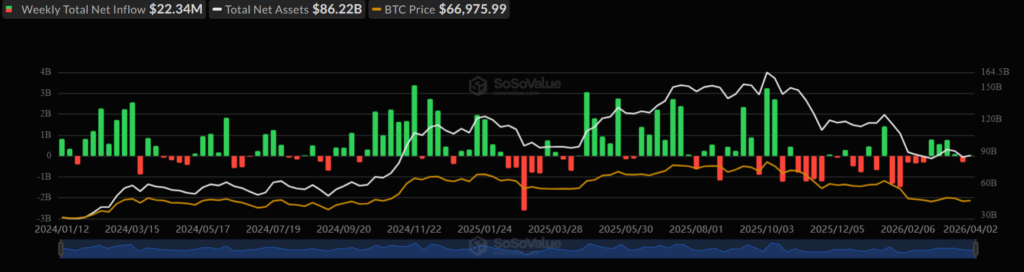
Occasionally it has attracted ETF inflows as a liquid digital store of value. Other times, it has simply sold off in sync with risk assets. With BTC spot ETF AUM currently at approximately $86.22 billion, down from roughly $95 billion in late March, the recent pattern leans more toward correlated risk-asset behavior than independent store-of-value behavior.
That distinction matters for how traders should interpret any BTC rally on ceasefire headlines. A rally driven by declining oil prices and improved risk sentiment is correlated. It rises with equities and falls when the next headline arrives. A rally driven by independent ETF inflows and genuine institutional accumulation is structurally different. The data from late March into early April, with the AUM drawdown of approximately 5 to 6%, suggests the former dynamic is dominant for now.
The Leverage Problem Has Not Gone Away
Derivatives open interest across crypto markets sits near $470 billion. That number represents a market carrying significant leverage into a week packed with macro catalysts. Lower oil, stable yields, and a resumption of ETF inflows could begin to unwind that exposure, but none of those conditions are confirmed. Ceasefire discussions are not a ceasefire. WTI at $111 per barrel is not energy normalization. The structural fragility that built up through March remains in place, and Monday’s session did nothing material to reduce it.
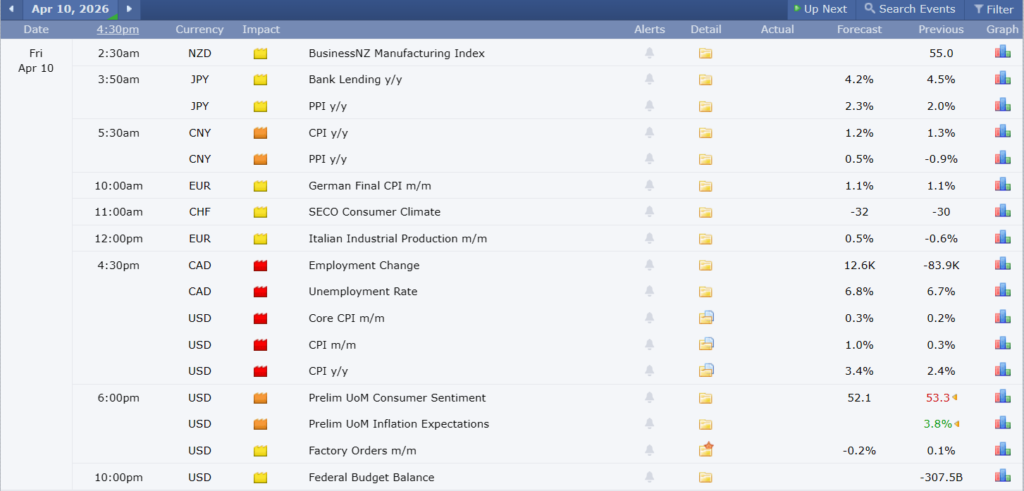
The FOMC minutes, CPI data, ISM Services PMI, preliminary Michigan Consumer Sentiment reading, and the PCE report are all scheduled to release in the week ahead. Japanese yen weakness at approximately 159.5 per dollar, near its weakest levels since July 2024, adds currency intervention risk from Tokyo to a watchlist already crowded with macro events. Any yen intervention that triggers rapid currency moves creates collateral volatility in adjacent assets.
The practical read from Monday’s session is that conditions have improved at the margin. But improvement at the margin, with $470 billion in open interest, a 5 to 6% ETF AUM drawdown still in place, and the Fed’s rate path yet to be clarified by the week’s data releases, is not the same as a resolved macro environment.
What to Watch
The highest-impact data points this week: WTI price trajectory and any official ceasefire confirmation, FOMC minutes for rate path signals, CPI for inflation persistence data, and daily BTC ETF net flow figures. A resumption of consistent ETF inflows combined with oil stabilizing below $105 would shift the balance materially. The absence of either keeps the current fragility intact.


