





Bitcoin is trading close to $66,400 at the time of writing, up a marginal 0.06% in the past 24 hours and down 0.28% over the past week. Those numbers look stable bu the 30-day picture tells a different story: BTC is down 19.94% over the past month, sitting more than 47% below its all-time high of $126,198.07. With $39.67 billion in 24-hour volume and a market cap of $1.32 trillion, liquidity is not the problem. Confidence is.
That backdrop is what made the latest U.S.-Iran escalation a real stress test rather than a routine headline risk.
The Knee-Jerk Drop and What Followed
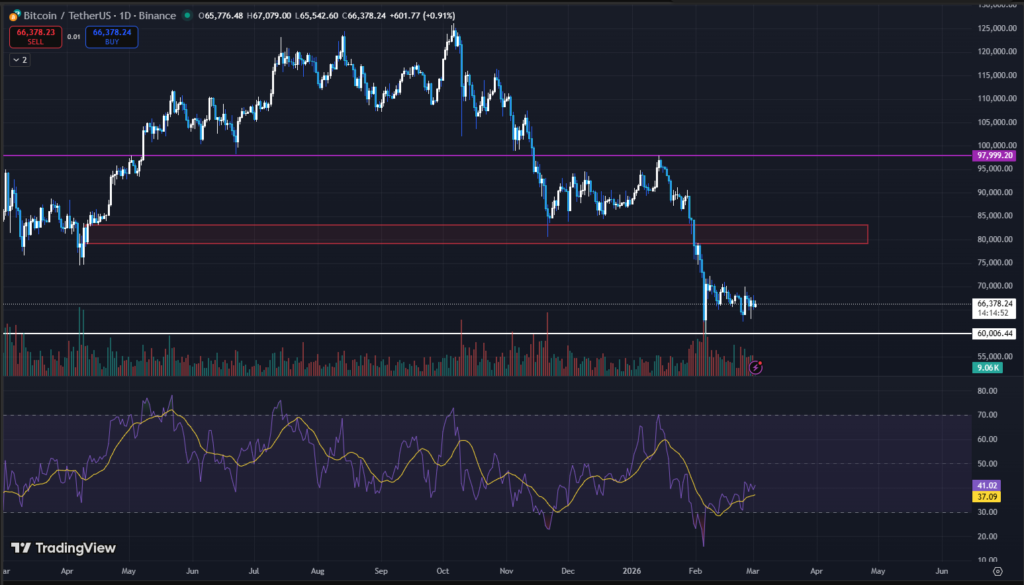
When strike headlines broke, Bitcoin fell toward $63,000. The move was fast, directional, and familiar: a high-beta asset shedding exposure alongside equities as traders priced in uncertainty. The recovery back toward the mid-$66,000 range followed, but the episode left a clear fingerprint on how the market currently reads geopolitical risk.
Oil moved above $80 on supply disruption fears. Gold rallied. Capital rotated into traditional safe havens with conviction. Bitcoin did not follow that script.
Lacie Zhang, Research Analyst at Bitget Wallet, frames the divergence precisely: “The escalation of U.S.-Iran tensions has triggered a classic macro divergence across asset classes. Bitcoin initially dropped toward $63,000 following strike headlines before stabilizing in the mid-$66,000 range, behaving more like a high-beta risk asset alongside equities rather than a geopolitical hedge.”
The widening gap between Bitcoin’s behavior and that of gold or oil is not just a short-term anomaly. It reflects something more structural about where crypto sits in the current macro regime.
The instinct to label Bitcoin a “digital gold” safe haven runs deep in crypto discourse. The data from this episode challenges that framing directly. Zhang identifies the mechanism at work: “What we are observing is less ‘geopolitical hedging’ and more liquidity front-running traders preemptively reducing exposure ahead of potential policy responses or further escalation. Bitcoin’s correlation with equities has intensified, while its link to safe-haven flows has weakened in the short term.”
This is a meaningful distinction. Geopolitical hedging suggests that the capital is shifting into Bitcoin because investors believe it holds value under stress. It does appear like liquidity front-running is pointing to something different this time. Investors in the market are pulling out of risky assets like Bitcoin, probably because they see more price volatility coming and want to hold some cash for later. That 19.94 percent drop over the month makes it clear that such activity was already going on way before the news hit this week.
Derivatives Markets Signal Caution, Not Collapse
The derivatives layer offers a more nuanced read than spot price alone. Funding rates and positioning data point to a market that is defensive but not disorderly.
Rachel Lin, CEO of SynFutures, notes the distinction: “Current funding rates and positioning indicate caution rather than capitulation, which points to a market that is recalibrating risk rather than exiting aggressively.”
That is a technically important point to note, as capitulation would show up as aggressive negative funding, liquidation cascades, and a breakdown in open interest. What the market is showing instead is measured de-risking, elevated caution without the structural damage that typically precedes extended bear legs.
Lin also points to the recovery as evidence that demand has not evaporated: “The recovery from weekend lows back toward the $66,000 level suggests that underlying demand remains intact despite near-term volatility. Historically, geopolitical shocks tend to trigger short-term deleveraging and defensive positioning, particularly in derivatives markets, but they rarely alter Bitcoin’s longer-term structural trajectory.”
A Structural Shift in How Institutional Risk Is Managed
One underreported element in this cycle is where hedging activity is migrating. Zhang highlights a notable development running beneath the spot price drama: “The surge in commodity trading on decentralized perpetual platforms signals a structural shift; institutional hedging is increasingly migrating to 24/7, blockchain-based venues that offer transparent settlement and cross-border accessibility.”
Traditional commodity markets close; geopolitical events do not. The architecture of decentralized perpetuals, accessible around the clock without intermediaries, is increasingly attractive to participants who need to hedge exposure in real time regardless of time zone or market hours. That is a quiet but durable tailwind for on-chain derivatives infrastructure, even as spot BTC remains under macro pressure.
What Comes Next: The Medium-Term Case
The near-term trajectory remains tied to geopolitical developments and macro signals, particularly energy prices and inflation data. With BTC already down nearly 20% in 30 days, the asymmetry of further downside versus a macro-driven recovery is a calculation traders are actively making.
Lin captures the forward-looking tension directly: “Going forward, price action will likely remain sensitive to geopolitical developments and macro signals, especially movements in energy markets and inflation expectations.”
Zhang offers the more constructive medium-term scenario: “Over the medium term, if conflict-driven fiscal expansion leads to renewed liquidity easing, Bitcoin could reprice higher as macro conditions stabilize and risk appetite rebuilds.”
The keyword is “if.” That scenario depends on a policy pivot that has not yet materialized and a geopolitical de-escalation that remains uncertain.


