





The most important price driver in crypto right now is not a protocol upgrade, a token unlock, or a whale wallet. It is the U.S. Consumer Price Index report due March 11, followed by an FOMC meeting on March 18. That sequencing tells investors nearly everything they need to know about where short-term volatility is coming from and why a $15/barrel oil move this week produced $225 million in crypto liquidations within hours.
Crypto is no longer priced in isolation. The total market cap sits at roughly $2.31 trillion, up a modest 0.81% over 24 hours, but that number masks an asset class that is increasingly synchronized with U.S. equity markets. Seven-day correlations between crypto and major equity ETFs (SPY, QQQ) have risen materially, confirming what many institutional participants already treat as fact: crypto now behaves like a high-beta risk asset within a broader macro portfolio.
The Oil Transmission Mechanism
The week’s clearest illustration of this dynamic came from energy markets. Oil surged sharply following reports of coordinated strategic reserve releases tied to escalating geopolitical tensions involving the U.S., Israel, and Iran. The move, which at its peak measured approximately $15/barrel on an intraday basis before partially reversing and then falling back below ~$104, had no direct relationship to any blockchain network. Yet it triggered roughly $225 million in crypto liquidations: approximately $150 million in Bitcoin and $75 million in Ethereum within a 24-hour window.
The mechanism is straightforward. Rising oil prices revive inflation expectations. Elevated inflation expectations delay anticipated Fed rate cuts. Delayed cuts tighten real liquidity conditions. Risk assets, including crypto, reprice lower. Leveraged positions amplify that repricing. The cascade from the commodity market to the crypto derivatives book happens in hours, not days.
Rachel Lin, CEO of SynFutures, captured the dynamic precisely: “The sharp surge in oil prices following escalating tensions between the U.S., Israel, and Iran has revived inflation concerns globally, which could complicate expectations for interest rate cuts and weigh on risk sentiment across financial markets.”
What makes the situation particularly consequential for crypto is timing. Unlike equities, crypto markets operate continuously, meaning geopolitical shocks get priced in around the clock, including over weekends when traditional markets are closed. As Lin noted, “This can create short-term volatility, but it also highlights Bitcoin’s role as one of the most responsive macro assets. ” “Responsive,” in this context, is not necessarily a compliment. It means exposure without the circuit breakers that equity markets use.
Derivatives Are the Accelerant
None of this volatility would move as sharply without the leverage structure underneath it. Global open interest across crypto derivatives sits at approximately $383.6 billion, up roughly 5% in 24 hours. Perpetuals alone account for approximately $373.2 billion of that figure, up 3.6% in the same window. Bitcoin’s 24-hour liquidation volume reached $129.7 million, more than double the prior period, a 107% increase.
Funding rates have turned slightly negative, a signal that directional short positioning or hedging is becoming crowded. This configuration, rising open interest combined with negative funding, creates asymmetric conditions in both directions.
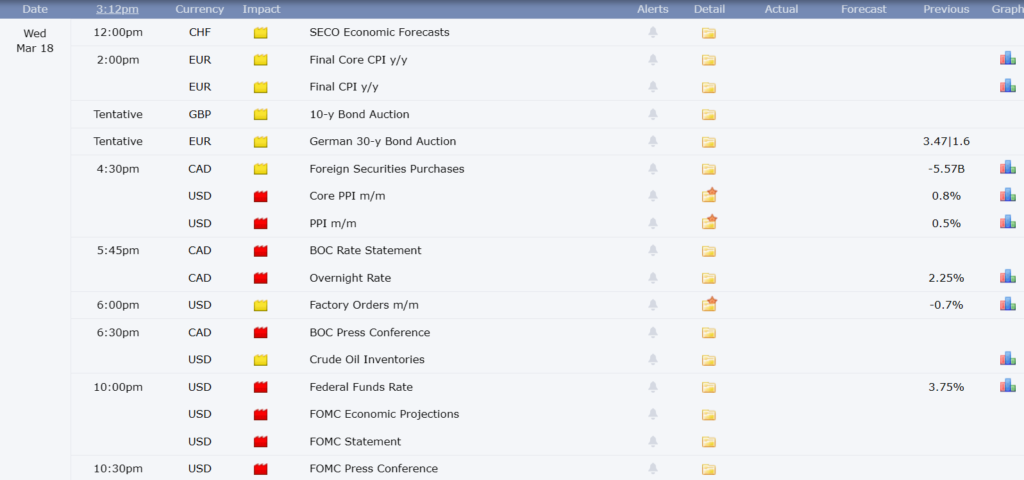
A softer-than-expected CPI print on March 11 could trigger a fast short squeeze because the short side is crowded. A hotter print, or hawkish FOMC language on March 18, could accelerate forced deleveraging. Either scenario produces outsized intraday moves relative to the fundamental shift in information. The leverage structure is the amplifier.
ETF Flows: Stabilizer, Not Shield
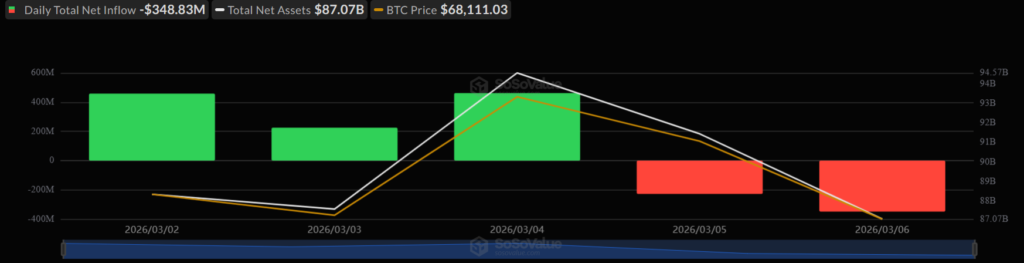
Spot Bitcoin ETF assets under management (AUM) remain substantial at approximately $87 billion, providing a structural institutional presence in the market that did not exist in prior cycles. These represent genuine demand absorption at scale. However, their presence does not eliminate volatility when macro shocks and leveraged positioning coincide. Recent sessions have shown both inflows and outflows on a daily basis, and in periods of acute macro stress, institutional participants reduce exposure like any other risk manager. ETF AUM is a stabilizer on balance, not a guarantee against sharp drawdowns.
Sentiment Develops Fragility
The social layer compounds the setup. Net social sentiment across crypto sits at approximately 4.85 out of 10 over the past 24 hours: below neutral and fragile. The character of that sentiment is notable. Loud, high-engagement bullish posts coexist with bearish threads claiming large-scale whale selling. Quality-weighted, the net signal is cautious. In this environment, a single macro headline, an oil price print, a Fed official’s comment, or a large on-chain movement can generate outsized crowd repositioning because conviction is shallow on both sides.
What Investors Are Actually Watching
The near-term framework is clear. The March 11 CPI (Consumer Price Index) and March 18 FOMC (Federal Open Market Committee) are the key macro inputs. Inflation that surprises to the upside compresses rate-cut expectations and pressures risk assets, including crypto. Inflation that underperforms gives the crowded short side reason to unwind quickly. Either way, the leverage structure and thin sentiment mean the magnitude of the move will likely exceed what the fundamental data shift would normally justify.
Beneath that volatility, Bitcoin’s behavior around the $67,000 level is worth noting for what it signals structurally. Lin observed that “Bitcoin holding above key support levels suggests underlying demand remains intact, particularly from investors who increasingly view it as a global, liquid asset capable of reacting quickly to shifts in macro and geopolitical conditions.” The resilience relative to equities, which cannot reprice on weekends, reflects this structural characteristic.
The asset class is not being driven by crypto-native catalysts this week. It is being driven by the same variables that move Treasury yields, equity risk premiums, and commodity markets. Traders who are not reading macro data alongside on-chain metrics are working with an incomplete picture.
Conclusion
Crypto’s current volatility environment is a product of three converging forces: a critical macro calendar with CPI and FOMC outcomes still unknown, a derivatives market carrying $383.6 billion in open interest at negative funding rates, and sentiment that is too fragile to absorb surprises cleanly. Oil and geopolitics added the first stress test this week; the macro calendar will provide the next one. Until those prints resolve, the $2.31 trillion market will remain highly sensitive to data it did not create.


