





The cryptocurrency market dropped 4.25% in 24 hours, pulling the total market cap down to $2.43 trillion. The move was not driven by anything internal to crypto. It was a macro event, and the market data makes that clear. The Federal Open Market Committee (FOMC) held rates steady at 3.75% on March 19 but revised its 2026 PCE inflation forecast upward to 2.7%. Chair Jerome Powell cited elevated oil prices as a persistent risk, effectively closing the door on near-term rate cut expectations. Risk assets repriced immediately. Crypto followed equities down with an 89% correlation reading over the period, removing any ambiguity about what drove the selloff.
The Fed Decision and What Changed
Holding rates was the expected outcome. What the market did not fully price in was the inflation revision.
A 2026 PCE forecast revision to 2.7% is not a minor technical update. It tells the market that the Fed expects inflation to remain above target further into the future than it previously acknowledged. For risk assets, that has a direct implication: rates stay higher for longer, and the cost of holding volatile, non-yielding positions like crypto does not come down on the timeline traders were pricing in.
The rate cut narrative that had been supporting risk appetite into the FOMC meeting did not survive the press conference. Investors who built positions around an earlier easing cycle are now staring at a forecast that pushes that timeline out, and the repricing was immediate. Crypto does not trade in isolation from macro. When the Fed signals it is in no rush, leveraged risk positions feel it first.
The move in crypto was not isolated. The 89% correlation with the S&P 500 over this period confirms that the selling was macro-driven rather than crypto-specific. When correlation runs that high, the asset class is effectively trading as a risk-on/risk-off instrument rather than on its own fundamentals. In that environment, Fed language matters more than on-chain data.
The Liquidation Cascade That Made It Worse
The Fed decision created the conditions for a sell-off. Leverage did the rest. Over the 24-hour window, $150.77 million in BTC positions were liquidated, with $139.89 million of that coming from longs. That breakdown signifies how the market was positioned before the FOMC decision landed: crowded long, levered up, and exposed.
The Fed’s news-induced price drop didn’t merely remove weak players. It triggered a mechanical cascade. Stop levels hit, liquidation thresholds crossed, and the forced selling added a second layer of downward pressure on top of the original macro move. The catalyst was the Fed. The magnitude was derivative. This is a familiar sequence in crypto, and a macro-driven decline initiates the move, but the leverage structure in perpetuals turns it into something larger than the fundamental trigger alone would have produced. The price does not just reflect the news. It reflects the news plus every overleveraged long that got caught on the wrong side of it.
Total open interest currently sits at $421.79 billion in perpetuals. That figure remaining elevated suggests the deleveraging process is incomplete. As long as open interest stays high relative to spot volume, the market retains the mechanical conditions for another liquidation event if the price continues lower.
Key Levels and What Comes Next
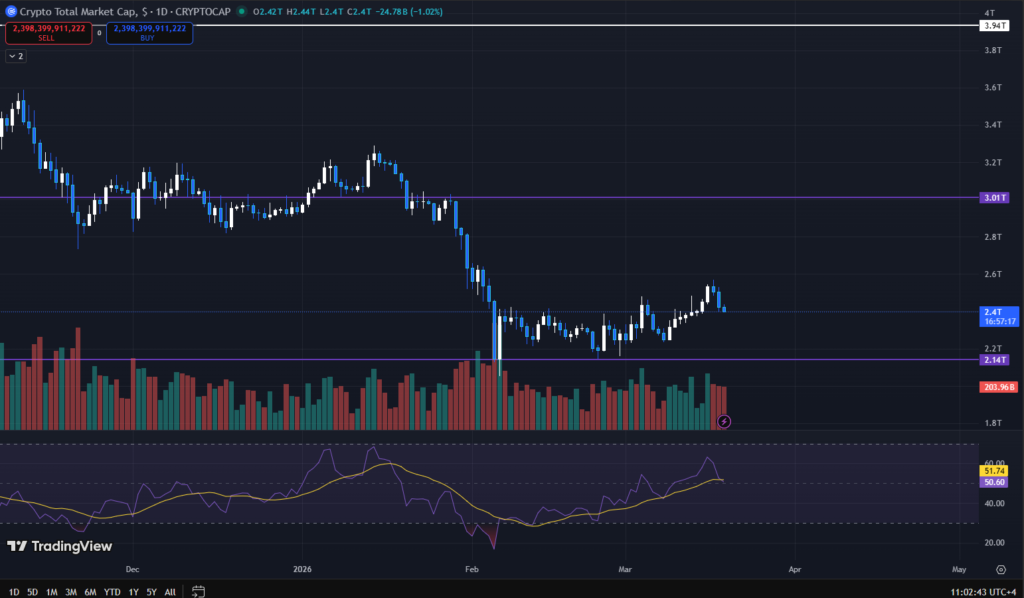
The immediate structural question is whether the $2.3 trillion market cap level holds. That level corresponds to the 38.2% Fibonacci retracement from the recent swing high and represents the first meaningful support below current prices. A sustained break below $2.3 trillion opens a test of the $2.21 trillion swing low, which would represent an additional 3.7% decline from the current support zone.
The Fear and Greed Index sitting at 32 (CoinMarketCap) confirms that sentiment has shifted firmly into fear territory. That reading does not by itself predict further downside, but it does indicate that the market is not in a position to absorb negative catalysts without significant price impact. Buyers at current levels are taking on the elevated risk that another macro shock pushes prices through support before stabilization.
The March 28 PCE inflation print is the next hard data point that could shift the narrative in either direction. A reading that comes in below expectations would revive rate cut hopes and likely provide relief for risk assets. A hot reading that confirms the Fed’s revised inflation projections would reinforce the higher-for-longer narrative and increase the probability of testing lower support levels.
What Traders Should Watch
Three variables define the near-term setup. Open interest at $421.79 billion needs to come down meaningfully before the cascade risk clears. Until that number shows a sustained decline, the derivatives market remains loaded with positions that can be force-closed on any additional downside move. The deleveraging process is not complete, and that mechanical risk does not disappear just because prices stabilize temporarily.
The 89% crypto-equity correlation means macro events will continue to override anything happening on-chain. On-chain metrics, exchange flows, and wallet activity are largely irrelevant as price drivers when correlation runs this high. Traders watching crypto-native signals in isolation are missing where the actual price discovery is happening, which is in equities and rates markets. Until that correlation compresses, the S&P 500 open and Fed speaker headlines carry more weight than any on-chain development.
The market is currently in reactive mode. It is not trading based on crypto-native factors. It is trading on inflation expectations and Fed policy signals, and until that changes, macro data releases carry more weight than anything happening on-chain.


