





As of early 2026, the crypto markets continue to face pressure because global capital is favoring defensive positioning amid high geopolitical and trade-related uncertainties. It is true that the blockchain infrastructure and institutions’ access to crypto assets have greatly increased in the last year; however, the short-term behavior of the market is more of caution rather than that of growth-oriented risk hunger.
The present situation is primarily characterized by macro-driven capital rotation rather than by any specific weaknesses in the cryptocurrency market. Escalating geopolitical conflicts, the return of trade disputes among the biggest economies, and fading trust in dollar-based investments have directed the investors to safe havens with less volatility. Therefore, due to the significant influence of liquidity and mood, crypto assets are currently undergoing a phase of consolidation rather than an upward trend.
Bitcoin Holds Key Levels but Lacks Momentum
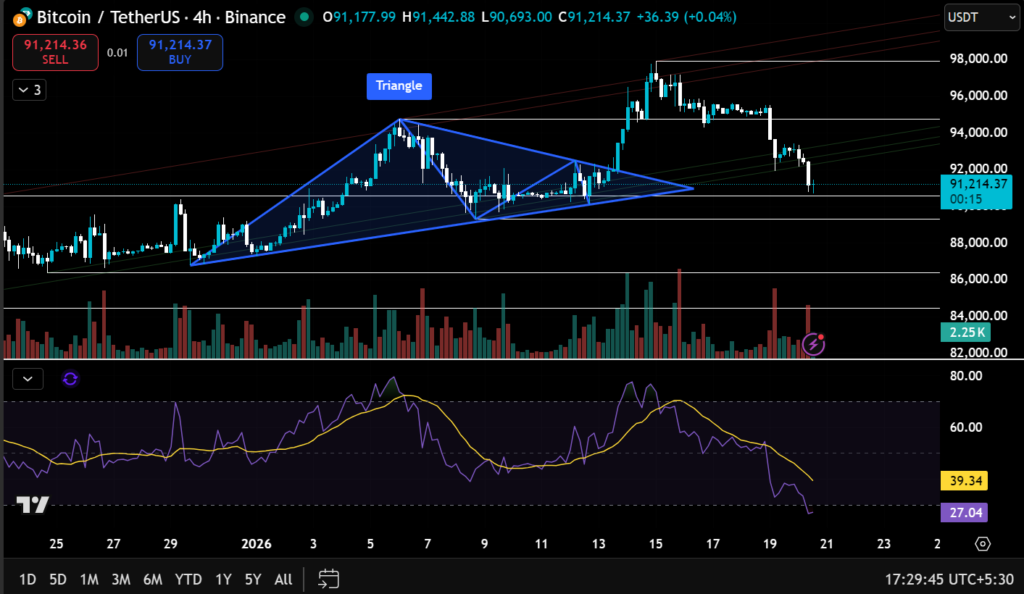
At the time of writing, Bitcoin is changing hands at a price of around $91,200. Despite a drop in its value of about 2% in the last 24 hours, which has left the value somewhat lower than that of last week, the largest cryptocurrency has been successfully staying above the significant level of $90,000, which is considered to be between the buyers and the sellers. The total value of Bitcoin in the market is about $1.82 trillion, which further proves its position as the major source of liquidity in the digital assets market.
Bitcoin’s price movement from an analytical point of view is seen as a compression rather than a breakdown. The institutional involvement through ETFs is still intact with the total net inflow of 616.35K BTC but with a daily total outflow of 4.13K BTC. The shifts of leverage and macroeconomic uncertainty have restricted directional conviction. The ability to sustain price above major support levels suggests structural demand remains intact, even as upside catalysts remain delayed by broader liquidity conditions.
Ethereum Underperforms as Risk Appetite Stays Selective

Ethereum, on the other hand, has been showing a weakness compared to Bitcoin and is currently trending in a symmetrical triangle pattern. The price for the asset is currently around $3,100 after the latest 24-hour trading dropped by almost 4% and last week by only 1%. Even with a market cap of about $375 billion , Ethereum is still getting the most out of its constant network usage and protocol upgrades, but these strengths have not yet been reflected in the price increase.
The underperformance highlights Ethereum’s sensitivity to risk-off flows. While decentralized finance activity and staking remain solid, capital rotation away from growth assets has weighed on smart-contract platforms more broadly. This implies that macro liquidity conditions, rather than internal network developments, more closely influence ETH’s near-term trajectory.
Large-Cap Altcoins Show Diverging Trends
The leading altcoins have shown varying performance, indicating selective rather than general demand. Among them, BNB has been quite strong, relatively, its price being around $913 with slight increases during the last week considering the short-term swings in the market. The asset’s market cap that stands at roughly $124 billion indicates the ongoing demand that is mainly driven by the use of the asset in exchanges and other activities in the ecosystem.
XRP is experiencing greater downside pressure in a sharper way. The asset is trading at about $1.93 and has a market capitalization of approximately $118 billion; it has lost more than 6% of its value in the last week. This trend implies that the market could experience increased volatility due to the transition of speculative trade positions caused by regulation, which at the same time highlights XRP’s dependence on market mood changes.
Solana has been, in terms of performance, one of the least successful among the large caps. Trending at about $129 and a market cap close to $73 billion, SOL has lost over 9% in value in a week. The higher-beta Layer 1 asset, Solana, has a bigger share in the current risk-off scenario of deleveraging and profit-taking.
Tokenized Assets Highlight Capital Rotation
Crypto-native assets are going through consolidation, and at the same time, tokenized instruments on blockchain platforms are attracting an increasing influx of capital, pointing to a crucial variance between infrastructure usage and asset preference. The gold products have reached all-time highs, showing that the market prefers defensive exposure and not taking speculative risks.
Bitunix analyst Dean Chen emphasized that this behavior reflects capital allocation choices rather than a loss of confidence in crypto markets.
XAUTUSDT has once again set a new all-time high, with prices briefly reaching USD 4,715 per ounce.
From a 4-hour structural perspective, pullbacks have been shallow and price is consolidating near the top, indicating that buyers remain firmly in control.
He added that as long as support near USD 4,650 holds, the broader bullish structure remains intact. For crypto markets, this divergence is instructive. Capital is increasingly flowing through blockchain rails, but it is being deployed into lower-volatility, hedge-oriented instruments rather than digital-native growth assets.
Research Outlook: Rotation Over Structural Weakness
The present phase in cryptocurrency markets seems to indicate rotation rather than a structural downturn. The current state of the cryptocurrency markets looks to be more of a rotation than a structural decline. In the past, capital preservation has always been the first reaction to periods with geopolitical tension and trade disputes, followed by investing in riskier assets when the dust settles on the volatility.
The crypto market remains grounded by essential supports through the performance of Bitcoin, whereby the major support levels were not broken; the consistent activity on the Ethereum network; and the progressive development of the ecosystem on the main chain. If the global liquidity situation gets better or the macro risks become less threatening, the cryptocurrencies might go through a delayed but faster catch-up phase by the end of 2026. The crypto market is currently in a state of consolidation, caught between robust structural foundations and prudent macro-driven capital flows.


