





The total crypto market cap sits at $2.34 trillion, 24-hour volume is running at a moderate $77.64 billion, and leverage is elevated without yet reaching the kind of extreme readings that historically precede forced unwinds. By most surface-level readings, this looks like a market in a holding pattern, range-bound and waiting. But beneath that apparent stability, something more structurally significant is happening, and it has very little to do with on-chain activity, protocol fundamentals, or any crypto-native narrative.
The Correlation Problem
Over the past seven days, the total crypto market cap has tracked U.S. equity ETFs with a closeness that should give traders pause. The 7-day correlation between crypto and QQQ, the Nasdaq 100 ETF, sits at 0.96. With SPY, the S&P 500 benchmark, it’s 0.94. Even small-cap equities, tracked by IWM, carry a 0.79 correlation over the same window. SPY itself has declined roughly 3.64% over the recent sample period, which maps almost exactly onto crypto’s own soft tone.
This is not a permanent structural feature. Drop to the 30-day window and these correlations collapse: QQQ falls to 0.38, SPY to 0.20, and IWM to near zero. Gold, often cited as crypto’s philosophical cousin in the “store of value” conversation, sits at roughly 0.11 over seven days and near zero over 30. In short, crypto is not behaving like digital gold in any near-term sense. It is behaving like a leveraged bet on U.S .growth stocks.
The implication is direct in the cases like when equity risk sentiment deteriorates, whether triggered by inflation surprises, Fed guidance, or geopolitical shocks; crypto absorbs the impact quickly and disproportionately. This is not a new dynamic, but the current reading of 0.96 against QQQ represents a particularly tight coupling that leaves limited room for crypto-native catalysts to move the market independently.
Institutional Demand Is Pulling Back
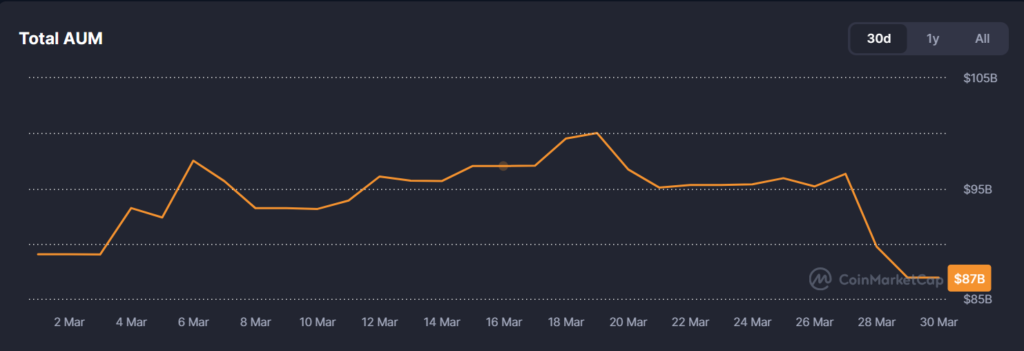
The clearest evidence of macro-driven pressure is visible in the spot BTC ETF data. Total AUM has dropped from approximately $95.38 billion to $86.92 billion over roughly six days. That’s a decline of 8.87% in under a week, driven by a combination of net outflows and price impact from existing holders.
Spot ETF flows represent regulated money managers making considered, compliance-approved allocation calls. So when that cohort starts trimming, it carries a specific kind of weight: the institutions most capable of providing consistent demand are choosing not to. That is a different signal than a retail trader closing a position.
What makes the current AUM decline harder to dismiss is the context around it. Flows had actually been recovering month-to-date before this drawdown, clawing back ground after weeks of net outflows. That recovery was fragile from the start, built against a backdrop of rising geopolitical risk and the repricing of rate expectations that tends to follow oil shocks. The pullback resuming now suggests that recovery did not have much conviction behind it.
The concern around a prolonged conflict driving higher oil prices is not speculative. Higher energy costs feed directly into inflation readings, which in turn reduce the probability of central bank rate cuts. Market participants who entered 2026 treating rate cuts as near-certain are now revisiting that assumption. Fewer cuts mean tighter liquidity conditions, and tighter liquidity is historically unfavorable for risk assets broadly and for crypto specifically. The ETF AUM data is already beginning to reflect that repricing.
Leverage Is Elevated, Not Extreme
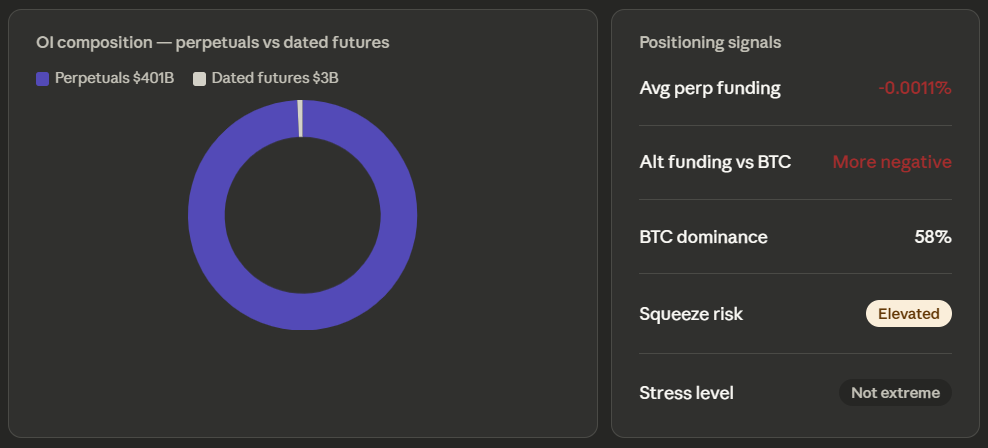
Global derivatives open interest across crypto stands at approximately $404 billion, with perpetual futures accounting for $401 billion of that total. That figure is up roughly 7% over the past seven days, meaning leveraged exposure has been growing even as prices stagnated and ETF flows softened.
The funding rate provides some nuance here. Average perpetual funding is running at approximately -0.0011%, slightly negative, meaning shorts are paying longs by a marginal amount. Altcoin funding is even more negative relative to BTC. This is not the euphoric, one-sided long positioning that typically precedes violent deleveraging events. It leans toward cautious, slightly defensive positioning without being an outright crowded short.
BTC liquidations over the most recent 24-hour period came in at $137.36 million. That number is elevated day-on-day but sits well short of the multi-hundred-million or billion-dollar liquidation cascades that mark genuine market stress events. The setup describes a market with enough leverage to produce sharp squeezes in either direction but not one that is obviously on the edge of a forced unwind.
BTC dominance holds near 58% and has barely shifted over the past week. The altcoin market cap at $982.69 billion is modestly lower, confirming that the recent de-risking has been broad rather than a dramatic sector rotation. he market is moving sideways with a slight risk-off tilt.
What Moves Crypto From Here
Given how tightly crypto is tracking U.S. equity sentiment right now, the variables that will matter most over the coming weeks are not on-chain. CPI and PCE inflation prints will be the first filter, because any reading that comes in hotter than expected shifts rate cut probability in a direction that is unfavorable for risk assets broadly, and crypto, sitting at a 0.96 seven-day correlation with QQQ, is at the high-beta end of that distribution. Nonfarm payrolls and PMI data feed a separate but related question around whether the economy is threading a soft landing or beginning to slow in ways that suggest something more damaging, with both extremes, whether growth is so hot it keeps inflation sticky or data is weak enough to signal recession, historically negative for assets that depend on loose financial conditions to sustain demand.
FOMC communications are where both threads converge, with dot plot revisions and any pushback on cut timelines transmitting through bond markets and equities into crypto at a speed the current correlation regime makes almost mechanical. Layered on top is the geopolitical backdrop: sustained conflict driving oil prices higher feeds directly into inflation, which reduces the probability of rate relief, which tightens the financial conditions crypto needs to sustain institutional demand. The ETF flow data suggests regulated money is already pricing in some version of that scenario.
Beyond U.S. data, the geopolitical backdrop carries meaningful tail risk. If conflict in the Middle East becomes prolonged, the energy price and inflation channels become more persistent than the initial shock. That scenario is not priced in as a base case, but it is no longer implausible, and the ETF flow data suggests institutional capital is already accounting for it.
On a longer horizon, regulatory developments in Asia represent a genuine potential catalyst. Appetite for crypto among Japanese retail investors is reportedly strong, and regulatory frameworks there are advancing. A formal ETF approval in that market would represent a structural inflow story disconnected from the current U.S. macro-driven dynamics.


