




Key Takeaways
- DeepMind Has Unveiled SIMA 2 With Enhanced Reasoning Capabilities: The new agent can understand objectives, plan actions, and respond dynamically in 3D environments.
- SIMA 2 Is Showing Strong Performance in Unfamiliar Games: Tests across titles such as ASKA and MineDojo revealed that the system can complete complex tasks without prior training.
- The New Agent Learns and Improves Without Human Input: After initial training, SIMA 2 continued developing through Gemini-driven feedback loops, demonstrating autonomous, self-improving behavior.
- DeepMind Has Released SIMA 2 in a Controlled Research Preview: Early access has been granted to select academics and developers to gather feedback and assess real-world performance.
Table of Contents
Google DeepMind has introduced the second version of its virtual agent platform, SIMA 2, designed to interact, learn, and evolve within complex 3D gaming environments, as part of its effort to develop more autonomous and intelligent agents capable of executing multi-step tasks and adapting to unfamiliar digital worlds.
SIMA 2 builds on the foundations of its predecessor, which was able to follow simple language commands across a variety of virtual environments.
Now enhanced with DeepMind’s Gemini models, the new version has evolved into an agent capable of reasoning through objectives, engaging in dialogue with users, and improving its performance through continuous interaction.
From Instructions to Collaboration
According to Google DeepMind’s official announcement, the second-generation agent introduces several key upgrades that distinguish it from its predecessor.
One of the most notable advancements is its ability to engage in high-level reasoning and collaborative interaction rather than merely carrying out preset commands.
While the original SIMA was primarily reactive, executing user instructions like “turn left” or “open map”, SIMA 2 demonstrates a deeper level of understanding. It interprets objectives, strategizes next steps, and executes actions based on its assessment of the user’s goals, according to DeepMind.
This transformation was made possible by embedding the Gemini model at the agent’s core, allowing SIMA 2, through extensive training with annotated human gameplay footage and Gemini-generated labels, to articulate its planned actions and explain its decision-making in real time.
According to DeepMind, interacting with SIMA 2 feels more like collaborating with a teammate than issuing commands, as the agent was trained and evaluated across a broader set of video game titles in partnership with multiple developers.
Improved Generalization and Language Flexibility
The integration of Gemini has significantly enhanced SIMA 2’s ability to navigate complex and unfamiliar environments.
The agent successfully completed advanced tasks in new digital worlds, including ASKA, a Viking-themed survival game, and MineDojo, a research platform based on Minecraft.
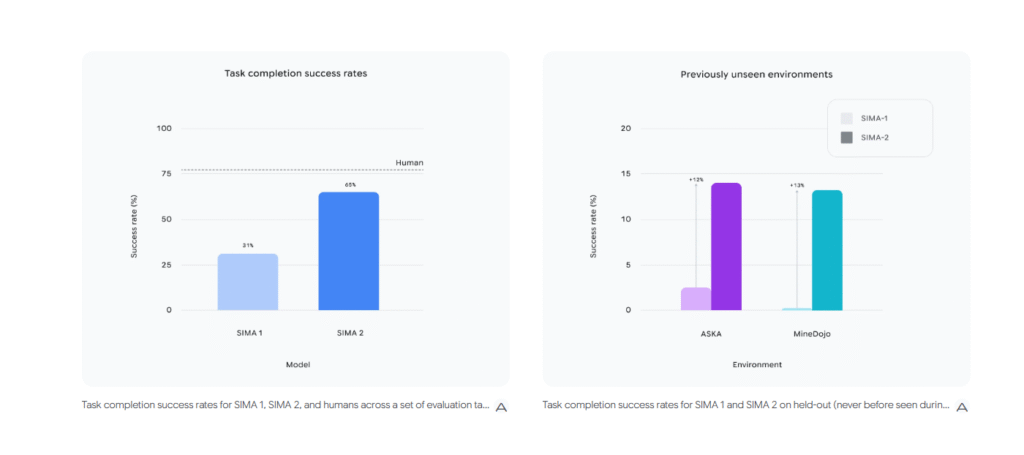
Beyond task execution, SIMA 2 now handles a broad spectrum of input types, interpreting multimodal prompts such as text, images, emojis, and commands in multiple languages. It also demonstrates cross-contextual learning, translating concepts like “mining” from one environment into “harvesting” in another, pushing its generalization abilities closer to those seen in human cognition.
Testing in AI-Generated Worlds
To assess adaptability, researchers combined SIMA 2 with Genie 3, a generative AI system that constructs new 3D virtual environments from text or images.
In these newly created environments, SIMA 2 was able to find its way, understand the user’s instructions, and take meaningful action, even without having encountered the setting before.
Self-Improvement Without Human Data
DeepMind has equipped SIMA 2 with the ability to learn autonomously, reducing reliance on human-generated data.
After a phase of initial training on gameplay demonstrations, the agent began improving through Gemini-powered feedback loops.
According to the company, SIMA 2 was able to take on unfamiliar games and tasks without further human input, marking a step toward self-sustaining, open-ended learning.
This feedback-based learning mechanism has shown promise in accelerating AI development with minimal oversight, allowing agents to grow in capability through exploration and self-play, the report noted.
Real-World Use Cases and Limitations
While SIMA 2 remains a research prototype, DeepMind views its architecture as a model for future AI systems with physical-world applications. Skills such as navigation, tool use, and cooperative task execution, essential in robotics, are being refined within the virtual framework.
However, the agent still faces notable limitations. It struggles with long-duration tasks that require sustained memory and complex, multi-step reasoning. It also finds precise control through keyboard and mouse inputs difficult and still struggles to achieve consistent accuracy in interpreting complex 3D scenes.
Limited Release for Research and Developer Feedback
For now, SIMA 2 is being released as a limited research-focused pilot, with early access provided to a small group of academics and game developers.
DeepMind said the rollout is aimed at gathering practical feedback and varied perspectives as it explores broader applications and continues to refine the system.
This phased approach, the company noted, is designed to support collaborative testing and build a clearer picture of how the agent performs across different virtual environments.
Read More: Be Nice to Your AI, It May Be More Aware Than You Think, Anthropic Research Finds


