





Dubai’s Virtual Assets Regulatory Authority (VARA) has released new guidance on the Virtual Assets Issuance Rulebook to draw sharper lines around who can issue tokens in the emirate, when a license is required, what disclosures must be made to the market, and how far asset-backed structures must go to prove their claims.
The new document does not replace the rulebook, but it provides issuers, distributors, and advisers with a more detailed operating manual, especially on classification, whitepaper standards, risk statements, and the treatment of asset-referenced products.
A Clearer Structure for Token Issuance
At the center of the guidance is a three-layer framework for token issuance: Category 1, Category 2, and Exempt VAs. VARA says that every entity in Dubai issuing a virtual asset in the course of a business must first work out where its product sits within that structure before going to market.
Category 1 is the most tightly controlled. It covers Fiat-Referenced Virtual Assets, or FRVAs, and Asset-Referenced Virtual Assets, or ARVAs. Any entity seeking to issue one of those assets must be licensed by VARA in advance. Once licensed, that issuer becomes a VASP and must comply not only with the issuance rules, but also with VARA’s compulsory compliance and risk, technology, and market conduct rulebooks. VARA also requires prior approval of the whitepaper for each Category 1 asset before issuance.
Category 2 issuance follows a different model, covering virtual assets that fall outside both Category 1 and the exempt category. The issuer does not need a VARA license, but the asset cannot be placed or distributed freely. Instead, VARA requires all placement and distribution to be carried out by a licensed distributor, meaning a VASP authorized to provide broker-dealer services.
The exempt scope is narrow, covering for now only non-transferable virtual assets and redeemable closed-loop virtual assets.
What Counts as Business Activity
VARA gives the phrase “in the course of a business” a broad reading, making clear that an issuance does not need to resemble a straightforward sale for money to fall within scope. The guidance states that a direct or indirect commercial element, remuneration, incentives, a link to business activity, or even issuance by non-profit or charitable bodies may be sufficient to bring a token within the framework, while only tokens issued solely for personal or non-commercial use may fall outside the framework.
The guidance also makes clear that a virtual asset cannot be shifted into a different category unless the issuer has first met the requirements of that new category. If an issuer amends a token so that it no longer fits its original classification, the necessary approvals, licensing, or distribution arrangements must already be in place before the change takes effect.
Whitepapers Move Closer to Prospectus-Style Disclosure
For most issuances, VARA requires a whitepaper to be published before the asset is offered or marketed, and it must be kept in a single easily accessible, machine-readable format, with the only exception being the Exempt VAs.
VARA sets a clear standard for whitepapers, saying they must be fair, clear, and written in good faith, with enough information for current and prospective holders to make an informed decision, while steering issuers away from vague, promotional, or generic language in favor of specific and meaningful disclosure.
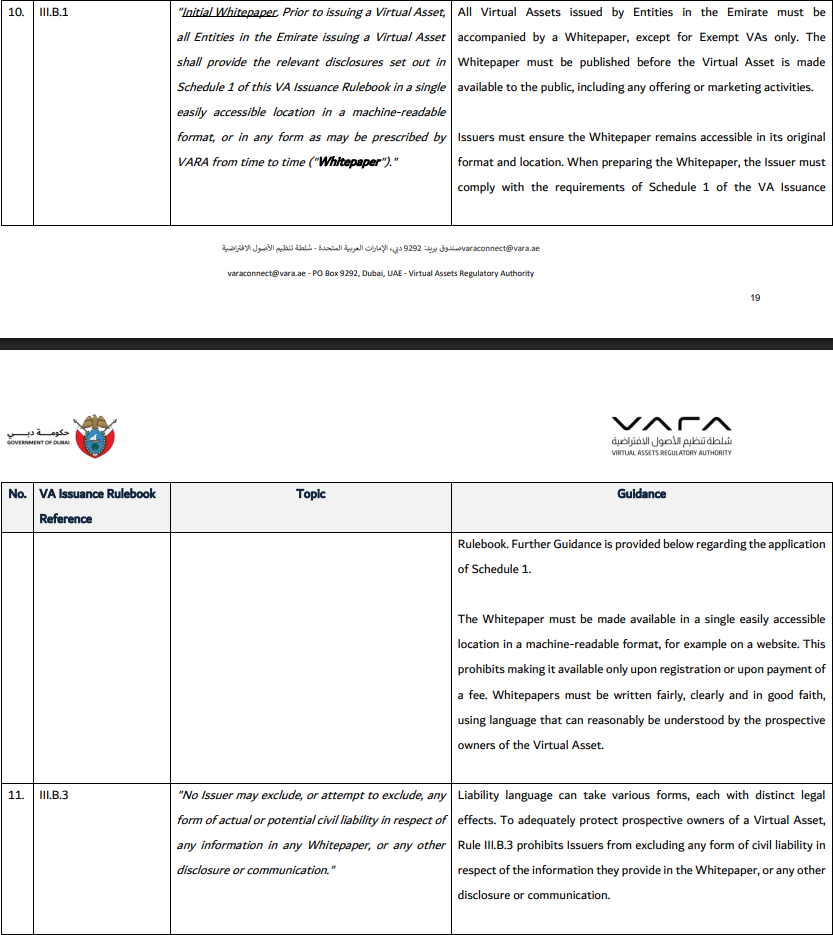
VARA makes clear that the whitepaper obligation does not end at publication, requiring it to remain accurate and complete at all times, with dated updates and earlier versions kept available for as long as the asset remains in the market, while holders must also be notified of changes before they take effect except in urgent cases tied to security or market integrity.
VARA also bars issuers from relying on familiar crypto-style disclaimers, stating they must not exclude civil liability for statements in a whitepaper or in other disclosures and communications.
Risk Statements Must Be Specific, Concise and Material
Separate from the Whitepaper, issuers must also publish a Risk Disclosure Statement in the same accessible location. VARA says that statement must be concise, non-technical, and comprehensible, while still giving a detailed account of all material risks linked to the asset.
The emphasis is not on listing every theoretical danger, as the guidance says issuers should refrain from disclosing non-material risks, avoid generic disclaimer language, and draw a clear, direct link between each disclosed risk and the specific virtual asset, while grouping risks into categories, ranking them in descending order of materiality, and leaving out any risk altogether if mitigating measures render it non-material.
Asset-Backed Structures Face the Heaviest Scrutiny
The most detailed treatment is reserved for ARVAs, which VARA broadly describes as virtual assets linked to an underlying real-world asset or to income derived from such an asset. The definition is deliberately wide enough to cover direct ownership claims, indirect exposure, stable-value structures, wrapped or fractionalized versions, and rights to share in income produced by RWAs.
Issuers of ARVAs must provide extra whitepaper disclosures on the rights the token grants, the reference assets it relates to, whether those assets can change, whether reserve assets will be maintained, how the creation and destruction of tokens affect reserves, what redemption rights exist, how custody works, and what risks arise in management, investment, and liquidation. The guidance criticizes vague formulations such as references to “high-quality, liquid assets” or “prudent reserve management” when they are not backed by specific detail.
For ARVAs designed to maintain a stable value against a reference asset, VARA says reserve assets may be required and must be sufficient and acceptable to secure the rights and value attached to the token. If the ARVA instead transfers a direct right of ownership in the underlying asset, the issuer must ensure that ownership is legally and validly established and properly transferred with each token transfer.
The paper allows VARA to require legal opinions for ARVAs on a broad range of issues. Those opinions must come from an independent, duly registered practicing lawyer, not internal counsel, and may need to address the issuer’s authority, the ARVA’s legal classification, the enforceability of the rights it grants, compliance with applicable law, and whether reference or reserve assets are protected from third-party recourse, including in insolvency.
Tighter Rules for Stablecoins
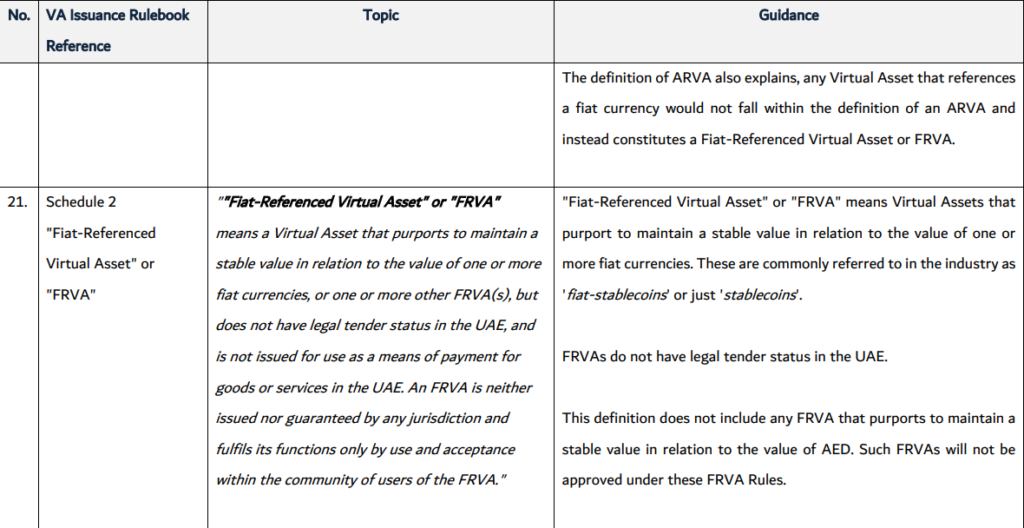
The guidance confirms that FRVAs are virtual assets designed to maintain a stable value against one or more fiat currencies, while making clear that they do not have legal tender status in the UAE. It also draws a notable boundary around AED-linked products, with VARA saying fiat-referenced virtual assets tied to the UAE dirham are excluded from the FRVA definition in this guidance and will not be approved under the FRVA rules set out in the new document.
A Clearer Regulatory Path for Issuers
Taken together, the guidance shows VARA’s effort to move token issuance in Dubai away from loose categorization and stylized crypto disclosure, and towards a more formal regime built on licensing, regulated markets, and product-specific transparency. The broad message is simple: classify first, disclose precisely, keep documents current, and expect the toughest scrutiny where tokens claim stability, asset-backing, or ownership rights over real-world value.


