





Table of Contents
The European Central Bank is pressing ahead with technical work on a possible digital euro, setting out a broader timetable for pilots, standards, and market preparation as officials try to keep the project on course for a potential launch from 2029.
Speaking to the European Parliament on March 24, ECB Executive Board member Piero Cipollone said the Eurosystem was pressing ahead with preparations for the digital euro so it would be ready if lawmakers approve the required legislation. He said issuance would only be considered once the legal framework is in place and would be carried out in full compliance with that legislation.
The update comes as the ECB tries to frame the digital euro not as a new payment tool, but as part of a broader effort to strengthen Europe’s monetary sovereignty, cut fragmentation in retail payments, and reduce dependence on non-European providers.
Inclusion at the Centre
A large part of the ECB’s case for the digital euro now rests on accessibility.
Cipollone said the project was being designed as a digital complement to cash and needed to work for all users, including people with disabilities and those who struggle with digital financial services.
The ECB has already carried out interviews and focus groups across the euro area to understand barriers faced by vulnerable consumers, and recently signed a collaboration agreement with Spain’s ONCE Foundation to help shape the digital euro app and test future prototypes.
Among the features under consideration are voice commands, larger text displays, simplified workflows, and tools to help users manage spending. The ECB said it wanted the digital euro to go beyond minimum accessibility requirements under European law and make sure it could be used easily across the bloc.
Backing Private-Sector Innovation
The ECB is also trying to convince the market that the digital euro would support, rather than push out, private payment firms.
Cipollone said the project could provide common infrastructure and shared standards that banks, fintechs, and payment service providers could use to develop services across borders. He pointed to a 2024 innovation platform that drew around 70 participants, including merchants, banks, researchers, and fintech companies, to explore how the digital euro could support new business models and simplify payments.
That work is now being split into two tracks. One will focus on practical experimentation around features such as conditional payments, e-receipts, bill-splitting, and budgeting tools. The other will look further ahead at possible future applications, including business-to-business payments, micropayments, artificial intelligence, and machine-to-machine transactions. The ECB said it would also run an offline payments hackathon as part of that effort.
Fitting Into Europe’s Payment System
Another part of the ECB’s plan is that the digital euro would sit alongside existing European payment frameworks rather than replace them.
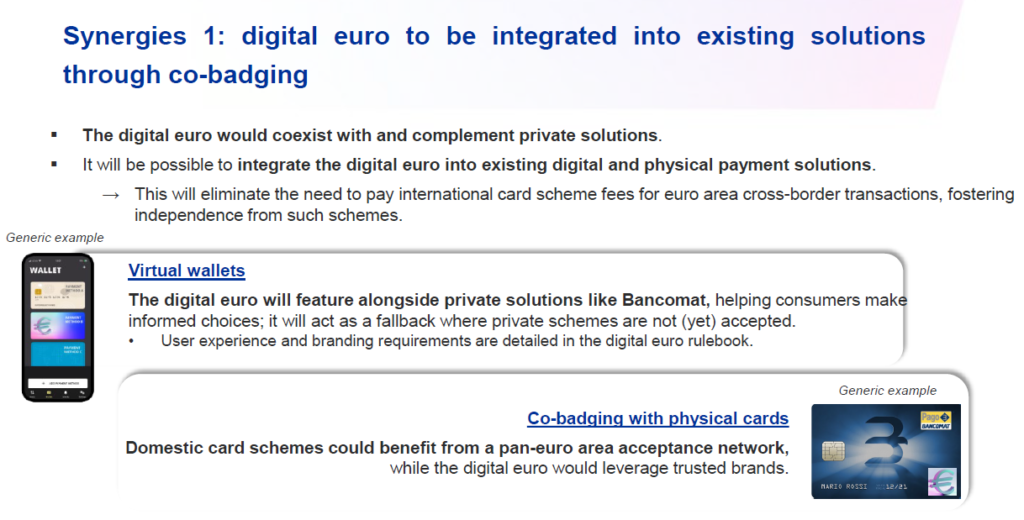
Cipollone said the ECB is considering co-badging with domestic schemes and common European standards to integrate the digital euro into existing payments systems, allowing users to rely on a single card or wallet across the euro area while reducing dependence on international card networks.
The central bank expects to announce by the summer which European standards it plans to use for the digital euro. But Cipollone said those standards can only be finalized once legislation is adopted, because only then will the market have certainty that the framework will be deployed across the euro area.
The Pilot Phase Draws Closer
The ECB has also started laying out the next testing phase.
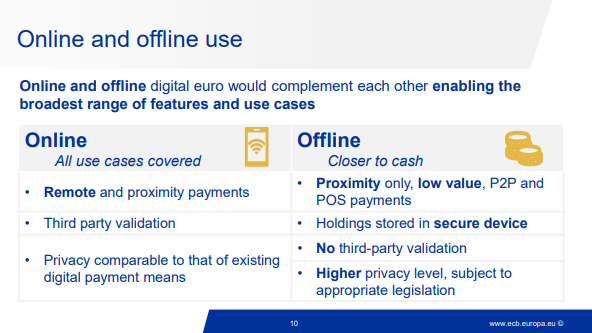
In early March, the Eurosystem launched a call for licensed payment service providers to express interest in taking part in a pilot that will test person-to-person and person-to-business payments in both online and offline settings. Selected participants are expected to be notified in June, with development due to begin in the third quarter of 2026. The pilot itself is scheduled to start in the second half of 2027 and run for 12 months.
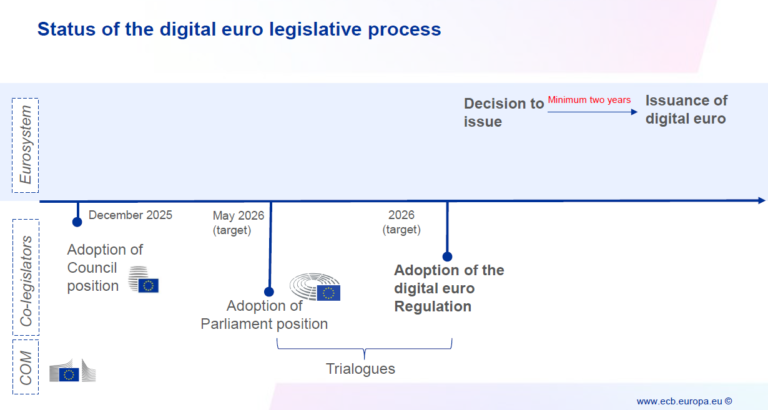
Cipollone said the pilot was part of preparations aimed at ensuring technical readiness for a possible issuance as early as 2029, based on the assumption that EU lawmakers approve the legislation this year.


