





Ethereum staking is at a new peak, with almost 36 million ETH secured on the beacon chain. This is almost 30% of Ethereum’s entire circulating supply and a market value of over $119 billion at current market prices.
The ValidatorQueue and beaconcha.in data reveal that the staked ETH steadily increased from around 35.5 million in the beginning of January to nearly 36 million, with the range being between 35.9 million and 36 million. The constant growth has taken place in spite of a more than 30% drop in Ether’s price since August 2025, which indicates the long-term trust among validators and institutional players is still in force.
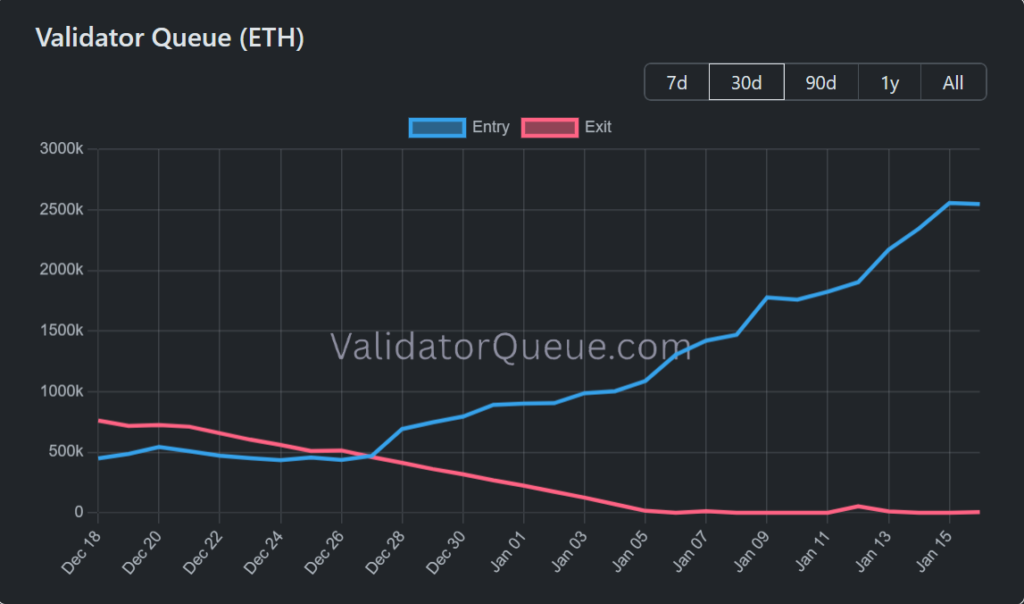
The staking queue has shown strong growth, climbing above 2.5 million ETH and attained its highest level since August 2023. Following the same time period, the unstaking queue stays at zero, which demonstrates minimal near-term exit pressure. Together, these metrics indicate strong demand for participation in Ethereum’s proof-of-stake network and limited immediate selling risk.
The participation of institutions has been a significant factor driving the recent growth of staking. Companies listed on stock exchanges and large staking providers have persisted in their ETH accumulation and validator capacity enhancement even when the market was more or less stable. Increased staking participation reinforces Ethereum’s security and raises the economic cost required for potential network attacks to the extent of being unthinkable.
Vitalik Buterin Urges Focus on Real-World Applications
Ethereum co-founder Vitalik Buterin urged the developers on Wednesday to stop doing theoretical experiments and start building user-facing products that are real and practical. Buterin said that the core infrastructure of Ethereum has now reached maturity as he pointed to the proof-of-stake consensus, the reduced fees for transactions, and the large-scale Layer 2 networks backed by ZK-EVM technologies.
He pointed to the evolution of early Ethereum messaging concepts like Whisper into Waku, alongside active applications such as Status, Railway, and Fileverse. Buterin presented what he described as the “walkaway test” and argued that a truly decentralized application should continue operating and retain the user data even if the development team is not available.
Buterin distinguished between decentralized platforms and centralized services that rely on subscriptions and continuously collect user data. He pointed out that Ethereum has now been able to back up the permissionless applications in finance, social media, governance, and other real-world use cases, where users have complete power over their assets and information.
Market Snapshot

At the time of writing, ETH trades near $3,310 and has now broken the falling wedge pattern. At the time of writing, Ethereum is trading in a symmetrical triangle (marked in blue). The current daily RSI stands at 62.26, which shows strength in price action. If the price action holds strong, the asset can reach its Fib level of 0.618, standing around $4070. Record staking levels, continued institutional accumulation, and renewed concentrate on practical development highlight strong long-term conviction in Ethereum’s ecosystem.
While short-term price volatility is still present for the asset, on-chain indicators demonstrate that the network stays structurally strong and well positioned for wider adoption in the upcoming years.


