




Ethereum and Solana are still the first two most important smart contract platforms; both market leaders worked on different design ideas. Solana was launched five years after Ethereum. The Ethereum blockchain, at the same time, puts decentralization, security, and stable ecosystem development over the long term as its main priorities, whereas Solana offers very high throughput, very low latency, and extremely low transaction fees as its main attractions.
This article compares the market performance, scalability, transaction fees, DeFi activity, user adoption, and decentralization of the two networks.
Market Metrics

Ethereum is still the largest cryptocurrency by market capitalization and liquidity, thus confirming its position as the primary settlement layer for both decentralized finance and high-quality assets. The estimated total market capitalization of Ethereum is around $376 billion in January 2026, with 120 million ETH in circulation and a spot price of approximately $3,130. Solana, on the other hand, has maintained rapid growth, although it is still a small player in the market, and now has a market capitalization of about $79 billion, with a circulating supply of 470 million SOL and a price close to $140.5. Solana’s market capitalization is 78.99% less than that of Ethereum’s market capitalization.
Performance and Scalability
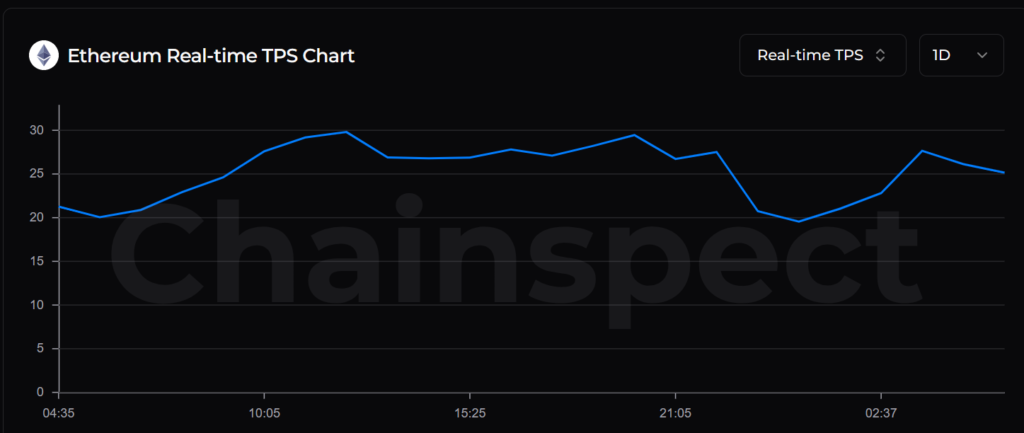
Scalability is still by far the most prominent technical distinction between the two networks. The base layer that underpins Ethereum handles between 25 and 30 transactions in a second, and the blocks are completed once every 12 seconds on average. However, the network is getting more dependent on Layer 2 rollups, namely Arbitrum and Optimism, which together are capable of processing thousands of transactions per second and hence, scaling Ethereum’s throughput.
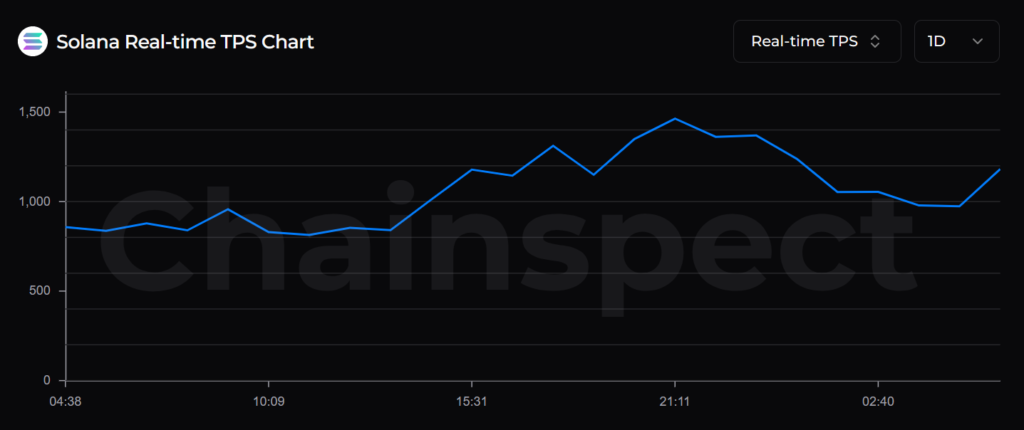
Solana functions as a high-performance unified chain that focuses on delivering real-world throughput between 1100 and 1500 transactions per second, with block times approximately 0.4 seconds. This performance characteristic makes the chain particularly suitable for low-latency applications, such as gaming, memecoins, and high-frequency trading. Periodic congestion during market demand spikes remains a challenge, although network stability has improved in comparison to earlier years.
Transaction Fees
Every network’s transaction costs represent its architectural trade-offs. Ethereum, after some recent upgrades, is now having an average transaction fee of $0.15. The fee still fluctuates during the times when the network is heavily used, but rollups have taken over the major part of the retail traffic.
On the other hand, Solana keeps charging very low fees and is currently at $0.01149. Such a price structure allows for the use of high-volume and microtransactions with no need for secondary channels. In 2025, Solana revenue was about $1.053M, whereas Ethereum’s chain revenue reached $323.2K.
Total Value Locked and DeFi Activity
According to data providers such as DeFiLlama, Ethereum is still the unrivaled king in decentralized finance. The total value locked in Ethereum is almost $72.1 billion as of January 2026, which is more than half the total value of the DeFi market worldwide.
Although Solana’s DeFi sphere is limited to a smaller size, it has gradually increased, and the total value locked stands at around $8.9 billion. The main reason behind the activity is the retail-oriented apps, like Jupiter and Raydium. Although capital concentration is lower, the transaction speed and users’ involvement are relatively high.
User Adoption and Application Activity
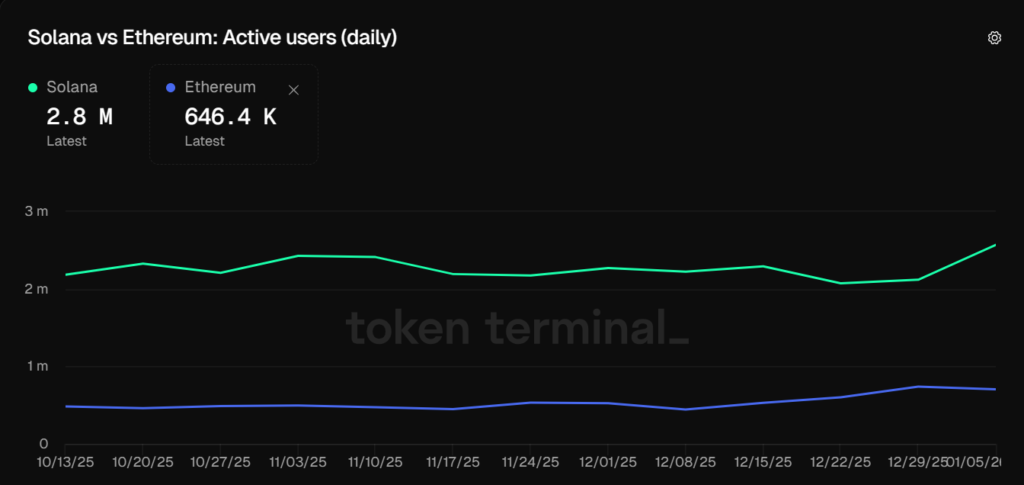
Solana is the undisputed leader in user activity, with daily active users numbering approximately 2.8 million. The primary factors of the increase in users are the consumer-oriented apps, such as memecoins, NFT trading, and on-chain games. The creation of wallets increased dramatically at the end of 2025, with around 50 million new addresses created in just one month.
Ethereum has a lower daily user count of live addresses between 480k and 700k and daily transactions of 1.1 million to 1.9 million. Despite that, Ethereum has more than 4,000 dApps and is thus still drawing the bulk of institutional clients and high-value transaction use cases.
Security and Decentralization
Ethereum is still at the top of the list when it comes to decentralization and network security. There are more than 700,000 validators in total distributed over 80 different countries, which means there’s been a major step towards concentration risk reduction and fault tolerance improvement. The network has been almost 100% up since it moved to PoS, thanks to the support of different client implementations, all of them being independent.
Conclusion
Ethereum and Solana still have contrasting roles in the blockchain ecosystem. Ethereum, on the other hand, is the top choice among platforms for those applications that need a great deal of security, capital, and major institutions’ participation, not to mention the advantages of strong liquidity and decentralization. The main characteristics of Solana are high speed, low costs, and large-scale user engagement, which result in it ideal for consumer applications with enormous volumes.
These top blockchains are not battling against each other in a fierce way; instead,; the on-chain data shows that they are both attempting to fulfill the users’ requirements and are expanding in different areas. Ethereum is seeking to improve its performance by scaling Layer 2 to a point where it can compete with Solana, which, on the other hand, is promoting its trustworthiness and distribution. The future of these two networks will be a battleground where the power of their respective domains will be the winning factor, as well as how firmly they hold them.


