





The day after Ethereum spot ETFs collectively pulled in $169.4 million, a single fund reversed the narrative entirely. Yesterday (March 5, 2026), the Ethereum spot ETF complex posted a total net outflow of $90.94 million, according to SoSoValue data. The swing came not from broad-based selling across issuers but from a concentrated exit in Fidelity’s FETH, which alone shed $115 million in a single session. That one fund’s outflow was 3.1 times larger than all measurable inflows combined on the same day, and it arrived on what was otherwise a mixed-to-constructive day for most other ETH ETF products.
When the Headline Number Misleads
The $90.94 million aggregate outflow flattens a more nuanced picture. On the same day FETH was bleeding capital, two other funds were actively attracting it.
BlackRock’s ETHA recorded the largest single-day net inflow in the complex at $30.25 million, lifting its historical cumulative total to $138 million. Grayscale’s Ethereum Mini Trust ETH added $7.13 million, bringing its own cumulative to $90.18 million. Together, the two funds absorbed $37.38 million in fresh capital on March 5. For most of Q1 2026, that would have been considered a decent session.
The challenge is that FETH, with its $115 million single-day exit, overwhelmed the combined inflows by a factor of 3.1 and dragged the sector-wide figure deep into negative territory. FETH’s historical cumulative net outflow now stands at $150 million, meaning the fund has returned more capital in aggregate than BlackRock’s ETHA has ever managed to attract. That inversion sits quietly beneath the headline, but it is one of the more telling data points in the complex right now.
This trend is not uniform selling pressure. It is one issuer shedding assets while another builds them, with the aggregate figure making both look like the same story.
The Volatility Pattern Is Hardening
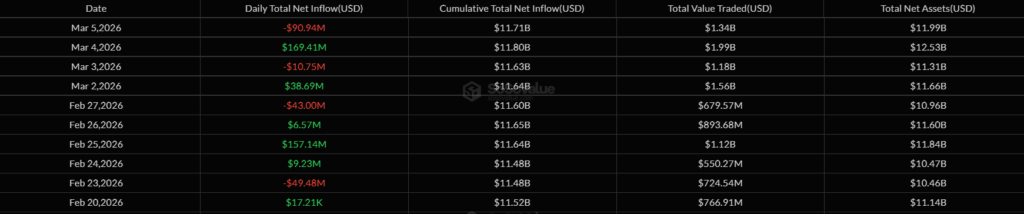
March 5’s outflow did not arrive in a vacuum. The four trading sessions of the current week produced a net inflow of $106.4 million, but the session-by-session breakdown tells a different story: +$38.7 million, -$10.8 million, +$169.4 million, -$90.9 million. Each directional move is being partially or fully undone the following session, with no sustained trend in either direction.
The prior two months were more severe. February 2026 closed with a cumulative net outflow of $337.1 million. January 2026 was nearly identical at $353.2 million. Across the last 30 trading sessions, the complex has posted 17 outflow days against 13 inflow days. Back-to-back months of net outflows exceeding $330 million each make March’s volatile but nominally positive week look less like a recovery and more like a temporary reprieve.
Volume on March 5 reinforces the concentrated-exit thesis. Total trading volume came in at $1.34 billion, above the 30-session average of $1.02 billion, yet the outflow was narrowly sourced. The prior day’s $169.4 million inflow session ran on $1.99 billion in volume, meaning the buying was broadly distributed while the selling was not. Broad-based buying followed by concentrated selling is a structure that favors the sellers in net flow terms, even when raw volume figures appear comparable.
AUM and the Mark-to-Market Problem
Total net assets across Ethereum spot ETFs closed March 5 at $11.99 billion, with a net asset ratio of 4.75% relative to Ethereum’s total market cap.
The proximity of that figure to the historical cumulative net inflow of $11.71 billion is worth pausing on. With $11.99 billion in assets against $11.71 billion in cumulative invested capital, ETH price appreciation has contributed only approximately $283 million in mark-to-market gains across the entire product history. That is a 2.4% return on invested capital over 19 months. For a category sold on exposure to a high-growth asset, that number is difficult to frame positively.
The AUM trajectory compounds the picture. Total net assets peaked near $32 billion in early October 2025, when Ethereum’s price and cumulative inflows were both at their highs. From that level, AUM has contracted 62.5% to $11.99 billion today.
The cumulative inflow figure peaked at about $15.08 billion at the same time and has lately dropped by $3.37 billion, averaging roughly $674 million in net monthly outflows over the five months since. The steepest single drop came in early February 2026 during the time when AUM collapsed from $13.4 billion to $10.9 billion across just two sessions, a pair of heavy redemptions and ETH price weakness hitting simultaneously. The current AUM indicates just a partial recovery from that trough.
Implications for Traders and Investors
The FETH dynamic raises a structural issue the Ethereum ETF market has not resolved. When a single fund can overwhelm the combined inflows of every other product in the complex, the aggregate daily flow figure loses its value as a sentiment indicator. Analysts reading total daily flows as a proxy for institutional demand are working with a number one redemption desk that can distort on any given morning.
The actionable read is the issuer-level divergence. ETHA’s $138 million cumulative inflow, built against a backdrop of $3.37 billion in sector-wide net outflows since October 2025, signals that some institutional capital is directionally committed to Ethereum exposure through the ETF wrapper. FETH at negative $150 million cumulative signals the opposite. Tracking that gap is more useful than tracking the aggregate.
The 4.75% net asset ratio also matters for context. Ethereum ETFs hold a materially smaller share of their underlying asset’s market cap than Bitcoin spot ETFs do relative to BTC, a gap that reflects both ETH’s relative price underperformance and the weaker institutional urgency to gain ETH exposure through a regulated wrapper. The 2.4% mark-to-market return on cumulative invested capital is the number behind that narrative.
Forward Outlook
The week-to-date net of $106.4 million provides a buffer through the end of the week, but FETH is the variable that makes any projection unreliable. If yesterday was a one-off institutional redemption, ETHA’s consistent bid should keep weekly flows positive. If FETH continues at any pace resembling last session, that buffer disappears fast. A fund with $150 million in cumulative net outflows is not in recovery mode.
Longer term, the Ethereum ETF market is in a structural consolidation phase; the data has been consistent about it for five months. AUM is down 62.5% from its peak. Monthly outflows have averaged $674 million. The net asset ratio is shrinking. A reversal requires either a meaningful ETH price rally or a genuine shift in institutional allocation appetite for the asset. Neither condition is visible in current data.


