





The top five digital assets by market cap are all green on the week. Examining the deep trend details reveals a more complex story. Diverging drawdowns from all-time highs, competing ETF flow narratives, and a geopolitical backdrop that sent gold past $5,400 tell a more complicated story than a simple recovery headline.
The Week in Numbers: Green Across the Board, But Not Equally
Bitcoin sits at $66,473, up 5.30% over seven days and carrying a $1.33 trillion market cap. Ethereum trades at $1,948, up 6.97% on the week despite a slight 0.24% dip on the day. BNB holds at $623, up 5.89%. XRP at $1.35 is the week’s laggard with a 1.29% gain. Solana leads the group at $84.34, up 10.24% over the same period. That SOL outperformance is not a minor detail. A 10.24% weekly gain against BTC’s 5.30% represents nearly double the return, and SOL’s consistent presence on centralized exchange “top traded” lists confirms this is volume-backed, not a thin-market move.
What these headline numbers obscure is the drawdown picture. Every asset in this group remains deeply below its all-time high. XRP is down 64.94% from its peak. SOL is off 71.35%. ETH sits at a 60.66% drawdown. Even BTC, the most recovered of the five, remains 47.33% below its ATH. These are not corrections. They are structural dislocations that define the risk/reward calculus for any position taken at current prices.
BTC: ETF Flows Providing a Floor, Headlines Creating the Ceiling
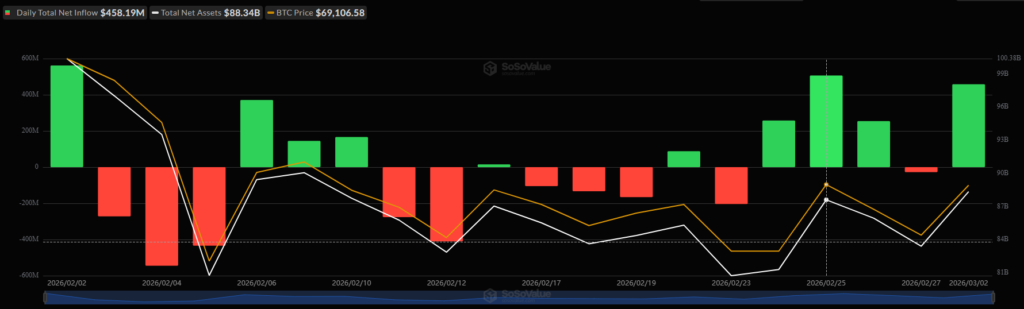
Bitcoin’s week was shaped by two competing forces. On the institutional side, a single-day net inflow of approximately 6,970 BTC (roughly $458 million) into US spot BTC ETFs, part of a broader $521 million session across US spot crypto ETF products, signals that demand at the institutional level remains intact. That kind of daily inflow does not disappear quietly, and it has provided meaningful support during dips.
The ceiling came from geopolitics. Intraday swings between roughly $63,000 and $68,000 over the past week were directly tied to Iran-Israel conflict headlines. When risk-off sentiment spikes, Bitcoin gets sold alongside equities, regardless of its ETF demand backdrop.
Shawn Young, Chief Analyst at MEXC Research, frames the situation bluntly: “The crypto market is experiencing a wobbly recovery as its positive technical push is being hampered by broader geopolitical tensions.” He notes that over 9 million BTC are currently held at a loss, which historically has created a base for eventual price recovery, but cautions that “the macro trend makes clear that investors still aren’t stepping into risk assets.” Young also flags the possibility of a deeper pullback, suggesting that if Middle East tensions do not ease, investors may need to “allow for a 55-60% drawdown” from ATH, implying a potential test below $60,000 on BTC.
ETH: Outperforming BTC but Still Looking for a Catalyst
Ethereum’s 6.97% weekly gain outpacing BTC’s 5.30% is notable given the headwinds. ETH-linked ETF products had been seeing outflows in recent weeks, including a period where combined BTC and ETH products shed roughly $250 million in a single week. The latest daily data shows ETH ETF flows back in positive territory, which may explain some of the weekly strength.
On the protocol side, the Ethereum Foundation released what it calls a “strawmap” outlining development priorities through 2029. The focus is rollup-centric scaling and L1 efficiency improvements, with no immediate hard fork on the near-term horizon. For traders looking for an upgrade-driven catalyst comparable to the Merge narrative, this roadmap does not provide one. What it does provide is a clear, long-term technical direction, which matters more for medium-term conviction than for short-term price action.
XRP vs. BNB: A Market Cap Battle with Structural Subtext
XRP and BNB are effectively trading places around the fourth and fifth positions by market cap. BNB at $84.96 billion holds a narrow lead over XRP at $82.28 billion. The gap is close enough that a single strong session could swap their rankings.
BNB’s technical roadmap is arguably the more concrete of the two in the near term. BNB Chain’s 2026 Tech Roadmap details 2025 hard forks that cut block time from approximately 3 seconds to 0.45 seconds and reduce finality to around 1.1 seconds, with gas price reductions included. Targets for 2026 include approximately 20,000 TPS with sub-second finality and parallel EVM execution. Longer-term ambitions through 2028 target up to 1 million TPS with hybrid on-chain and off-chain compute. This is an engineering roadmap, not a price catalyst, but it gives the BNB Chain ecosystem a credible performance narrative heading into the next cycle.
XRP’s angle is different and arguably more immediately relevant to capital flows. While BTC and ETH products experienced weeks of net outflows, XRP-linked ETFs have attracted consistent inflows, capturing roughly 50% of new altcoin ETF capital during that period. Cumulative net inflows stand near $1.24 billion, with AUM just over $1 billion. On the protocol side, XRPL devnet work, including a reboot and update cycle, is scheduled around now, which is developer-facing maintenance rather than a consumer-facing upgrade.
SOL: The Week’s Standout with Institutional Backing
Solana’s 10.24% weekly gain is the strongest in this group and comes with institutional validation. SOL spot ETFs have recorded positive inflows alongside BTC, ETH, and XRP, placing it firmly in the category of assets that institutional products are treating as quality large-cap exposure rather than speculative bets.
The near-term protocol work is ecosystem-level rather than consensus-layer. Performance-tuned validator clients and infrastructure improvements, including Solana-focused CDN and client development, are ongoing, but there is no base-layer consensus change driving the weekly price move. The price action appears to be demand-driven, supported by trading volume across centralized exchanges.
Forward View: Correlation Holds Until It Doesn’t
The five assets in this snapshot share a common dependency on macro resolution. As Young notes, “Altcoins have continued to maintain correlation with Bitcoin, and, irrespective of their larger drawdowns, they are likely to recover alongside BTC in the coming months. ” That correlation is a double-edged observation. It means a genuine BTC recovery lifts the group. It also means that a BTC flush toward $60,000 or below, which Young’s 55-60% drawdown scenario implies, would pressure every asset here regardless of their individual ETF flows or technical roadmaps.
The data as it stands shows institutional infrastructure building through ETF products, credible technical development across all five ecosystems, and price action that has so far respected the ETF-driven support floor. What it does not show is a clean macro backdrop. Until geopolitical risk eases, the market’s ability to fully price in its fundamentals remains constrained.


