




Key Takeaways
- U.S. lawmakers introduced the bipartisan GUARD Act to restrict AI chatbots from interacting with minors.
- The bill requires chatbots to verify user age, disclose that they are not human, and ban access for minors to AI “companions.”
- Companies that violate the law could face penalties of up to $100,000 per offense, enforced by the U.S. Attorney General and state attorneys general.
- Senators said the measure is a response to rising reports of emotional manipulation and self-harm linked to AI chatbots, calling it a “moral duty” to protect children online.
Table of Contents
A bipartisan group of U.S. senators led by Josh Hawley on Tuesday introduced sweeping legislation to restrict artificial intelligence chatbots from interacting with minors, citing growing reports of emotional manipulation and self-harm linked to AI companions.
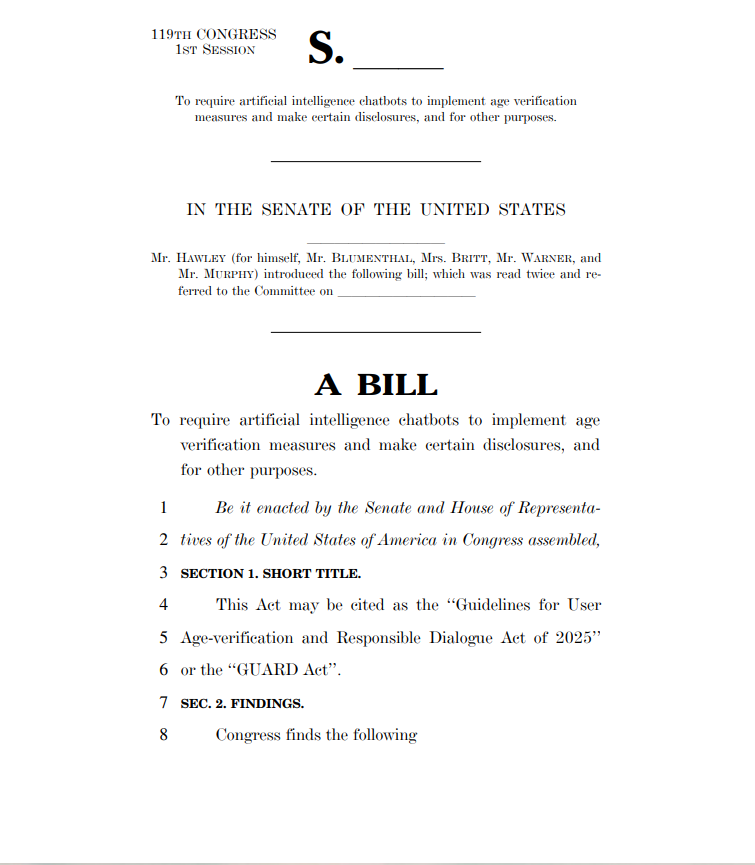
The Guidelines for User Age-verification and Responsible Dialogue Act of 2025, known as the GUARD Act, would make it a federal crime for companies to design chatbots that solicit or produce sexual content for minors. It would also require all AI chatbots to clearly state that they are not human and implement strict age verification systems before users can engage.
“AI chatbots pose a serious threat to our kids,” Hawley said at a Capitol Hill press conference attended by parents whose children died by suicide after interactions with AI systems.
More than 70% of American children are now using these AI products. Chatbots develop relationships with kids using fake empathy and are encouraging suicide. We in Congress have a moral duty to enact bright-line rules to prevent further harm from this new technology.
Standing alongside Hawley were co-sponsors Senators Richard Blumenthal, Katie Britt, Mark Warner and Chris Murphy (D-Conn.), reflecting a rare bipartisan consensus around regulating AI’s influence on children.
In their race to the bottom, AI companies are pushing treacherous chatbots at kids and looking away when their products cause sexual abuse, or coerce them into self-harm or suicide,” Blumenthal said.
“Our legislation imposes strict safeguards against exploitative or manipulative AI, backed by tough enforcement with criminal and civil penalties. Big Tech has betrayed any claim that we should trust companies to do the right thing on their own when they consistently put profit first ahead of child safety.” He added.
GUARD Act Requires Age Proof, Clear AI Disclosures, and Heavy Penalties for Violations
Under the proposed law, AI providers would be required to verify user ages using government identification or other “commercially reasonable” methods, meaning simple birthdate checks would no longer suffice.
Companies would also have to classify users as adults or minors, block minors from accessing “AI companions,” and re-verify user status on a regular basis.
Additionally, violations could bring civil and criminal penalties of up to $100,000 per offense.
The legislation also mandates that every AI chatbot must identify itself clearly as an artificial system at the start of each conversation and again at thirty-minute intervals. It forbids chatbots from pretending to be licensed professionals such as therapists, lawyers or doctors, and requires a clear reminder that users should consult a qualified human professional for any medical, legal, financial, or psychological advice.
Senator Britt said the measure was long overdue. “In recent months, we have seen multiple alarming incidents involving chatbots—from encouraging suicide to engaging in sensual conversations with minors—that should give every American pause. It is our job in Congress to do everything we can to protect our children as we navigate the new reality of living in a world where AI is increasingly integrated into our lives. This legislation is a critical first step toward doing just that,” she noted.
Murphy added, “You can’t overstate the harm these AI companion chatbots pose to our kids. Nearly 70% of teenagers are turning to chatbots as a substitute for friendship, making them more isolated and disconnected, but what’s even scarier are the stories of chatbots encouraging young people to hurt themselves or others.
Big Tech companies are fighting regulation because they want to maximize their profits by addicting our kids to their technology, no matter the cost. Our bill forces these greedy AI companies to take responsibility and implement common sense protections to keep kids from accessing these dangerous chatbots and holds those companies criminally accountable when their product pushes minors to self-harm.” He said
If enacted, the bill would take effect 180 days after being signed into law. It authorizes both the U.S. Attorney General and state attorneys general to enforce compliance through civil penalties and injunctions.
The GUARD Act represents one of the most far-reaching federal efforts yet to set boundaries for AI tools designed for young users, reflecting growing concern in Washington and across the tech industry over how to protect children while allowing innovation to thrive.
Read More: Microsoft Secures 27% Stake in OpenAI Under New $250B Azure Partnership


