





The crypto market is in a synchronized risk-off phase that goes deep. The total market capitalization stands at $2.17 trillion. This decrease is about a 2–3% drop in the last 24 hours, which is in line with the 27–28% drop over the past 30 days. The Crypto Fear & Greed Index is at 8, which means it’s in the extreme fear zone and has been there for over a week. The trend shows that investors are highly alarmed because of volatility, low volumes, and social sentiment metrics.
Konstantins Vasilenko, Co-Founder and CBDO at Paybis stated for Bitcoin
The “buy the dip” narrative has matured into something more structural. The market now has buyers who think in multi-year cycles. When such an approach arrives, short-term fear still matters, but it stops being the whole story.
Risk-Off Regime Across the Market
The price action matches the extremes of sentiment. Bitcoin’s dominance is close to 58%, with only a small drop from month to month. Ethereum’s dominance is just above 10%. This small change in altcoins is happening in the middle of a bigger downtrend. The derivatives markets show a lot of deleveraging, with open interest dropping sharply and funding rates going negative. This suggests that futures traders are either being defensive or outright short. Institutional channels through spot ETFs have cooled off significantly. Bitcoin ETFs have seen about $2.8 billion in net outflows so far this year.
Synchronous Drawdowns in Major Markets
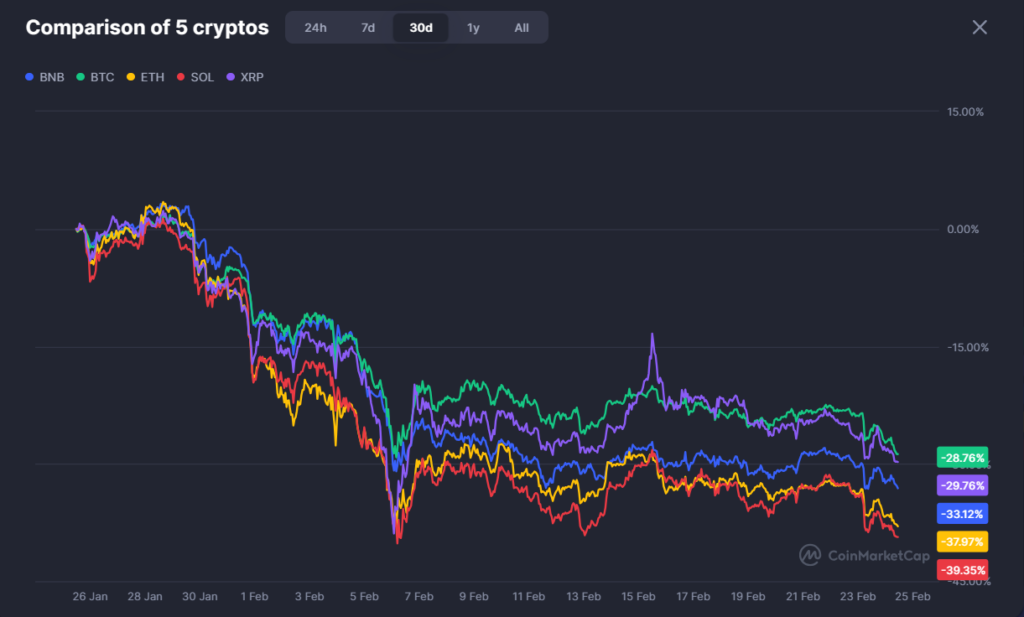
Over the course of 30 days, the top coins lose between 29% and 39% of their value. Momentum indicators suggest that the market is running out of steam rather than speeding up. For example, RSI(14) values are in the low-to-mid 30s, which is close to classical oversold levels. MACD histograms on Bitcoin and Ethereum show only a small amount of positivity, which means that the peak speed of selling may be behind us even though the overall trend is still bearish.
Bitcoin is trading around $63,382, which is down about 29–30% over the past 30 days and about 50% from its all-time high of around $126,000. It is well below the 30-day SMA of about $73,000 and far from the 200-day SMA of about $99,000. The overall market liquidity is stable with 24-hour volume in the $40-45 billion range. Additionally, the analyst observes that Bitcoin keeps doing what it always does. It shakes out weak conviction, then quietly rewards patience. Vasilenko quoted
The most telling signal for me is the network’s posture. We just saw mining difficulty jump to ~144.4T (about +15%), and hashrate rebounded toward ~1 ZH/s, which is basically miners saying: “We’re still here, and we’re still investing.
Ethereum is trading between $1,821 and $1,854, which is a 35–38% drop over the past 30 days and about 63% lower than its previous peak of around $4,950. It trades below its short-term SMA near $2,220 and far from its long-term SMA near $3,480. Its dominance is slightly behind Bitcoin’s performance. For the second largest asset by market cap, the analyst holds the point that if UX improves, it doesn’t mean demand always spikes overnight, but developer gravity tends to follow.
XRP is currently worth about $1.33, which is a 30% drop in the last 30 days and more than 65% below its all-time high. Its RSI of about 35 suggests that selling pressure is a little less strong than it is for the majors, which is backed up by strong 24-hour volume of more than $3 billion.
BNB is trading at about $592, which is the group’s smallest drop, down about 33% in the last 30 days and only 8% in the last year. The daily volume is lower at about $1.8 billion, which is in line with a holder-heavy profile linked to ecosystem utility rather than broad speculative flows. For Konstantins, the metric is its performance during traffic spikes. The setting questions are these: does the chain stay predictable, do apps stay smooth, and do users still feel instant? So, growth becomes a product experience when that holds.
Solana, the leading layer 1, is changing hands near $77 at the time of writing. The asset continues to face the downward pressure and has lost 39% in the time period of just 30 days, the most in the last year (52%). The digital asset is down roughly 74% from its historical peak near $294. The classic high-beta asset carries a 24-hour volume of about $4 billion.
Bitcoin and Ethereum are still the most popular cryptocurrencies for providing liquidity and institutional exposure. XRP, BNB, and Solana, on the other hand, mostly add to the same macro-driven downside without any major independent catalysts affecting price action in the near term.
Not So Obvious Insight: The Liquidity Hierarchy Stays Strong in Pain
This correction highlights a structural fact: Solana and other high-beta names take the biggest percentage losses, but Bitcoin and Ethereum are the main ways to reduce risk and debt. ETF outflows and negative funding rates put pressure on these anchors first, and then they spread out. BNB’s relative strength over the past year comes from on-chain stickiness, such as gas usage, application concentration, and reliance on native venues, rather than any real market rotation. If stabilization does happen, it will probably start with Bitcoin and Ethereum getting back to their technical levels, which will give altcoins a base to build on.
What this means for traders and investors
Taking a strong position in this environment is very risky. As long as prices stay below falling simple moving averages and ETF flows stay negative, any rallies can be called corrective bounces. Keep a close eye out for signs of stabilization, such as a slowdown or reversal in ETF outflows, a floor in derivatives open interest, RSI readings climbing decisively out of oversold territory, and the successful reclaiming of 30-day moving averages across the majors. Until those conditions happen, it’s smart to stay defensive.


