




Gold was the undisputed winner of 2025, racking up a whopping 62% gain over the year and clearly surpassing both Bitcoin (BTC) and U.S. equities. The uptrend proved a remarkable change in investor mindset, with money shifting back to the traditional markets as crypto went through severe volatility and stocks offered stable but limited returns.
In contrast, Bitcoin ended 2025 with a nearly 10% loss, and the S&P 500 rose by about 17%, thus further cementing gold’s position as the most rewarding asset of the year.
Macro Forces Influence Asset Performance
The 2025 financial markets were influenced by Donald Trump, the emergence of geopolitical conflicts, and the constant worries about inflation. The investors’ confidence in power-friendly government policies and AI innovations raised the stock prices, while the world’s unease and the central banks’ buying of gold drove its price up significantly.
Post-halving positive sentiment and exchange-traded fund (ETF) flows boosted the price of Bitcoin to $96,960 at the start of the year. The year 2025 experienced an ETF net total outflow of $421.35M (updated as of 31 Dec 2025). The ETF’s strongest month was July 2025, with a total inflow of $11.04B. However, as regulatory pressure grew and risk appetite dropped, the momentum started to fade, which led to a lengthy correction which wiped out early gains.
Bitcoin Struggles on Risk-Adjusted Basis
Gold, one of the precious metals, outperformed beyond headline returns. The asset delivered a Sharpe ratio of 2.59, far higher than both Bitcoin and equities, while sustaining relatively low volatility around 19%. The corrections were shallow, with losses capped below 10%, strengthening gold’s defensive demand.
On the other hand, Bitcoin’s unique characteristics place it in an entirely different context. Volatility increased to more than 34%, followed by a 32% maximum price drop, which was a sign of typical crypto corrections in the late cycle. The largest cryptocurrency’s Sharpe ratio also entered into negative territory, which was a sign of poor performance when weighing the risk. The S&P 500, on the contrary, was placed in the middle and provided low volatility along with a Sharpe ratio of 0.92.
| Asset | 2025 Return | Volatility | Sharpe Ratio | Max Drawdown |
|---|---|---|---|---|
| Gold | 62.39% | 19.0% | 2.59 | -9.78% |
| Bitcoin | -9.64% | 34.7% | -0.03 | -32.07% |
| S&P 500 | 16.65% | 18.8% | 0.92 | -18.90% |
Visual Trends
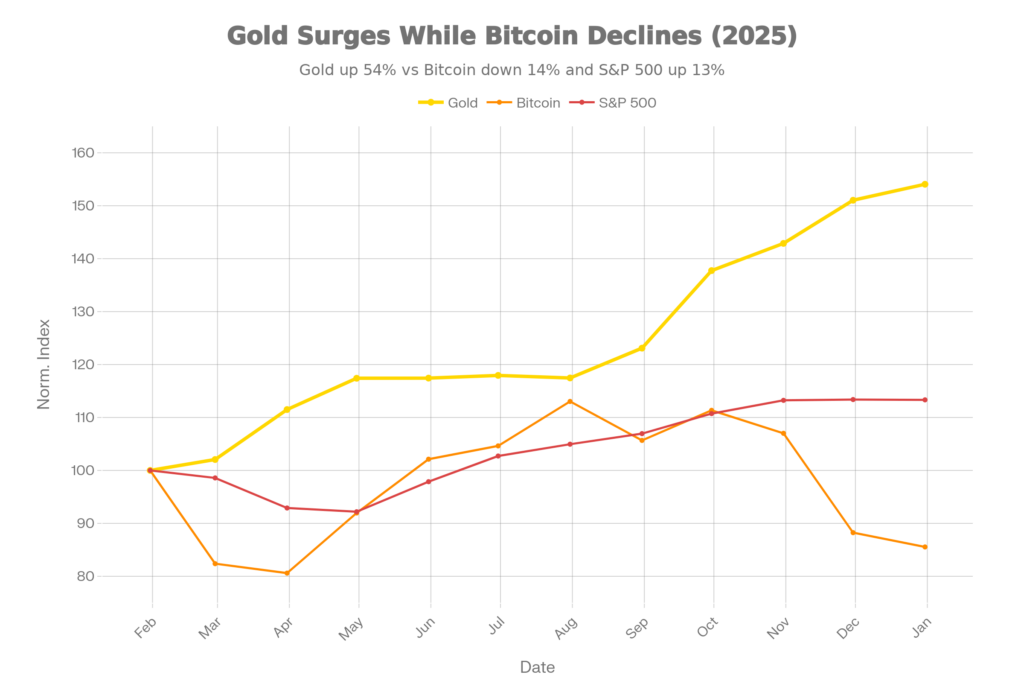
Starting at 100 in January, the three assets quickly diverged. Gold climbed steadily each quarter, ending near 154 for a 54 percent gain. Bitcoin experienced a volatile trajectory, initially declining, rebounding in the middle of the year, and ultimately closing below its initial level at 86. The S&P 500 moved steadily, closing around 113.
Gold’s Q3 surge from 123 to 138 cemented its lead, while Bitcoin and equities lagged. The year highlighted gold’s safe-haven appeal, Bitcoin’s volatility, and the steady but modest returns of equities.
Why Gold Pulled Ahead
Gold benefited from the central bank accumulation, a strong flow of money into ETFs, and demand for hedging against geopolitical risks working together perfectly. It avoided sharp corrections during the year and, unlike risk assets, was able to maintain a steady increase as investors were more likely to preserve their capital than to seek growth.
Bitcoin kept on being regarded as a risky asset with a high beta despite the long-term adoption narrative. The surges in volume driven by retail investors did not manage to keep the price up, thus highlighting the asset’s dependence on liquidity conditions rather than macro hedging demand.
Equities Hold Steady, but Trail
AI-driven earnings growth and anticipations of fiscal stimulus significantly fueled the U.S. stock market’s performance. Although summer sell-offs put a little pressure on the market, recoveries were quick and reflected that equities were considered a middle ground between the defensive nature of gold and the volatility of bitcoin.
Bottom Line
The performance gap of 2025 highlights a transformation in the market ranking of different assets. Gold regained the position of the best hedge, stocks were the most stable investments with a slight price increase, and Bitcoin could not decide whether to showcase its growth story or the accompanying high volatility. For the investors, the year was a reminder that in times of uncertainty, the capital still favors the quality of being resilient rather than the risky ones.


