




The Largest Cryptocurrency: Bitcoin
Bitcoin trades at $66,433.10, down 1.49% in the last 24 hours and 6.44% over seven days. The weekly loss is visible, but the 30-day picture tells a different story: the price is essentially flat, just 0.07% off where it started the month. That matters because it means the medium-term structure has not broken and the volatility is intraweek noise rather than a trend shift. Its 90-day correlation to equities sits at approximately 0.78, which means Federal Reserve communication and macro liquidity conditions are feeding directly into BTC price. Add rising derivatives activity and reduced stablecoin rotation into the mix, and it becomes clear that this digital asset is increasingly being moved by funding and leverage cycles rather than straightforward spot demand.
Lacie Zhang, Research Analyst at Bitget Wallet, frames this setup carefully: “Despite headline-driven volatility, underlying demand remains intact and structurally supportive,” pointing to BTC and stablecoins continuing to function as capital movement channels with “relatively low correlation to traditional assets and increasing room for institutional accumulation.”
Her April price range for BTC sits at $60,000 to $84,000, with institutional inflows and geopolitical de-escalation identified as the primary catalysts toward the upper end of that range.
Ethereum: A Structural Shift That Price Has Not Fully Priced
ETH trades at $2,025.43, down 1.34% in 24 hours and 5.98% over seven days, though it remains the only asset in this group showing a positive 30-day return at plus 2.09%. That divergence from the rest of the group is notable, but it does not mean ETH is immune to pressure.
The more important dynamic is structural. Layer-2 migration has reduced base-layer fees, shifting value capture away from ETH’s direct revenue narrative. For price, this dynamic creates a split reality: L2 adoption is genuinely growing adoption, improving user experience, and expanding the ecosystem, but it reduces the short-term revenue argument for holding ETH itself. Institutional and ETF allocation trends are therefore a critical variable. Without sustained inflows, ETH’s L2-driven growth story may continue to support the network without equally supporting the token price.
Zhang’s Q2 scenario analysis illustrates the binary nature of ETH’s outlook clearly. A risk-off escalation driven by sustained geopolitical tension and oil above $120 could push ETH to approximately $1,500. A rapid de-escalation scenario, conversely, supports a move to $2,700 to $2,800. The $2,025 current level sits almost precisely in the middle of that range, which itself reflects the undecided nature of current macro conditions.
XRP: Regulatory Framing Is Doing Heavy Lifting
XRP at $1.31 is the weakest performer in this group over both the 24-hour period, at down 3.21% and the 30-day window, at down 5.32%. Its $80.36 billion market cap continues to trade in close competition with BNB at $82.52 billion, with ranking flips observed in both directions during the reporting period.
The XRP story is not primarily a technical or on-chain story right now. This is a regulatory and corporate narrative, and the recent inflows were driven by digital commodity classification headlines and Ripple’s expansion into Brazil. Those catalysts created volume spikes and whale-driven rank changes, but ETF flows into XRP products have shown mixed behavior, including some outflows. With Ripple historically holding approximately 40% of total supply, large corporate actions including buybacks and licensing moves remain outsized price drivers that are difficult to model with standard technical tools.
The asset’s 24-hour volume of $1.84 billion is solid relative to its market cap but does not reflect sustained organic demand. Concentrated flows from a small number of wallets can produce misleading volume signals here.
BNB: The Quiet Competitor
The Binance ecosystem’s native crypto, BNB, at $605.15, down 1.97% in 24 hours and 2.73% over 30 days, is perhaps the most stable-looking asset in this group on a relative basis. Its market cap of $82.52 billion and 24-hour volume of $1.61 billion reflect a mature CEX-linked token with steady ecosystem activity through custody and launchpad mechanisms.
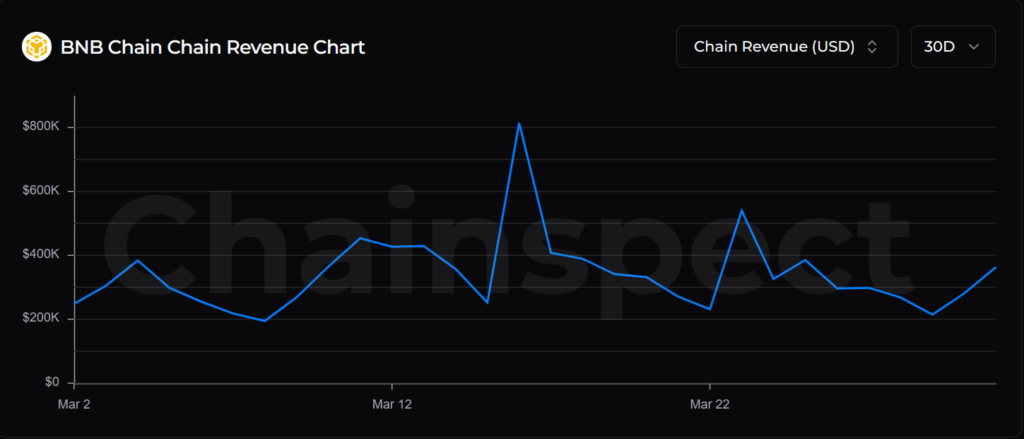
The digital asset carries strong fundamentals but the question is whether those fundamentals are priced in. Institutional allocations to BNB ecosystem funds have been reported, and on-chain transaction counts remain healthy. The relative metric, like BNB Chain revenue, stands at $363.4K. Its price sensitivity, however, remains closely tied to Binance operational decisions and any regulatory actions that affect exchange utility directly.
Solana: The On-Chain Leader With a Price Lag
SOL’s data tells the most interesting divergence story in this group. The asset is down 10.81% over seven days and trades at $81.77, making it the worst performer on a weekly basis by a significant margin. Its market cap stands at $46.82 billion with 24-hour volume at $3.74 billion.
Yet Solana outpaced Ethereum in DEX volume during March, which is not a minor footnote. It reflects genuine retail and protocol-level activity, supported by Pump.fun ecosystem activity and a high-throughput infrastructure that is being actively upgraded through initiatives including the Alpenglow consensus improvement. Institutional interest, including reported Goldman Sachs allocation mentions, adds a longer-duration buyer profile.
The gap between SOL’s on-chain activity metrics and its price performance this week captures a broader market condition: strong fundamentals do not protect against macro-driven liquidations in a leveraged, sentiment-sensitive environment.
The Structural Variable Most Are Underweighting
Zhang raises a point that cuts across all five assets and deserves attention from anyone thinking beyond the next week. Bitcoin’s traditional four-year halving cycle, she argues, “is becoming less predictive, as ETF-driven institutional flows now outweigh miner dynamics, shifting the market toward a more macro and liquidity-driven structure.”
If that structural shift is accurate, and the data on ETF inflows and miner revenue contribution supports it directionally, then the analytical frameworks many market participants still rely on are operating with outdated inputs. The CLARITY Act, which Zhang assigns a 40 to 60% passage probability this year, remains a variable that could shift regulatory certainty for multiple assets simultaneously.
Q2 2026 shapes up as a range-bound, event-driven quarter. The $55,000 to $94,000 BTC range and $1,500 to $2,800 ETH range Zhang identifies a wide range precisely because the macro and geopolitical inputs remain unresolved. That width is not analytical imprecision and is an honest reflection of genuine uncertainty.


