




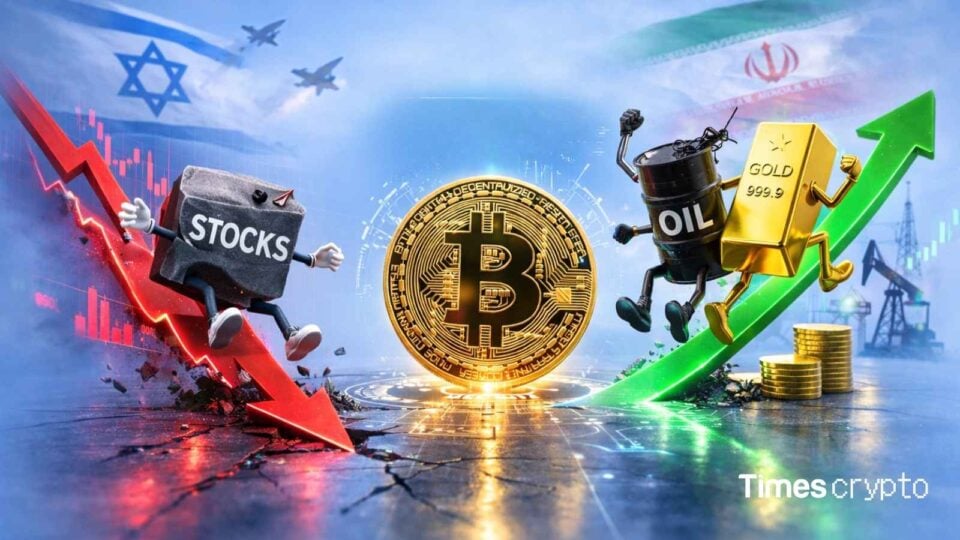
Risk appetite weakened on Monday as the Iran conflict and major disruption in the Strait of Hormuz sent oil prices sharply higher, pushed global stocks lower, boosted demand for the U.S. dollar, and drove investors toward cash and energy while pulling back from riskier assets.
Crypto
The crypto market cap stands at $2.33 trillion (+0.43%), while the Fear & Greed Index is at 20, the Altcoin Season Index at 37/100, and the average crypto RSI at 47.48, pointing to a market that is still cautious rather than signaling a full reversal.
Bitcoin trades at $68,379, up 3.64%, Ethereum is at $2,019, up 4.23%, BNB at $629.99, up 2.94%, and Solana is at $84.54, up 3.62%.
Spot Bitcoin ETF flows have turned sharply negative over the last two recorded sessions after a strong inflow on March 4. Total net flow was +$461.9 million on March 4, led by IBIT at +$306.6 million, but flipped to -$227.9 million on March 5 and -$348.9 million on March 6.
Commodities
Oil is the market’s main driver, with WTI trading at $98.83, up 8.29% in 24 hours, while Brent stands at $103.12, down 5.12%, but still near its highest levels since mid-2022 after an explosive intraday surge. The move is being driven by Middle East supply fears, producer outages, tanker disruption around Hormuz, and talk of emergency reserve releases.
Gold is at $5,112.94, down 1.14%, after pulling back from recent highs as investors appear to be taking profits to cover losses elsewhere, while the safe-haven case remains intact, with silver hovering at $83.92, off 0.66%.
Stock Market Indices
In the U.S., the S&P 500 is at 6,740.01 (-1.33%), the Dow Jones at 47,501.55 (-0.95%), and the Nasdaq at 22,387.68 (-1.59%), as investors rotate out of growth and cyclicals and reassess rising inflation risk.
In Asia, Nikkei 225 futures are at 53,000 (+0.76%) after an earlier sell-off, while Europe’s FTSE 100 is at 10,159.9 (-1.57%), after being hit by the energy shock and weaker risk appetite.
Geopolitics & Market Movers
On the diplomatic front, markets are reading the widening U.S.-Israeli conflict with Iran and the appointment of a new supreme leader as a signal that policy is still driven by hardliners and that it is too early to expect de-escalation.
A secondary flashpoint is the physical energy market itself: refinery damage, force majeure declarations, and stranded tankers are deepening fears of a prolonged supply shock.
On the economic front, the oil surge is reviving inflation anxiety just ahead of key U.S. CPI and core PCE data, while bond yields are rising as traders push back Fed easing expectations. Investors are now watching whether Washington moves on emergency reserves and whether central banks start talking less about cuts and more about inflation containment.


