




Nvidia (NVDA) stock price posted modest losses near $188.60 by the end of Wednesday’s holiday-shortened U.S. trading session. Still, NVDA looks set to face a three-year uptrend, with the 41% yearly rise for 2025.
Notably, NVDA’s daily trading volume on Nasdaq dropped to the lowest level in 10 years, with the latest figures of 65.5 million shares, while the market capitalization (market cap) edged higher to around $4.58 trillion. It’s worth observing that Nvidia is the world’s biggest firm and the second-largest asset, next to gold.
That said, market capitalization or market cap is the total value of an asset, derived by multiplying the total available quantity for trading/investment by the market price. Market cap highlights the underlying asset’s size, stability, and market value, giving an overview of the asset.
Apart from the firm’s technological advancements and a critical place in the global set-up, the recent trade, geopolitical, and earnings surrounding the global chipmaker also keep the market’s attention on the Nvidia stock price.
Let’s discuss key catalysts and a brief guidance for 2026!
What Happened with NVDA so Far?
Multiple developments recently affected the Nvidia stock price and are worth discussing.
Among them, Wednesday’s news about Nvidia’s non-exclusive inference technology licensing agreement with Groq is the latest one. While Nvidia is dominant in training (building frontier AI models), the market’s latest shift towards inference (an act of efficiently running those models in production), could help NVDA’s price.
However, concerns about Nvidia’s ability to commercialize Groq’s technology, the actual market impact of the agreement, and financial details about the move seem to test the Nvidia stock price.
Apart from the Nvidia-Groq agreement, buzz surrounding Nvidia’s H200 shipments to China also gained a prominent stage in affecting the NVDA stock. In its latest report, Reuters mentioned Nvidia’s plan to export 5K to 10K H200 chips to China as U.S. President Donald Trump eased chip export controls for the said Nvidia chips for 25% tax. Though, government approval on both the sides is still pending, while Beijing is on the move to ease reliance on the U.S. exports, which in turn can challenge NVDA optimists about the U.S.-China technology trade. More importantly, the H200 chips are second in class, will be third soon, and hence Chinese customers may not show that much zeal in accepting the technology when introduced, allegedly in February 2026.
Moving on, Nvidia’s $5.0 billion investment in Intel got a green light from the U.S. FTC (Federal Trade Commission) and other antitrust agencies and helped favor the Nvidia stock price. However, buzz surrounding Nvidia’s testing of 18A process technology and then a stall tested the optimism surrounding the key technology tie-up.
Elsewhere, Nvidia’s third-quarter (Q3) earnings, reported on November 19, were strong enough to propel NVDA as revenues jumped 94% year over year (YoY), to $57.00 billion, comprising a $51.2 billion part from the Data Centre revenues. Additionally, the EPS (Earnings Per Share) per the Generally Accepted Accounting Principles (GAAP) marked a stellar 116% YoY growth to $1.30. Apart from that, Nvidia President and Chief Executive Officer (CEO) Jensen Huang also mentioned that sales of their latest Blackwell chips are “off the charts”.
Along with the upbeat data and Huang’s optimism, the December 26 dividend payout also seems to favor the Nvidia stock price, with eyes on the fourth-quarter (Q4) earnings, scheduled for February 25, 2026.
Challenges for the Nvidia Stock Price
Despite the aforementioned positives, not everything is green, and given the Nvidia stock price, a few challenges loom large and can offer intermediate pullbacks in NVDA.
Among them, the political risks surrounding Nvidia’s exports are a major problem for the company executives and shareholders. Questions like what if the U.S. continues to curb Nvidia chips and China develops its own out of disappointment? becomes crucial.
Even though the Nvidia-Groq deal opens a new platform for the chipmaker, the firm’s loss of advantage in training leadership also highlights a problem for the Nvidia stock price.
Meanwhile, year-end positioning amid a light trading volume could also test the NVDA bulls.
Nvidia Stock Price Action
Although the Nvidia stock price offered a negative daily close on Wednesday, it’s up for the second consecutive week and reverses the previous monthly loss while bracing for a 41% yearly jump, its third in a row.
Nvidia Price: Daily Chart Defends NVDA Bulls
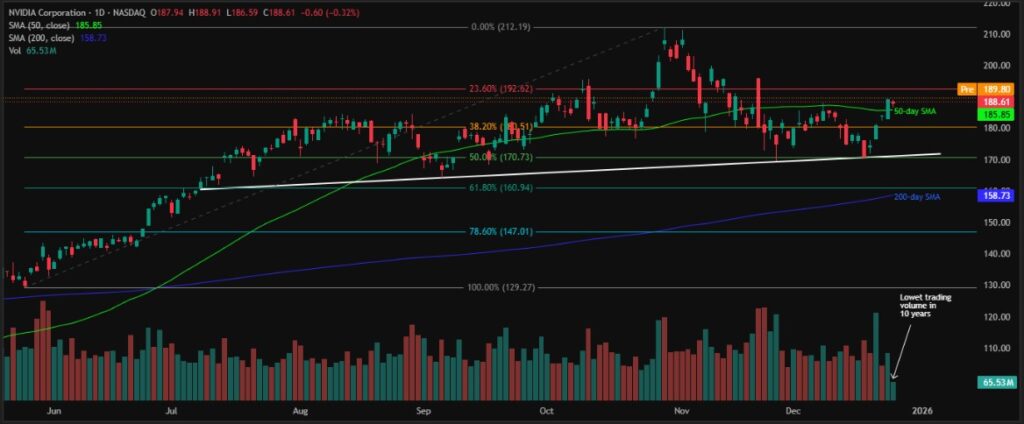
On a technical note, the Nvidia stock price extends recovery from an ascending support from July, around $170.00, to cross the 50-day Simple Moving Average (SMA), close to $185.00, making both these levels key support.
NVDA currently looks set to approach November’s peak, surrounding $196.00 and the $200.00 round figure. Following that, October’s record top of $212.19 will be in the spotlight.
NVDA Market Forecasts for 2026
Looking forward, a slew of top-tier banks and financial institutions convey their bullish 2026 outlook for the Nvidia stock price. Some of them are discussed as follows:
Citibank holds a ‘Buy’ rating with a target price of $220.00. The U.S. bank highlights Nvidia’s strong financials and chip dominance as the key catalysts to remain optimistic.
Bank of America (BofA) Securities fails to highlight any strong price level but highlights the Nvidia stock as ‘compelling’.
Analysts at JP Morgan put an ‘overweight’ rating on the Nvidia stock, but anticipate $250.00 price in 2026.
Also read: Is Bitcoin New Digital Silver Now? Silver Jumps 130% this Year!


