




Key Takeaways
- U.S. lawmakers are pushing a major crypto overhaul toward an early Senate vote, with both the Banking and Agriculture committees aiming to complete their work before the end of the year.
- Senator Tim Scott says the bill could place the United States at the front of global crypto market oversight, citing blockchain transparency, faster settlement and reduced intermediary costs as core advantages of the framework.
- The legislative push has been slowed by partisan disputes, with Scott accusing Democrats of delaying progress while negotiations gradually accelerate after months of delays.
- Ongoing tensions from the recent 43-day government shutdown could still complicate the bill’s path, as cooperation between both parties is needed to finalize the market-structure framework, though shared regulatory interests may keep it on track.
Table of Contents
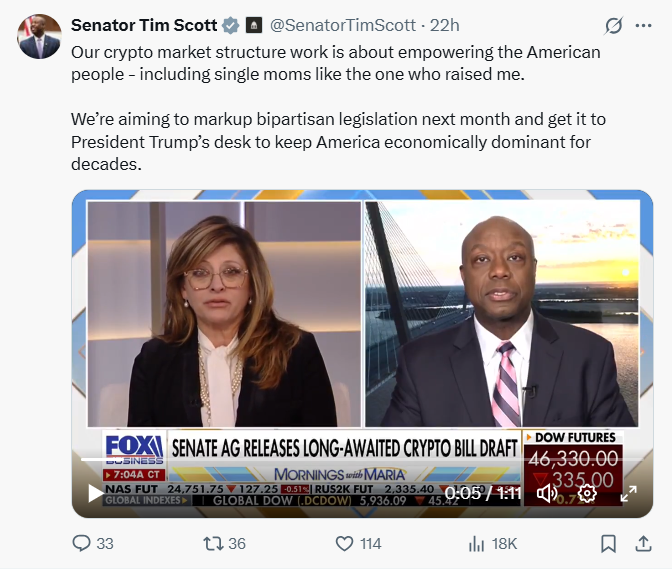
U.S. Senator Tim Scott, the top Republican on the Senate Banking Committee, said in an interview with Fox Business that lawmakers are preparing to take up the crypto overhaul next month, with the goal of sending the legislation to the Senate floor early next year.
According to Scott, the legislation has the potential to place the United States at the forefront of cryptocurrency market oversight once it is enacted.
We believe we can arc up in both committees and get this to the floor of the Senate early next year,” he said. “So that President Trump will sign the legislation making America the crypto capital of the world.
Bill Progress and Legislative Timeline
Scott said negotiations with Democrats have recently accelerated after months of delays, and he expects both the Banking and Agriculture committees to complete their parts of the legislation before year-end.
The Democrats have been stalling and stalling because they don’t want President Trump to make America the crypto capital of the world, Scott said.
He added that the legislation is still scheduled for Senate consideration early next year.
End of this year, next month, we believe we can arc up in both committees, he said.
Market Structure and Blockchain Integration
The draft released by the Agriculture Committee sets out a federal framework for supervising cryptocurrency markets and allocating regulatory authority among agencies.
Scott said the measure is intended to create uniform trading standards, strengthen consumer protections and establish a regulated environment for digital-asset exchanges.
He pointed to blockchain’s transparent ledger and round-the-clock settlement as key features the bill relies on to improve verification and oversight.
Blockchain creates like the open ledger, meaning that everyone can see what’s… there will be a technological footprint on every transaction.
According to Scott, the shift from traditional bank-processing times to blockchain-based clearing could reduce settlement windows from days to seconds.
We’ll be able to get that three-day wait time down to two or three seconds.
Scott also pointed out that peer-to-peer transfers could limit intermediaries, lower costs for users and keep markets running without interruption.
It’s like taking the middleman out,” Scott added.
Tensions Rise in the Senate After Government Shutdown
Scott later turned to the recent 43-day government shutdown, saying Democrats and Republicans had been sharply divided over how to resolve the standoff and reopen federal agencies. He accused Democrats of blocking repeated efforts to end the shutdown while using the dispute for political leverage.
“The Democrats, so thirsty for power, were willing to jeopardize air travel,” he said, citing delayed pay for air traffic controllers and law enforcement officers and the closure of public access to the U.S. Capitol.
Scott added that Republicans tried numerous times to bring the government back online:
We tried 14 or 15 times to reopen government…every single time we said, please put people back to work.
Could Senate Divisions Slow the Bill’s Progress?
The dispute over the recent 43-day government shutdown has sharpened divisions between Democrats and Republicans, raising questions about whether those tensions could complicate efforts to advance the crypto legislation.
The standoff left both sides blaming each other, and Scott’s criticism of Democrats during the shutdown may add friction at a time when cross-party cooperation is required to finalize a major regulatory framework.
If Democrats feel excluded, they could slow the process with longer negotiations, extra hearings or calls for tougher consumer-protection measures.
However, both parties have incentives to put a regulatory structure in place. Democrats have focused on consumer safeguards and fraud prevention, while Republicans have emphasized innovation, competitiveness and market clarity. If the final bill gives each side a policy outcome it can claim credit for, the recent shutdown dispute may not prevent it from moving forward.
In conclusion, while political tensions could hinder momentum, they do not necessarily derail the legislation. The bill’s path forward depends on sustained committee negotiations and presenting the proposal as a shared policy solution.
Read More: Trump Affiliated Crypto Company Draws Political Heat Over Suspected Token Sales to Sanctioned Actors


