




Solana (SOL) had inched up towards the $140-$145 range, gaining 1.8% in the last 24 hours, as buyers returned after a subdued price action. The token, after suffering a dramatic drop of 35–46% in 2025, is now showing early signs of stabilization and is even making higher lows near $135 since the selling pressure has diminished. The historical trends indicate that the rebounds that happen after a weak December often can lead to stronger rallies.
Trading Volume and Open Interest

SOL’s 24-hour volume is around $5.58B, and it has gone up by approximately 5.58% during the last day. The volumes for DEXs grew up to $52.4 billion with a 20% increase, thereby taking over the second position in L1/L2 infrastructures. The total open interest is now $3.79 billion, giving its position the slightest long bias (long/short ratio: ~1.02). The little liquidations amounting to $6.2 million indicate that the leverage is evenly distributed, while the rising open interest is an indicator of both ETF inflows and deep-pocketed traders positioning.
Institutional Inflows Support Price
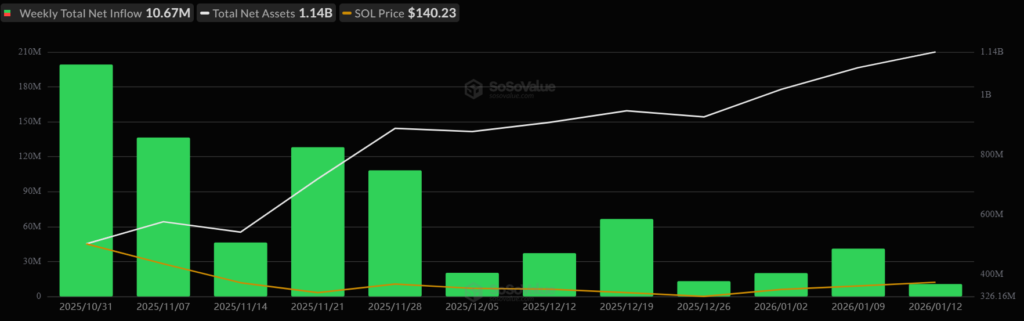
A major driver of the rebound is institutional participation. Cumulative Total Net Inflow for Solana now stands at $827.60M, with recent daily inflows of $10.6 million, signaling confidence despite broader altcoin weakness. Past performance shows SOL has historically rebounded in January following weak Decembers, which included 140% gains in 2023 and 22% gains in 2025. U.S. regulatory developments, like the Digital Asset Market Clarity Act, are also fostering a more favorable environment for adoption and institutional involvement.
Ecosystem Developments Boost Engagement
The SOL’s price increase has been supported by the news regarding the network and ecosystem. Sharps Technology, which holds 2 million SOL, started a Coinbase-operated validator and is actively taking part in the network security. In the meantime, Cue’s opinion markets platform is boosting experimental DeFi activity and user participation by employing social incentives. The Alpenglow upgrades planned for Q1 2026 are expected to bring the block finality down to ~150 milliseconds, thus further cementing Solana’s speed and scalability advantage. All these measures are pointing toward a transition from speculative hype to real utility and network growth.
Market Sentiment and Technicals
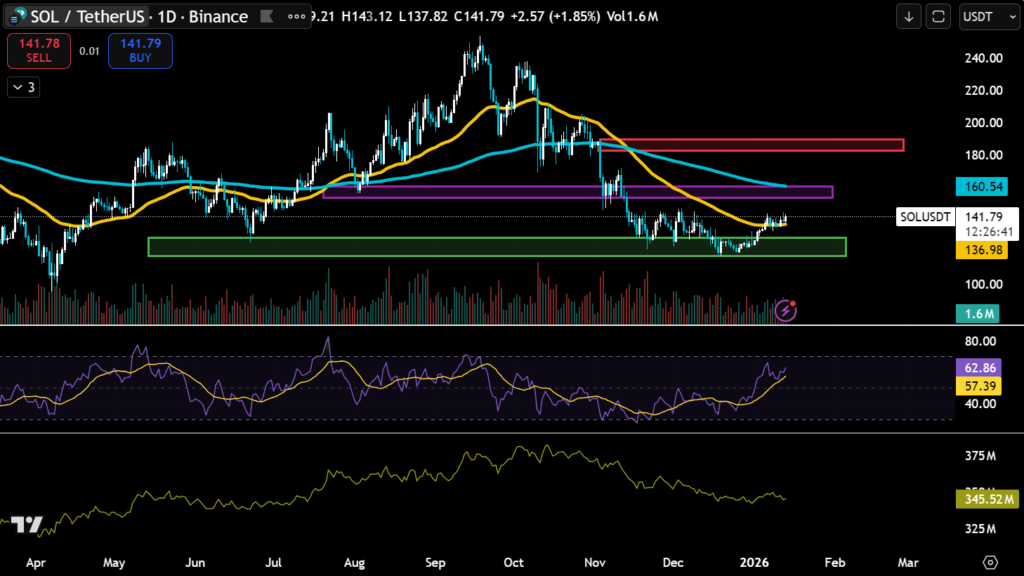
SOL has a strong correlation of 0.7 with equities; thus, it has been benefiting from the S&P 500’s recent ascent. Technical signals point towards a bullish trend, as the short-term moving averages are positioned over the long-term ones and the MACD is increasing on the positive side. The RSI stands at approximately 62 and may enter the range of the overbought zone. The $151–$155 range is the major resistance zone, which is why a breakout from this range may lead to a $180 target by the end of January. For 2026, the predictions range from $200 to $400, which will likely be powered by institutional investment and the network’s acceptance, including the tokenization of real-world assets.
Whale Activity Signals Confidence
Early January saw dormant whales reactivate. A significant transaction was made with the transfer of 80,000 SOL (~$11 million) from Binance to cold storage, which indicated a long-term accumulation strategy. Gradual buying throughout the ecosystem raises the belief in the upcoming improvements, such as Alpenglow, and in the $7.5 billion tokenized treasury. This “silent accumulation” is in stark contrast with the retailers’ caution and often comes before the wider market rallies.
On-Chain Metrics Remain Strong
Over the last seven days, Solana processed 453.5 million transactions (+17%) with 18.28 million active users (+23%), the highest among all chains. DEX volume totaled $52.4 billion (+20%), and network fees reached $5 million. In 2025, total transactions hit 121 billion (+34% YoY), TVL grew $30 billion, and stablecoin transfers reached $11.7 trillion. Throughput averages 1,100 TPS, reflecting robust network activity despite price volatility.
Conclusion
Solana’s rebound in 2026 happened at the same time that the market was increasingly paying attention to institutional support, healthy ecosystem, and actual utility. Exchange-traded funds (ETFs), accumulation of whales, launching of validators, and new updates are the factors that help raise the prices. The major support level at $140 is critical, but the combination of good technical trends, money from institutions, and strong on-chain data implies that SOL will continue its recovery.


