




Strategy (MSTR) stock hit a three-week low around $157.00, down 3.90% by the end of Tuesday’s New York trading, as Michael Saylor’s company braces for the “Crypto Winter” in its latest strategy.
The Bitcoin champion firm dropped for a second consecutive day, facing its third weekly and sixth straight monthly loss. More importantly, MSTR looks set to suffer the first yearly loss in three, to the tune of 45% by press time.
With the downbeat Strategy stock price, its market capitalization (market cap) also hit a two-month low of $47.6 billion, extending the pullback from the all-time high marked in July. Notably, market capitalization, or market cap, is the total value of an asset, derived by multiplying the total available quantity for trading/investment by the market price. Market cap highlights the underlying asset’s size, stability, and market value, giving an overview of the asset.
That said, the Michael Saylor-led firm gained prominence due to its status as the world’s largest publicly traded corporate holder of Bitcoin (BTC), having 650,000 BTC in reserve per the latest official reports.
What Happened in MSTR So Far?
Early in the week, Strategy announced that it raised $750 million last week via selling 4.5 million shares of common MSTR stock. The world’s biggest corporate holder of the cryptocurrency, however, didn’t use the receipts for accumulating its Bitcoin (BTC) Treasury reserve, suggesting preparations for a downbeat crypto price and attracting sellers.
Looking closely, Strategy has sold nearly 23 million shares in the fourth quarter (Q4) of 2025 and raised around $4.1 billion. The firm’s action increased its public holding of shares by 8.0% and cut down the MSTR’s valuation premium versus its Bitcoin holdings.
Out of the $4.1 billion, Strategy allocated $2.2 billion for a U.S. dollar reserve to cover interest costs, about $824 million a year. The rest were used to accumulate around 21K Bitcoin, even if the BTC hoarding failed to inspire the bulls.
It’s important to note that Strategy’s enterprise value, a total of market cap and debt, subtracting cash holdings, is still 110% of its BTC holdings, versus around 200% earlier in the year.
Strategy’s issuance of common stock to build the U.S. dollar reserves, rather than accumulating more BTC, flags fears of the firm’s shift in treasury strategy and weighs on the MSTR stock price, especially amid a downbeat Bitcoin price. In November, Strategy CEO Phong Le raised concerns about the potential “Bitcoin Winter” in his podcast. Additionally, buzz around the MSTR convertible debt holders’ probable early demand of payments, with a $1.0 billion payment scheduled for September 2027, also exerts downside pressure on the stock price.
“Crypto Winter”
As the Bitcoin price faces its first yearly loss in three, despite a softer U.S. dollar and upbeat policy support from U.S. President Donald Trump, not to forget the crypto industry development, talks surrounding the “Crypto Winter” gained attention of late. Given the MSTR’s heavy reliance on crypto, it’s better to discuss the concept.
Crypto Winter” is an industry term, like “bear market,” and signifies a prolonged period of downbeat cryptocurrency prices. The crypto market watchers also observed the historical crypto winters and highlighted low trading volume, as well as an overall indecision among investors, as additional catalysts.
Bitcoin Price during Crypto Winter
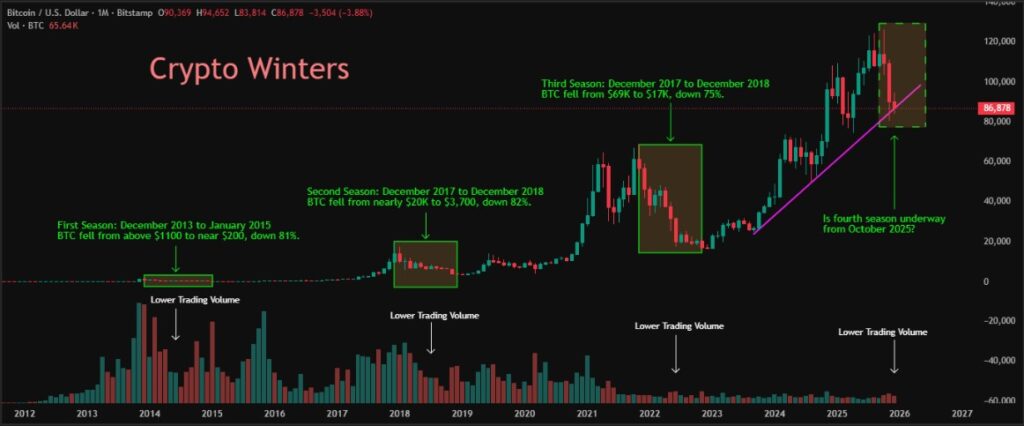
The cryptocurrency market watchers have so far identified three seasons of the crypto winter and are leaning towards considering BTC’s pullback from an all-time high in October as the start of the fourth season.
Notably, the first season started in December 2013 and ended in January 2015, wherein BTC fell from above $1100 to near $200, down 81%. In the second season, allegedly from December 2017 to December 2018, the Bitcoin price fell from nearly $20K to $3,700, down 82%. Moving on, the third season is said to have lasted from December 2017 to December 2018 and dragged BTC from $69K to $17K, down 75%.
It’s worth observing that the Bitcoin price saw more than 70% losses during each of the last three crypto winters, while its 2025 losses are less than or equal to 6%, raising doubts about the “Crypto Winter” confirmations. The market’s uncertainty will need strong negative catalysts, like an upbeat U.S. dollar, the market’s risk-off mood, and industry-negative policies from the major economies, to confirm the start of the crypto winter.
MSTR Stock Price Action
The Strategy (MSTR) stock price continues to struggle, having fallen to a three-week low early in December, despite an ascending support line from May 2024.
Strategy Stock Price Daily Chart: Bears Remain Hopeful
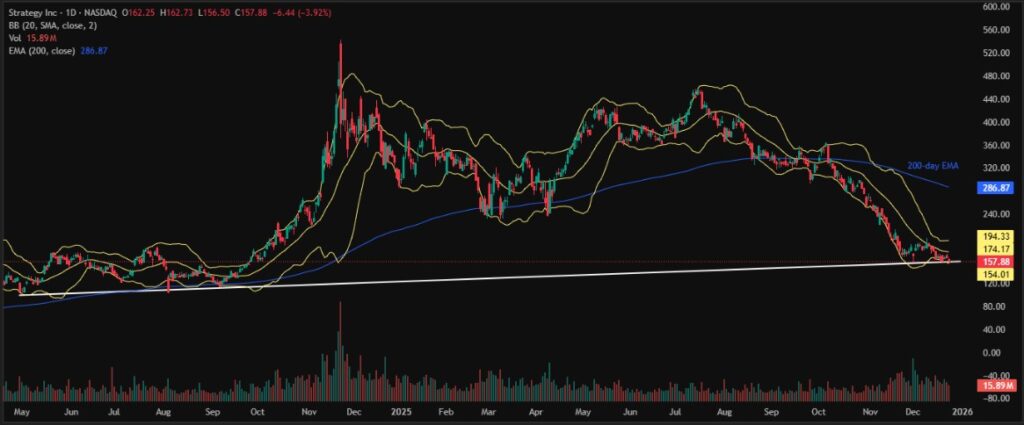
Given the quote’s sustained trading beneath the 200-day exponential moving average (EMA), the Strategy stock price is likely to break the immediate support near $157.00, which in turn can make it vulnerable to aiming for the August 2024 low near $104.00 before targeting the $100.00 threshold.
Alternatively, the MSTR rebound may initially aim for the March 2025 low near $231.00 but remains elusive as long as the Strategy stock price stays beneath the 200-day EMA of $287.00.
Also read: Is Bitcoin New Digital Silver Now? Silver Jumps 130% this Year!


