




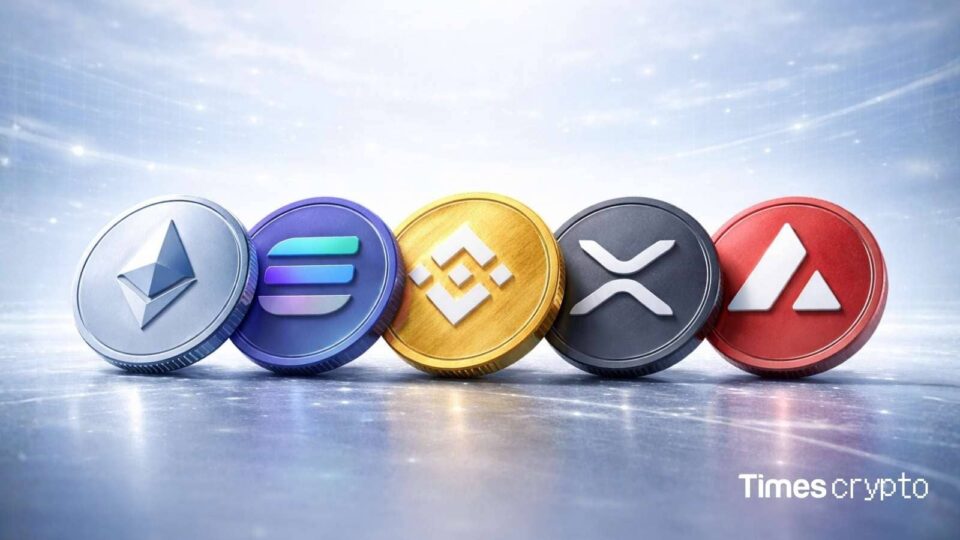
Blockchains are undergoing a rapid transformation, with major developments in security and adoption acting as the driving forces. Among these user-friendly initiatives are zkps (zero-knowledge proofs) that improve privacy and make the use of blockchain more efficient, the tokenization of real-world assets, which grants easier access to traditional finance, decentralized identity solutions, and the integration of AI into blockchain for serving the purpose of data tracing and decentralized computing. These developments are gradually allowing blockchain technology to support businesses, consumer applications, and legal compliance in a more efficient manner. The article combines investor opinions and market research for the five leading Layer 1 blockchains that are expected to have a significant impact in 2026.
1. Ethereum (ETH)
Ethereum is still the main blockchain for smart contracts and dApps, having the biggest developer ecosystem and the richest liquidity pools. The fact that Ethereum is the main settlement and liquidity anchor makes it difficult for the institution-grade assets in its absence. Among other parameters, it leads the way in DeFi, stablecoins, and RWA tokenization, and currently efficient scaling strategies, including Layer 2 (L2) solutions, are making it even more powerful. By 2026, it is expected to have better cross-rollup interoperability refinements to deal with the fragmentation of user experience issue, thus further solidifying its place as the most preferred network for high-value transactions and enterprise integrations.
Key Developments
- Integration of ZKPs for confidential transactions (e.g., ERC-7984).
- The continued development in RWA, with services like BlackRock’s BUIDL Fund tokenizing assets on the chain.
- With the continued development, analysts expect ETH to reach $8,000–$10,000 alongside broader ecosystem growth.
2. Solana (SOL)
Solana is widely recognized for its exceptional scalability and very low transaction costs, which are the key factors that make its platform suitable for the most demanding applications. As a consumer performance layer, Solana supports payments, NFTs, meme coins, and gaming, driven by strong developer momentum that promotes adoption. In 2026, the network is expected to focus on reliability under high demand, validator decentralization, and user retention. Its speed gives it an advantage for stablecoin growth and real-world use, potentially capturing more market share in emerging markets and consumer apps. Experts say Solana will outdo Ethereum by surpassing it in metrics like daily active addresses and stablecoin flows.
Key Developments
- Enhancements in confidential interactions to improve privacy.
- Integration to high-speed networks like DoubleZero would ensure low latencies, possibly up to 80%.
- Stablecoin dominance: Ranked highly for stablecoin ecosystems alongside ETH and TRX.
3. BNB Chain (BNB)
Binance’s BNB Chain brings in EVM support and a huge retail user market, hence creating an environment for easy integration with the Binance ecosystem. BNB Chain is a mass adoption engine, and it flourishes in retail DeFi, gaming, and emerging markets. Access through Binance gives it the distribution advantage, allowing millions to utilize it. There are various watch points for 2026: handling centralization perception, going through the regulatory changes, keeping innovation over the retail use cases, and so on. Besides, it is already trading and scaling for consumers, with anticipation of continued growth in user metrics.
Key Developments
- Strong growth in DeFi and stablecoins, which supports for high-volume trades in a cost-efficient manner
- Potential pairings with AI and PayFi advancements for neobanking applications.
- Market cap supremacy: consistently ranked among top cryptos by market value.
4. XRP Ledger (XRP)
The XRP Ledger was made primarily for the purpose of fast and cheap worldwide transfers, yet it still offers the features that banks and other financial institutions would prefer. It is the banks that get the most out of the platform, as they can remain compliant with regulations and at the same time help with the movement of funds and currencies tied to fiat currencies. In 2026, the future could depend upon binding up the right contract deals, growing into other areas besides payments, and different developer activities. The high frequency of transactions gives it a big chance to be the first choice in stablecoin and RWA utilization, and it also has a market in tokenized assets.
Key Developments
- Development in institutional DeFi and remittances, along with low fees attracting global users.
- Regulation measures expand the scope for the acceptance of non-security digital assets.
- Frequently listed in top investment picks for 2026.
5. Avalanche (AVAX)
Avalanche is built with subnets that allow for tailored blockchains that can handle EVM transactions, mainly focusing on improving scalability using different consensus methods. As an institutional layer, Avalanche highlights its use case in RWA pilots and institutional DeFi. Over the upcoming years, the stage is expected to shift from pilots to production usage, liquidity across subnets, and wider recognition in 2026. It is predicted that more Fortune 100 launches, particularly in banking and fintech, will be attracted as a consequent outcome.
Key Developments
- Subnet expansions for enterprise blockchains.
- RWA tokenization growth, aligning with global trends like tokenized bonds.
- Gaming comeback potential, with on-chain features.
Conclusion
The mentioned blockchains consist of a combination of matured and continuously innovating projects; each is working on trends like scalability, privacy, and real-world integration. Ethereum and Solana are the ones leading the game in parameters like liquidity and performance, but BNB Chain, XRP Ledger, and Avalanche are each offering certain benefits to draw in the masses and the banks. Investors need to keep an eye on the continuous shifts in regulations, technology enhancements, and adoption rates, because the sector could experience an outbreak of growth in sectors like stablecoins, RWAs, and AI collaborations.


