





Two of the most liquid assets in crypto are both climbing. However, they are not conveying the same narrative. Bitcoin and Ethereum are posting positive returns across short timeframes, yet the data separating them reveals two fundamentally different risk profiles, two different institutional theses, and two very different answers to the question of what a position in either asset actually means.
This is not a question of which asset is “better.” It is a question of what kind of exposure a trader or investor is actually buying.
The Numbers Do Not Lie, But They Do Require Context
Starting with price performance across timeframes, because that is where the divergence becomes impossible to ignore.
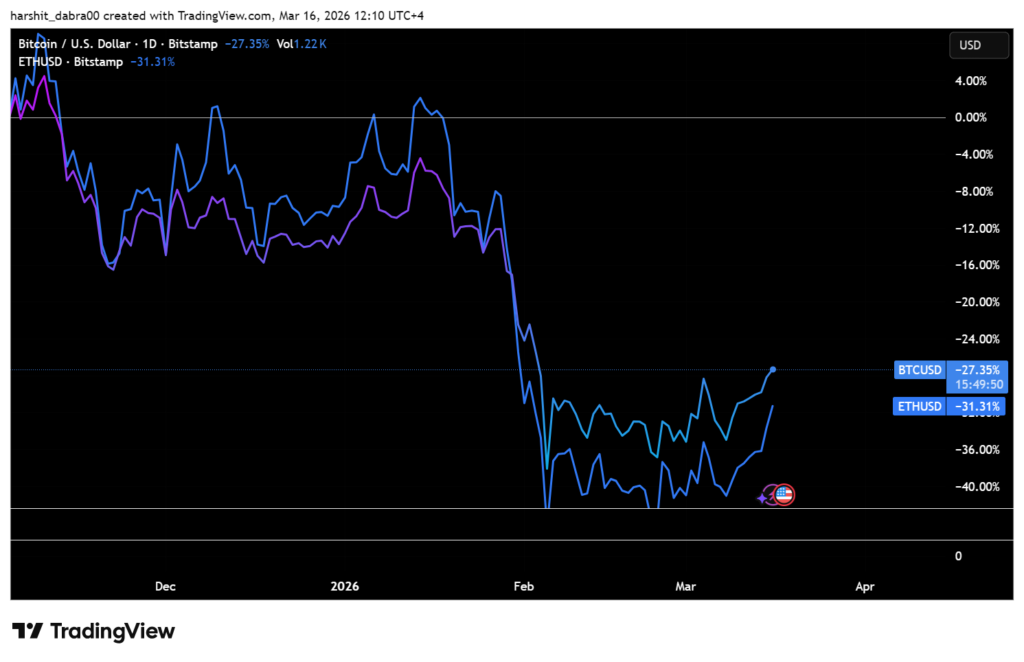
Over 24 hours, Ethereum gained 7.31% and Bitcoin rose by 3.14%. That is a 4.17 percentage point gap in a single session. Extend that window to seven days and ETH is up 12.97% against BTC’s 9.14%, a 3.83 percentage point spread. Over 30 days, ETH holds a 3.11 percentage point lead, up 10.53% versus BTC’s 7.42%.
The pattern is consistent and Ethereum is not occasionally ahead. It is systematically outperforming across every short window where both assets are positive. The one-year picture sharpens the case further. ETH is up 17.26% over 12 months, while BTC has experienced a downside of 12.52%. That is a 29.78 percentage point gap, and it is not noise. It reflects a structural difference in how the two assets have responded to macro pressure and recovery across a full cycle.
Over 60 days, ETH is down 31.65% versus BTC’s 23.43%. ETH has dropped 22.86% over the last 90 days compared to BTC’s 14.42%. The same characteristic that drives ETH’s outperformance in rallies is the same one that deepens its corrections. Higher beta works in both directions, and the medium-term drawdown data makes that unavoidable.
Both assets are also negative year-to-date. BTC is down 16.82% and ETH is down 24.53%. The recent short-term strength is real, but it is a bounce occurring inside a wider downtrend, not a confirmed structural reversal.
Scale and Liquidity: This Is Where Bitcoin Has No Peer
Bitcoin’s market cap sits at approximately $1.48 trillion, while Ethereum’s is $273.3 billion, making Bitcoin 5.42 times larger. On 24-hour trading volume, Bitcoin recorded $36.4 billion, while the second largest crypto, Ethereum, recorded $23.66 billion. Bitcoin runs 1.54 times more daily volume.
For most position sizes, ETH’s liquidity is workable. But at a massive institutional scale, where execution depth and price impact matter, Bitcoin’s order book has a structural advantage that ETH cannot currently match. Large flows move ETH more. That is not an argument against ETH. It is a constraint worth pricing in before sizing a position.
Circulating supply adds another dimension. BTC has approximately 20.0 million coins in circulation. ETH has approximately 120.69 million. The supply mechanics are intentionally different. Bitcoin’s fixed 21 million cap is the foundation of its monetary argument. Ethereum’s supply is dynamic, influenced by issuance rates and burn mechanics put in after the Merge. The followed metrics signify that neither is inherently superior, but they attract different types of capital for different reasons.
Institutional Capital Does Not Flow Into Both for the Same Reason
Bitcoin and Ethereum do not compete for the same institutional dollar, and conflating the two misreads how institutional allocation actually works.
Bitcoin is a macro reserve asset, and the institutional flows into this digital asset are driven by treasury diversification, ETF product demand, and sovereign or corporate balance sheet decisions. The investment thesis is deliberately simple: fixed supply, deepest liquidity, and lowest protocol surface risk. That simplicity is a feature, not a limitation.
Institutions allocating to Ethereum are expressing a view on smart contract adoption, DeFi settlement volume, layer-2 scaling, and the broader growth of on-chain financial activity. This makes Ethereum an infrastructure bet. The thesis is more complex and more dependent on ecosystem execution.
Neither asset has scheduled token unlock events, creating near-term supply pressure. ETH’s proof-of-stake structure introduces staking yield as a return component but also adds smart contract risk that Bitcoin’s proof-of-work architecture does not carry. That additional risk surface is the price of ETH’s additional growth levers.
What the Data Supports and What It Does Not
For short- to medium-term traders operating on a horizon of days to weeks, ETH’s momentum profile is the stronger setup right now. The 24-hour, 7-day, and 30-day outperformance is consistent and directional. If momentum holds, ETH generates more return per unit of time. The cost of that trade is accepting sharper corrections when conditions shift.
For investors where capital preservation, lower protocol risk, and execution depth at large size are priorities, Bitcoin is the more defensible allocation. Its medium-term drawdown figures are materially smaller. Its $1.48 trillion market cap and $36.4 billion daily volume provide structural stability that ETH does not offer at an equivalent scale.
What the data does not support is treating either asset as a confirmed recovery trade. Both are negative for 60-day, 90-day, and year-to-date. Until those windows start turning positive, the short-term momentum reads as a rally within a downtrend rather than a trend change.
The Forward Setup
The 60-day and 90-day return figures are the most important numbers on this page. They confirm that the broader structure for both assets remains negative. Bitcoin needs to flip its medium-term return windows before the case for structural recovery becomes credible. Ethereum needs to do the same, while also absorbing its deeper drawdown profile.
If short-term momentum extends, ETH will likely outperform given its beta characteristics. If macro conditions deteriorate again, ETH will underperform faster and deeper. That’s not speculation; it’s what the 60-day and 90-day data already demonstrated. The trade is not complicated. The risk profile of each asset is visible in the numbers. The only question is which one fits the position being built.


