




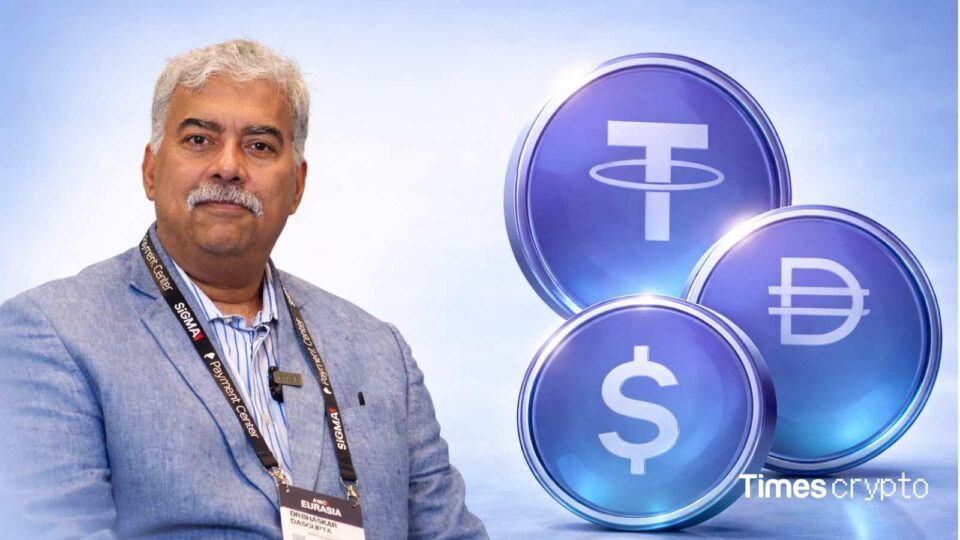
Stablecoins, once an emerging niche in digital assets, have quickly become a pillar of the digital economy. Their promise of fast, low-cost, blockchain-based transactions has driven rapid adoption, even as they trigger new questions about financial stability, monetary sovereignty, and the future role of banks.
To address these concerns in detail, TimesCrypto sat down with Dr. Bhaskar Dasgupta, chairman of the Middle East Stablecoin Association and a former banker and regulator, at AIBC Eurasia to discuss how yield-bearing stablecoins may affect traditional finance, what they could mean for the Gulf region, the future of stablecoins, and how regulators should respond.
Banks Face Deposit Flight as Yield-Bearing Stablecoins Scale
Dasgupta said concerns from global banks over yield-bearing stablecoins are very real, pointing to both revenue erosion and structural risks for the banking system.
Modern economies, he noted, have been built on bank deposits that fund credit creation through fractional reserve lending, as banks transform every unit of deposits and capital into a much larger volume of loans but pay depositors relatively low interest while carrying heavy regulatory and operational costs such as branches, staff, compliance, and payment infrastructure.
Stablecoins, by contrast, run on much leaner cost bases and can pass through more of the return from underlying reserves, typically short-dated government securities and other liquid instruments. If those reserves earn a few percentage points, he noted, an issuer can retain a modest spread and still offer meaningfully higher yields to users than most banks can match.
For Dasgupta, the risk goes well beyond the balance sheets of individual banks. As retail and corporate funds move from deposits into stablecoins, more of an economy’s liquidity ends up sitting in tokenized U.S. dollar assets. For countries outside the United States, he warned, that trend amounts to gradual dollarization and weakens domestic control over monetary policy.
As soon as an economy becomes dollarized, you lose control over your monetary policy” and that’s “a giant worry for both the finance ministries, the economic ministries, and the central banks,” he warned.
Despite this, he does not expect an outright conflict where one side wins and the other disappears. “I would ideally like both to coexist,” he said, adding that policymakers still have tools such as capital controls if pressures become acute.
Programmable Stablecoins to Reshape Corporate Flows
When asked whether a single dominant stablecoin is preferable to a fragmented market, Dasgupta argued that the real shift is not in how many brands exist, but in the fact that money itself can now be programmed.
He illustrated the point with airlines, which today use separate systems and currencies for jet fuel, aircraft purchases, catering, ticket sales, and loyalty points, each sitting in its own corner. A proprietary stablecoin, he said, could connect tickets, in-flight purchases, and supplier payments with in-brand loyalty rewards, bringing them together in a single programmable token backed by the airline’s balance sheet or reserves.
Similar models could emerge in sectors such as supermarkets, mobility, and other consumer industries, he said, where companies integrate payments, rewards, and supply-chain finance into a single tokenized framework.
In that context, whether the landscape ends up with a few large stablecoins or many specialized ones is a question for users and markets, not regulators, he suggested, describing the shift as “just different” and adding:
Having multiple options is good. We should let the market decide, and markets do end up deciding on their own. We have to believe in the intelligence and usage of the novel voter and consumer.
Gulf Stablecoin Hub to Channel a New Wave of Sharia-Compliant Wealth
Turning to the Gulf, Dasgupta said the region, and the UAE in particular, has already become a stablecoin hub rather than an aspiring one, helped by strong currency pegs to the U.S. dollar and long experience in handling large remittance and corporate flows, which together give Gulf economies a natural advantage.
In his view, the most immediate and powerful use case is cross-border payments, as remittances and commercial transfers into and out of the region through traditional channels are slow and expensive compared with stablecoins’ fast settlement and low fees.
Beyond payments, stablecoins are drawing parts of the regional economy that have historically been underrepresented in digital finance. Dasgupta said several issuers are actively working on Sharia-compliant structures for stablecoins, a technically complex task because such products cannot offer conventional yield.
Even without interest, tapping Islamic finance is potentially transformative. He estimated that more than half of the wealth in the Middle East is governed by Sharia principles, and tokenizing even a fraction of those assets in compliant structures could provide a major boost to virtual asset ecosystems across the region.
On the ground, he added, experimentation is already visible, with companies paying dividends and director fees in stablecoins, landlords and short-term rental platforms settling rent in tokens, and payment cards now linked directly to stablecoin balances. The next wave, he said, will integrate stablecoins with agentic AI and the Internet of Things to automate trade finance, collateral management, and real estate transactions.
To be honest with you, I actually can’t see any bottlenecks,” Dasgupta said, describing the UAE and Bahrain as “amazingly open-minded” and saying “they welcome new business ideas.
Investor Protection at the Core of a ‘Perfect’ Framework
When asked about the single rule he would insist on in an ideal regulatory framework for the region, Dasgupta answered from his background as a former regulator: investor protection comes first.
Any stablecoin regime, he said, must ensure that ordinary users and corporates are properly safeguarded through robust reserve requirements, transparent disclosures, strong governance, and clear redemption rights. A second priority is to maintain a healthy, well-functioning ecosystem, where payment systems, banks, fintechs, and virtual asset firms interact without systemic instability, he added.
The third pillar is agility, as supervisors need to be able to absorb and respond to new business models quickly, integrating innovations such as programmable money and AI without multi-year delays.


