





AAVE is no longer in a spiral of decline; it is in a reset phase. After printing a cycle high at $386.24, the digital asset is now changing hands near $119, with a gain of 5.6% on the latest daily session. The move from peak to current levels represents a 69% retracement. That magnitude shifts the conversation away from short-term correction and toward a full structural reset. The focus is no longer on why the asset has declined. The real question is whether this compression phase represents a base forming or merely a pause before the next move.
From Expansion to Distribution
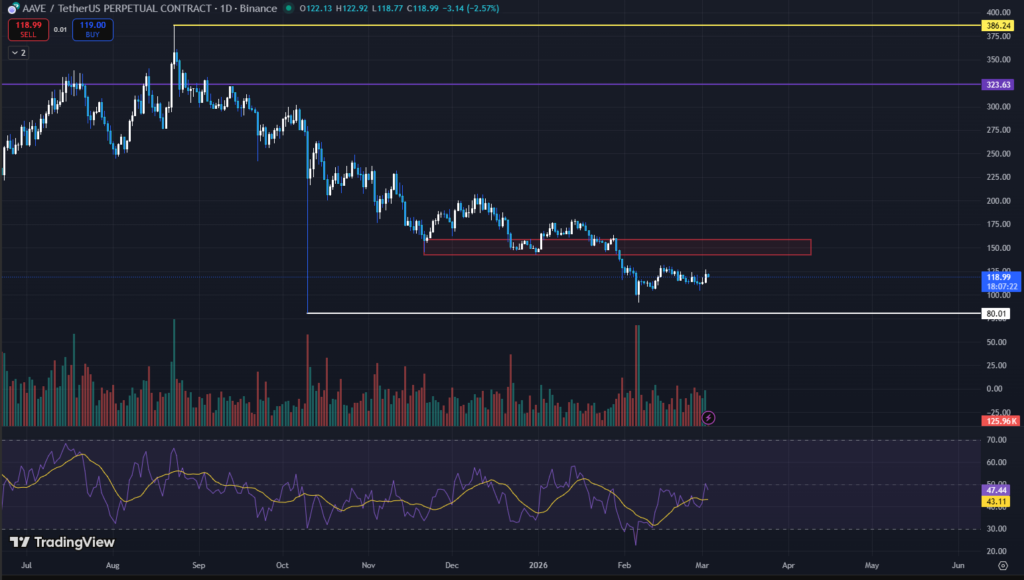
The rally toward $386.24 was followed by a sequence of lower highs and weakening momentum. The decisive structural event occurred when the price lost the $145 to $160 region, which previously acted as consolidation support. The respective area has since flipped into resistance. Each recovery attempt on that band has failed to establish acceptance above it. Sellers continue to defend that region. This confirms that the prior support zone is now acting as a strong supply zone. The failure to reclaim $145 to $160 is not a minor technical detail. It defines the current price structure of this DeFi token.
AAVE is sitting at $118.99 right now, which feels way below that old support level, but it’s still holding up above the base around $80.01. That spread between those two points is significant. The resistance up at $145 to $160 looks far off too, so there’s less probability of breaking out anytime soon. Price just hangs in the middle of this range that’s currently in formation.
In spots like this, the price can get choppy, moving around without much commitment. The real moves happen when it hits the edges, the actual highs or lows; the most significant level to reclaim is the “red zone” marked in the chart. The distance to the base keeps it from dropping hard, at least for the near term.
Volume Behavior Signals Distribution Exhaustion
The most aggressive volume spikes on the chart appeared during the sharp breakdown phases and again during the recent flush below $120. Those sessions showed clear participation expansion consistent with forced selling. Current daily volume reads 125.96K, notably lower than earlier spike sessions.
The volatility decline does not necessarily point to a bullish reversal. It highlights that the distribution phase for the asset has already been behind the market. With the sudden plunge in the price along with heavy liquidation, the market often sets its next transition to a positioning mode. The compression phases of the market usually follow up with exhaustion. The daily RSI currently prints 47.44, with its signal line at 43.11. During the February decline, RSI dipped into the low 30s, reflecting oversold conditions. The subsequent rebound has brought momentum back toward neutral territory but not into strength. RSI values below 50 indicate that bullish momentum has not regained control. At the same time, readings near the mid-range suggest that selling pressure is no longer dominant. This state is equilibrium, not a reversal and not a continuation either; in this phase, the market is compressing and quietly building pressure for the next directional move.
Structural Compression Between Clear Boundaries
The chart now reflects tightening behavior between two visible anchors. Support remains near $80.01. Resistance remains defined by the $145 to $160 supply zone. Intraday ranges are narrow, followed by low market participation. This combination signals compression. Compression does not last indefinitely. It resolves through expansion. The direction of that expansion will determine whether AAVE has completed its corrective phase or is preparing for another leg lower.
What Confirmation Looks Like
A decisive daily close reclaiming the $145 to $160 region would alter structure meaningfully. That move would invalidate the lower high sequence and shift the chart from bearish to neutral. Without reclaiming that band, any upside remains corrective inside a broader downtrend. On the downside, sustained weakness that pushes price toward $80.01 would increase the probability of a full retest of structural support. If that level fails, the correction transitions into continuation. At $118.99, neither scenario is confirmed.
Most commentary will focus on the 69% drawdown from $386.24. That observation is accurate but incomplete. The more relevant development is the shift from volatility expansion to volatility contraction. Forced sellers appear absorbed. Momentum has normalized. Volume has cooled. The market is no longer reacting emotionally. It is stabilizing technically.
This stabilization phase often precedes a decisive move. Traders who focus only on percentage drawdowns miss the more important signal, which is behavioral transition.
Implications for Traders
Current positioning offers limited asymmetric edge. Price is not testing structural support at $80.01, nor is it challenging the $145 to $160 resistance zone. The optimal approach in this environment is conditional. The market participants must wait for expansion and then react on confirmation. Avoid overtrading inside compression. If price reclaims former support as resistance turns to acceptance, structure improves. If price breaks lower from compression, risk increases toward deeper support.
The key is not predicting direction. It is recognizing that compression increases the probability of a meaningful move.
Forward Perspective
AAVE has completed a full corrective cycle from $386.24 to sub-$120 levels. Momentum has reset. Volume has normalized. The price structure for the asset has stabilized between specified levels. The chart is no longer chaotic. It is coiling, and coiled markets do not remain quiet. Expansion is the natural next phase. Traders who understand structure will focus less on narratives and more on confirmation at the boundaries.
Until $145 to $160 is reclaimed or $80.01 is threatened, AAVE remains in compression.


