





Algorand has spent roughly six months trapped inside a descending channel, printing lower highs and lower lows from October 2025 through late March 2026. That structure appears to have broken. What makes the current move analytically interesting is not simply that the price rose; it is how the break occurred and what the indicator stack says about whether the move is a structural shift or an exhaustion rally dressed up as one.
The Setup: Six Months of Compression
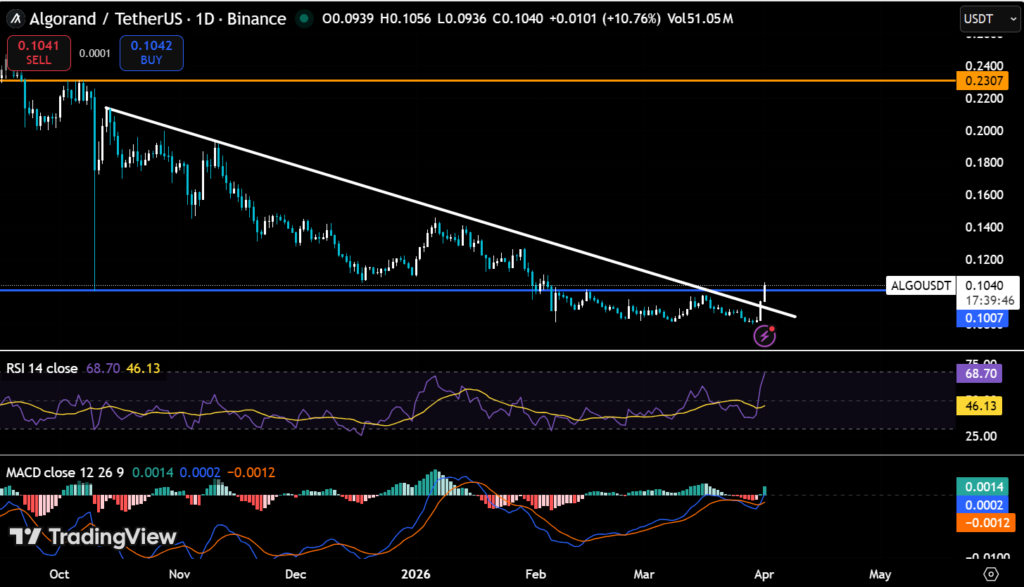
On the daily chart, ALGO established a clear descending channel beginning around October 2025, with the upper trendline capping every meaningful recovery attempt through December and into early 2026. Price action through late March was grinding along the lower boundary of that channel, consolidating in a tight $0.081 to $0.088 band for roughly five sessions from March 25 through March 31, before the move began.
Tight consolidation at the bottom of a multi-month descending structure often precedes the more decisive directional move, in either direction. At the time of writing, ALGO printed an intraday high of $0.1056 and opened the session at $0.0939, a single-session range that effectively punched through the upper descending trendline that had been in place since October.
The Volume Confirmation
The most analytically significant factor in this move is the volume profile. For most of the prior week, daily traded volume on ALGO was running in the $17 million to $40 million range, routine, low-conviction activity consistent with an asset in distribution or accumulation ambiguity. On April 1, 24-hour volume reached $123.46 million, representing a 3x to 7x surge depending on the reference session.
A volume of that magnitude accompanying a trendline break substantially increases the probability that the move reflects genuine demand rather than a low-liquidity stop-sweep. From a pure technical standpoint, breakouts on elevated volume carry more analytical weight than breakouts on thin volume, because they imply broader market participation rather than a mechanical trigger from a thin order book.
The price change from the March 25 close of $0.086684 to the current price of $0.10426 represents a gain of 20.25% in seven days. The 24-hour figure is +24.06%. These are not incremental moves, as they require an explanation, and the volume data provides one.
What the Indicators Indicate
The RSI tells a layered story across timeframes, with the short-window RSI reading of 68.70 sitting inside conventional overbought territory while the signal line at 46.13 remains in neutral territory, a divergence that indicates the speed of the recent move has stretched the short-term reading without pushing the intermediate momentum to any meaningful extreme, which is a profile more consistent with early-stage momentum expansion than with a market approaching exhaustion at a peak.
The MACD on the daily adds further context, with the MACD line at 0.0002 crossing above the signal line at -0.0012 while the histogram prints at 0.0014, a configuration where the crossover is confirmed and the histogram has turned meaningfully positive after an extended stretch of red bars through March, indicating that momentum is accelerating to the upside rather than simply stabilizing.
The short-term moving averages are already below price. The 7-day SMA is $0.08451 and the 30-day SMA is $0.08735, both now sitting roughly 18% to 20% below the current price of $0.10426. Short-term momentum is clearly positive, but the 200-day SMA at $0.13943 and the 200-day EMA at $0.13072 remain materially above the current price by 34% and 25%, respectively. This gap is the structural constraint the current rally has not addressed.
The Fibonacci Levels to note
Using the swing low at $0.08000 and swing high at $0.097856 as anchors, the Fibonacci extension levels project meaningful resistance at $0.10271 (127.2% extension) and $0.10889 (161.8% extension). The current price of $0.104 has already pushed through the 127.2% level, which now becomes a short-term reference point for support on any pullback. The next structural resistance, therefore, sits at $0.1089.
Below the current price, the first support reference sits at the 23.6% Fibonacci retracement at $0.09364, with the cluster deepening through $0.09104 at the 38.2% level and $0.08893 at the 50% mark. That 50% retracement carries additional weight because it sits within close range of the prior session pivot at $0.090042, forming a confluence zone between $0.0889 and $0.0900. A pullback that holds this zone would reinforce the breakout’s structural credibility. A daily close through it on meaningful volume would not.
The Key Structural Risk: The 200-Day Has Not Moved
While short-term structure has improved, the 200-day EMA at $0.13072 and the 200-day SMA at $0.13943 both sit roughly 25% to 34% above the current price, and neither has been tested, let alone recaptured. Any asset working through a genuine trend reversal eventually has to deal with those levels, and at $0.104, ALGO has not begun that conversation yet.
What this means practically: the current setup reads as a short-term technical breakout from a multi-month compression, supported by volume and indicator alignment, occurring within a still-intact longer-term downtrend. Those two things can coexist. A bear market can produce sharp, volume-backed countertrend rallies. The indicators suggest this move deserves attention, but the 200-day context suggests that treating this as a regime change requires substantially more price evidence.
Levels to Track Going Forward
For the breakout to maintain structural credibility, daily closes need to hold above the $0.0889 to $0.0900 zone, the 50% Fibonacci retracement and the prior pivot. A daily close below $0.0889 on elevated selling volume would suggest the breakout has failed and the prior range is reasserting itself.
On the upside, $0.1089 is the next meaningful Fibonacci resistance, followed by the horizontal resistance zone marked on the chart at approximately $0.1007, which the price has already pushed through. The orange horizontal level on the chart at $0.2307 represents the longer-term overhead resistance more relevant for position sizing than near-term trading.


