





Aptos (APT) printed a 17.02% single-day gain and is currently trading at $1.076, sitting at levels not meaningfully held since the token broke down from a long consolidation range in late October 2025. The chart tells a clear structural story. The data behind it raises a question that needs answering before sizing any position.
What the Chart Shows
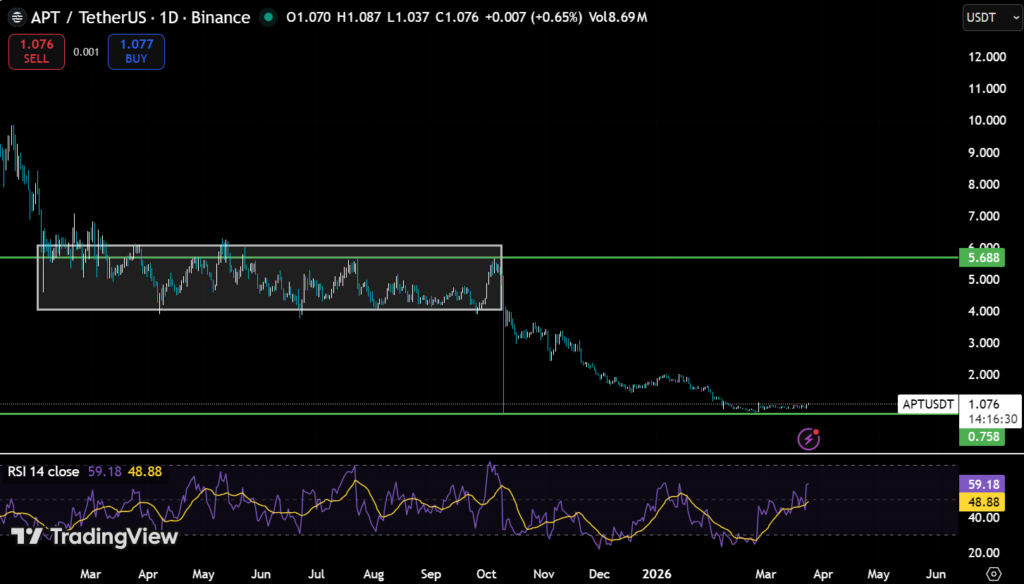
The daily chart for this digital asset reveals a defined range that held for roughly eight months, between approximately $4.00 and $6.00, with the green resistance line marked at $5.688. That range broke down decisively in late October 2025. From there, APT entered a sustained decline that carried the price from roughly $4.00 to a low near $0.758, the green support level visible at the chart’s base.
The current price of $1.076 is sitting just above that $0.758 support zone. It has not recovered into the prior consolidation range. The 17% move is a bounce from a historically significant low, not a breakout from a base.
RSI on the daily is reading 59.18 (purple line), with the secondary reading at 48.88 (yellow line). The 59.18 reading confirms recovering momentum without signaling overbought conditions. In prior RSI cycles visible on the chart, readings above 65-70 preceded local tops. There is still room before that threshold is tested.
The Momentum Picture
The short-term moving averages confirm near-term directional improvement. SMA7 sits at $0.99 and EMA7 at $0.99. SMA30 is at $0.95. The price at $1.076 is above all short and mid-term averages. However, the SMA200 is at $2.37 and the EMA200 at $2.19, both sitting far above the current price. This is not a recovery story yet. It is a bounce inside a longer-term downtrend.
MACD adds a supporting data point. The MACD line at -0.00161 crossed above the signal line at -0.01434, producing a histogram reading of +0.01274. Early bullish crossover. While the signal alone is not strong, it aligns with the RSI trajectory and the price structure above short-term MAs.
Fibonacci levels drawn from the recent swing low at $0.7926 to the swing high at $1.11 place the 38.2% retracement support at $0.9869, with the 50% level at $0.9498. If price pulls back from current levels, these are the zones to watch for continuation. On the upside, the 127.2% extension sits at approximately $1.19 and the 161.8% extension at $1.30. The immediate technical resistance is the swing high at $1.11, visible on the chart as the recent local peak.
The daily pivot is at $1.02. Price is trading above it. Intraday bias remains mildly bullish while the price holds.
Protocol Catalysts Behind the Move
The 24-hour volume of $240.92 million against a market cap of $846.92 million is a volume-to-market-cap ratio that is not routine. Moves of that magnitude on elevated volume typically have a fundamental catalyst. In Aptos’ case, several candidates are in play simultaneously.
Proposals #183 and #184 capped supply and revised inflation parameters. The 10x gas fee hike, with 100% burned, means every transaction now actively reduces circulating supply. If sustained, that burn mechanism directly reduces effective circulating supply over time and changes the supply/demand calculus. Additionally, Aptos has been cited as a leading chain for real-world asset tokenization, with institutional-grade integrations through partners including Securitize. RWA flow into a chain raises TVL, increases fee demand, and draws developer activity that compounds over time. The regulatory narrative is also shifting: mentions of APT receiving a commodity classification from U.S. regulators, if confirmed, reduce a major overhang that has weighed on many layer-1 tokens.
The Supply Discrepancy That Cannot Be Ignored
The reported market cap is $835.24 million. At a price of $1.07, that implies a circulating supply of approximately 791.5 million APT. The explanation is likely a reclassification of foundation or vesting holdings into circulating supply or an imminent unlock event that data aggregators have already priced into the float. Either way, the answer changes the dilution risk, the valuation framework, and how a potential unlock event should be interpreted by the market.
30-Day Price Context
The 30-day price sample moves from $0.84 to $1.01 to $0.93 and then to $1.07. The 30-day change is +25.38% and the 7-day change is +6.72%, meaning the bulk of the 30-day gain is concentrated in recent sessions. That acceleration, paired with a mildly bullish net sentiment score of 5.08, suggests the narrative is shifting but not euphoric.
What Traders Should Watch
The $1.11 swing high is the immediate line. A daily close above it on sustained volume opens $1.19 and $1.30 as the next Fibonacci extension targets. A rejection and closing on a weekly basis below $1.02 puts $0.9498 back in play, with the structural floor at $0.758. It will be crucial to monitor the daily fee burn rate for consistency on-chain, not just a one-session spike. RSI 14 at 59.18 has room to run, but this chart has topped near 70 before. That ceiling is closer than it looks.


