





On the surface, ASTER’s 30-day performance of -3.38% against a $1.65 billion market cap reads as quiet depletion. Currently the digital asset is changing hands close to $0.67. The short moving averages confirm it: SMA 7 at $0.664, SMA 30 at $0.682, and SMA 200 at $0.942, a full bearish stack with price trailing all three. But momentum, measured by RSI at 44.78, has not followed price into distress. That divergence between a declining price structure and a momentum indicator that refuses to confirm oversold conditions is the more precise question the chart is posing right now. Volume adds another layer to this reading. The 24-hour volume of $55.24 million, measured against the $101 million to $254 million range recorded during the March activity window, indicates that the current price compression is happening on notably lighter participation. Low-volume consolidation near a verified support level reads differently than low-volume drift into one.
The February Deviation: A Structural Reference, Not a Random Wick
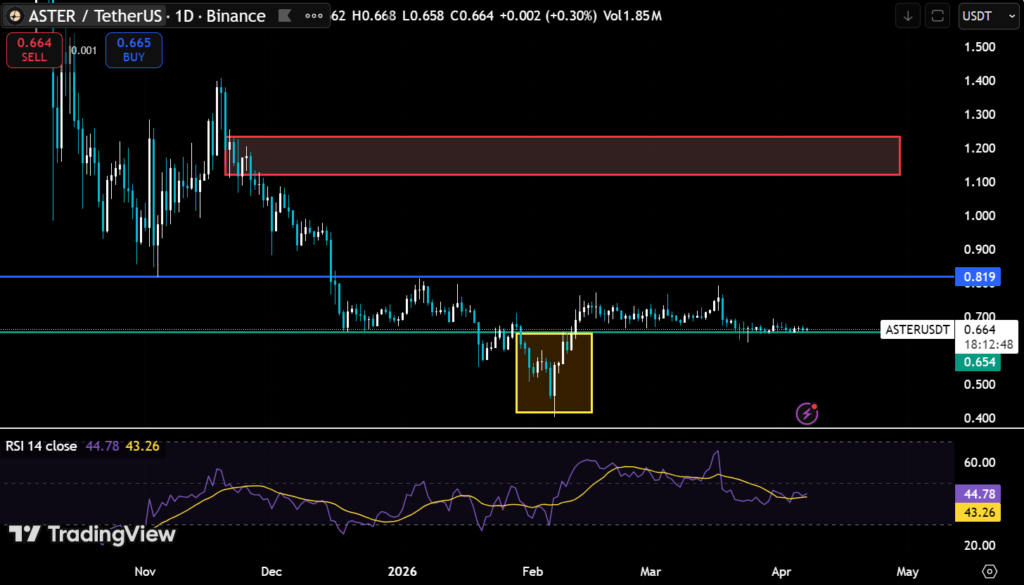
The most significant event on the daily chart is the deviation marked in the yellow box, which occurred in early February 2026. Price broke below the horizontal support level near $0.654 and swept into the $0.405-$0.50 range before recovering sharply back above the $0.654 level within the same short window. This type of move, where price pierces a structural low and immediately reclaims it, is a deviation rather than a genuine breakdown. The candles inside the yellow box show a sharp fall followed by a full recovery, and critically, the price has since held above that reclaimed level for the entirety of March and into April.
What this scenario tells market participants is that the $0.654 zone has been tested with a stop-hunt that failed to attract sustained selling. The fact that price returned to and held near $0.664 following that sweep gives the zone added structural significance. It is now a verified support area, not simply a horizontal line drawn on a chart. The more notable detail is that the recovery from the deviation low did not produce a sustained trend. Price reclaimed $0.654, ground back toward the $0.755 area by mid-March, and has since returned to almost exactly where it was post-deviation. That range compression, between approximately $0.638 and $0.695, has now been intact for roughly ten weeks.
Price vs. Moving Averages: A Layered Picture of Trend Weakness
The moving average stack confirms that ASTER remains in a medium-term downtrend, with short-term averages positioned below longer-term ones. The SMA 7 sits at $0.664, the SMA 30 at $0.682, and the SMA 200 at $0.942. The EMA configuration mirrors this: EMA 7 at $0.663, EMA 30 at $0.675, and EMA 200 at $0.935. Price is currently trading below all three SMA and EMA timeframes except for the very short-term 7-period band, which it is effectively hugging. The narrowing gap between the EMA 7 at $0.663 and the EMA 30 at $0.675 is worth noting. At twelve cents of separation, these two averages are close to crossing in either direction, and a confirmed bearish cross on the daily timeframe would add a mechanical confirmation to what the RSI and price structure are already suggesting.
The $0.819 horizontal level, marked on the chart as a blue line, and the 127.2% Fibonacci extension at $0.827 sit within eight cents of each other. That proximity is not coincidental framing. It represents the first zone where two independent technical references agree, making the $0.819 to $0.827 band the logical ceiling for any near-term recovery attempt before the price would face the larger supply zone above $1.20. The SMA 200 at $0.942 sits beyond that, a level 41.9% above the current price that remains a longer-term structural benchmark rather than an actionable near-term target.
RSI Structure: Compression Without Oversold Conditions
The daily RSI reads 44.78 on the purple line with the signal at 43.26, and the two are tracking in close proximity, which is itself a signal. When the RSI and its signal converge in the mid-40s below 50, it reflects momentum that has flatlined rather than a directional bias building in either direction. The chart shows the RSI peaked near 60 in March, aligning with the price high of $0.755 on March 18, and has since declined in a controlled, parallel fashion alongside the signal back to current levels. Despite the price falling from $0.755 to $0.664, the RSI has not broken below 40, meaning selling pressure has been steady but not aggressive enough to produce an oversold condition.
There is no mechanical flush to bounce from, but equally, no confirmed continuation signal either. A purple line crossing below the signal toward 40 would be the bearish confirmation to watch, while a reclaim of 50 with the signal following would be the first momentum read a recovery attempt would require.
Fibonacci Levels Provide the Trade Map
Using the verified swing high of $0.787 and swing low of $0.638, the Fibonacci retracement levels provide clear reference points. The 78.6% retracement at $0.670 is the level price needs to reclaim and hold to signal any near-term recovery. Current price at $0.664 is sitting just below this level. The 61.8% retracement at $0.695 and the 50% level at $0.712 are the next targets above if buyers establish control. On the downside, the swing low at $0.638 is the first line of defense, with the February deviation low below $0.500 serving as the deeper structural reference. The distance between $0.638 and $0.670 is effectively the decision corridor. Price has been oscillating within this thirty-two cent band for weeks, and the longer it does so without a directional resolution, the more significant the eventual breakout or breakdown becomes from a volume and momentum standpoint.
The Overhead Supply Zone
The red box spanning $1.20 to $1.25 marks the zone where ASTER previously topped and reversed. Price has not traded within that range since the breakdown that preceded the current structure, leaving it as untagged supply overhead with no base-building beneath it. This zone is 80% to 88% above the current price, making it a long-term structural reference rather than a near-term target. Between the current price and that supply zone, the chart presents two intermediate ceilings: the $0.819 to $0.827 confluence and the SMA 200 at $0.942. Any recovery narrative for ASTER has to clear both of those levels before the $1.20 range becomes a relevant discussion, which frames the overhead structure as a sequence of tests rather than a single obstacle.
The Technical Side for Traders
Price at $0.664 sits at the intersection of several meaningful levels: just below the 78.6% Fibonacci retracement at $0.670, near the prior deviation support at $0.654, and with RSI at 44.78 indicating neither oversold nor recovery momentum. The short-term range is effectively $0.638 to $0.695 and a daily close above $0.695 would shift short-term momentum and open the path toward $0.712 and $0.755. A break and close below $0.638, particularly without the recovery seen in February, would be a structurally different event. The fully diluted market cap of $5.32 billion against a circulating market cap of $1.65 billion also reflects that a significant portion of total supply is not yet in the market, a ratio that informed participants factor into longer-term positioning regardless of near-term price behavior.


