





Bitcoin is trading at $70,017.50, up 2.37% in the past 24 hours at the time of writing. The number feels significant, a round-number reclaim after a bruising slide from November’s $124,545 highs. But the chart tells a more measured story than the price tag implies. The real question is not whether Bitcoin is back above $70,000. It is whether this recovery has enough structural support to sustain itself or whether it is another failed rally inside a still-broken trend.
A Rally Built on Neutral Ground
The RSI (Relative Strength Index) on the daily chart sits at 51.28. The current reading shows the neutral sentiment from the market, which means a market that has stopped falling without yet committing to rising. That is a meaningful distinction.
Bitcoin’s RSI spent time near the 20 level in early February, a reading that marked the capitulation low around $60,000. The recovery from those oversold depths to the current 51.28 reading represents genuine momentum improvement. But 51.28 is not a number that historically precedes explosive continuation. It is the reading of a market in repair, not a market in breakout.
The 30-day return confirms this: up just 1.23% over the past month. Positive, but barely. The 60-day and 90-day returns are negative 22.86% and 24.28%, respectively. The weight of the November-to-February decline is still sitting on the medium-term ledger.
Where Price Actually Stands Structurally
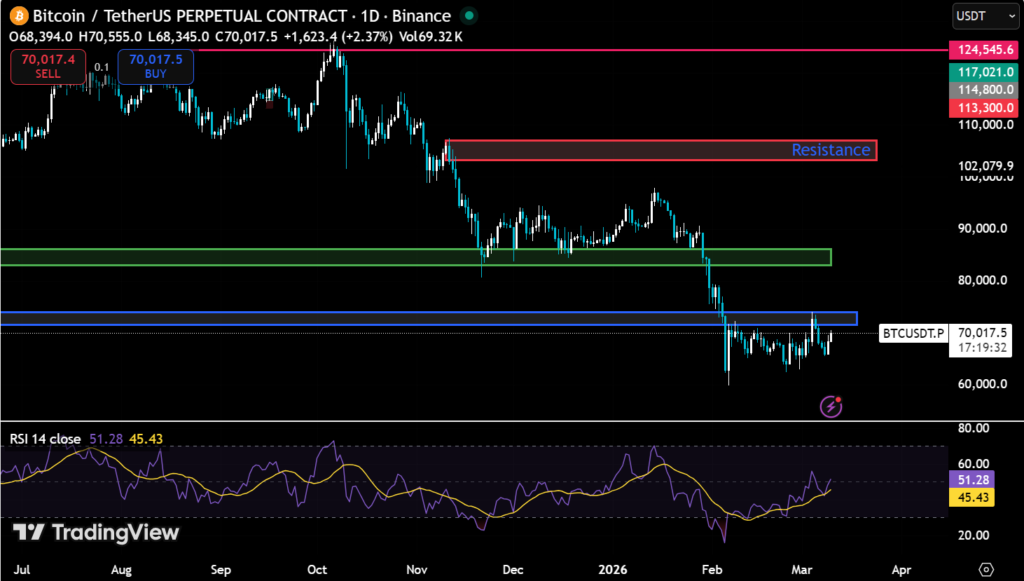
Three zones define the current technical picture, and Bitcoin is threading between all of them.
The blue support zone on the daily chart is near $70,500 and represents the level that the price is currently testing. This zone held as support from the right side of the chart through January before breaking during February’s sharp decline. A reclaim of this zone on a closing basis is meaningful, but the market needs to hold it, not just touch it.
The green support band spans roughly $83,000 to $85,000. This area was the prior demand zone that failed to contain the February sell-off. It now sits as overhead supply. Any recovery attempt toward $82,500 will probably encounter sellers who bought in that zone and are still underwater.
The red resistance block sits just under $103,079. This level is the zone where price was rejected hard in early November, and it remains the first major structural ceiling above the current range.
The Fibonacci retracement levels from the $62,553 swing low to the $74,051 swing high add precision to these zones. The 38.2% retracement at $69,659 and the 50% level at $68,302 form the immediate support cluster below the current price. A daily close below $68,302 would shift the intraday structure back to bearish. The 23.6% retracement at $71,338 is the first meaningful resistance above the current price that represents a level Bitcoin has not yet cleared on this recovery leg. The daily pivot sits at $67,911.78. Price is currently $2,105.72 above it, roughly 3.1%.
The 200-Day Problem
The single most important number on this chart is not $70,000; it is $95,205.66. That is where Bitcoin’s 200-day simple moving average sits. This measure is $25,188 above the current price, which represents a gap of 26.5%. To put that in perspective: Bitcoin would need to rally more than a quarter from here just to reach a level most trend-following models treat as the minimum threshold for a healthy bull market. That is not a gap that closes in a week of green candles.
The short-term averages are doing their part. The 7-day SMA at $68,803 and the 30-day SMA at $67,877 are both below the current price, a short-term constructive alignment. But stack those numbers against $95,205 and the picture reframes itself immediately. The short SMAs are not anchors of strength. They are low water marks from a prolonged decline, and the price sitting above them says more about how far the market fell than about how far it has recovered.

The MACD (Moving Average Convergence Divergence) adds a layer of nuance worth reading carefully. The histogram at +681.2 is positive and has been printing green bars for several sessions, a sign that selling momentum is losing force. The MACD line (blue) at -907.2 is curling upward toward the signal line (orange) at -1,588.4 but has not yet crossed it. That gap of roughly 681 points means the cross is approaching, not confirmed. Momentum is improving, and that part is real. But both lines remain well below zero, which matters. A bullish MACD cross above the zero line reflects genuine trend strength. A cross point deep in negative territory reflects a slowdown in selling pressure, not the arrival of buying conviction. The distinction is significant for anyone sizing a position based on this signal alone.
Taken together, the 200-day gap and the below-zero MACD cross describe the same market condition from two different angles: a recovery that is real but not yet verified.
What Traders Should Watch
The setup for the next two weeks is defined by a narrow band.
On the upside, $71,338 is the first genuine test. A clean break and daily close above that level with volume above the current $69,320 would open a run toward the $74,051 swing high. Above that, extension targets sit at $77,179 and $81,157, but those levels require a structural shift in conviction that the current RSI reading does not yet support.
On the downside, the $68,302 to $69,659 Fibonacci cluster is the zone that needs to hold. A break below $67,911 (the daily pivot) would be a short-term invalidation of the recovery structure and would likely bring the $65,013 Fibonacci 78.6% level into scope.
Volume is a critical filter here. The 24-hour volume of $48.69 billion and the 7-day total of $376.58 billion reflect genuine institutional-scale liquidity. Any breakout attempt without a volume expansion above recent averages should be treated with skepticism.
The Overall Picture
Bitcoin at $70,017 is a technical reclaim, not a trend reversal. The RSI at 51.28 describes a market in the early stages of recovery, the MACD histogram is turning positive from deeply negative territory, and the short-term moving averages are constructive. But the 200-day SMA at $95,205 remains 26.5% away, short-term returns over 60 and 90 days are still deeply negative, and the overhead supply zones from $80,000 upward are significant. The price is above its pivot. It is threading a Fibonacci support cluster. The next 72 hours of price action near $71,338 will determine whether the momentary price is the base of a sustainable recovery or another lower high in a longer corrective structure.

