




Bittensor (TAO) has been one of the cleaner momentum stories in the current altcoin rotation, and the daily chart reflects that with a degree of structural clarity that is worth examining closely. From $183.27 on February 19 to a current close of $301.20 with an intraday high of $310.60, TAO has appreciated approximately 66% in 30 days, posting a 32.76% seven-day gain and a 59.25% thirty-day gain, with the current daily candle opening at $282.60 and closing 6.66% higher in a session that saw price probe as high as $310.60 before pulling back into the close. What makes this rally analytically notable is not the magnitude of the move but the manner in which it developed, because the recovery from the February lows was not a single explosive candle driven by a one-day volume event but a stepwise progression where each leg built on the last with expanding volume confirmation, and that structure is now arriving at the single most consequential price level on the chart.
The Structure of the Rally
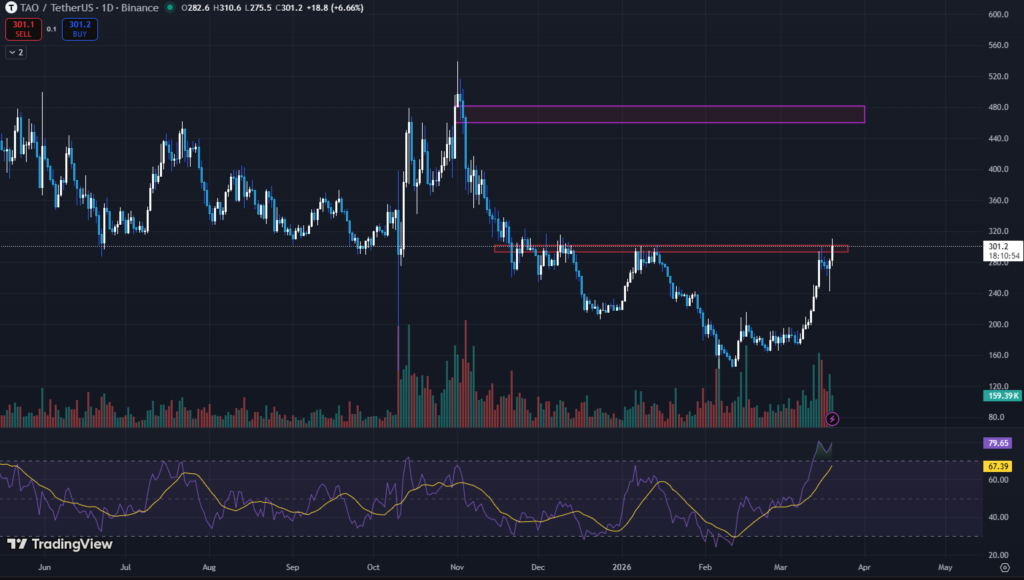
The move from the February lows developed in a sequence that matters technically because each step was confirmed by above-average volume on the daily chart. Price moved from $186.41 on March 3 to $203.36 by March 12, then accelerated sharply to $249.30 on March 15 and $272.66 on March 19 before reaching the current close of $301.20, with volume expanding visibly on each of the larger legs, particularly the March 12 to March 15 impulse and the continuation push through March 19, where the volume bars in the lower panel spiked well above the preceding average. That volume signature is the most important element of this rally because it separates a buyer-driven re-pricing from a low-liquidity drift that tends to reverse at the first meaningful supply zone it encounters.
The Resistance Zone TAO Is Testing Right Now
The chart shows a clearly defined red resistance band sitting between approximately $290 and $320, a zone that has been tested and rejected multiple times since November 2025, when TAO peaked near $540 before entering the prolonged downtrend that carried it into the February lows. The current daily candle opened at $282.60, pushed as high as $310.60, and closed at $301.20, meaning price has already probed inside the upper half of this resistance band intraday and pulled back, leaving a visible upper wick that confirms supply is actively present in this range on the first touch. That wick into the resistance on the initial approach is not an immediate invalidation of the bullish setup, but it does confirm that a clean daily close above $320 with sustained volume is the specific condition required before this zone can be considered resolved rather than simply tested.
Above the immediate resistance band, the chart shows a second and more significant supply zone marked by the purple horizontal rectangle, which spans approximately $460 to $480 and represents the distribution area from the November 2025 peak before the sharp sell-off into December. That zone becomes the primary upside target if and when TAO prints a confirmed daily close above $320, though the distance between the current price and $460 is approximately 53%, making it a secondary consideration that only becomes relevant after the immediate resistance is cleared.
What the RSI Is Saying
The two oscillator lines in the lower panel of the chart are sitting at readings of 79.65 on the faster purple line and 67.39 on the slower yellow line, with both lines having risen sharply through March in line with the price acceleration. These readings place TAO in overbought territory on the daily timeframe, and the spread between the two lines, with the faster line nearly 12 points above the slower, indicates that the momentum impulse is extended relative to the smoothed trend confirmation. In strong trending assets, elevated RSI readings can persist for longer than mean-reversion traders expect, but the combination of overbought momentum and a price sitting inside a well-established resistance zone is not a setup that historically favors aggressive new long positioning. The specific signal to monitor from here is whether the faster purple line begins to curl downward and cross below the slower yellow line while price remains inside the $290–$320 band, because that crossover without a breakout confirmation would represent the clearest early technical warning of a reversion toward the prior support area.
Supply, Tokenomics, and the Market Cap Context
TAO’s current market cap sits at approximately $3.28 billion against a fully diluted valuation of $6.40 billion, with circulating supply at 10.75 million TAO out of a hard maximum of 21 million, putting circulation at 51.19% of the total cap and giving an FDV-to-circulating market cap ratio of approximately 1.95x. No scheduled token unlock events are coming up in the near term, which removes one of the more common sources of mechanical selling pressure that tends to act as overhead in tokens at this market cap range regardless of price action, and the absence of a large unlock event in the near term reduces that particular risk factor for the current move. The 24-hour trading volume of $660.01 million against a $3.28 billion market cap produces a volume-to-cap ratio of approximately 20.1%, a reading that is elevated and consistent with a token in an active momentum phase where liquidity is sufficient to absorb institutional-scale positioning on both sides of the trade.
Key Levels to Watch
The $290 to $320 resistance band is the level the entire current setup revolves around, and the price action above or below it determines whether the March rally extends into a larger structural move or stalls and reverts. A daily close above $320 with sustained volume would shift the technical read from resistance test to confirmed breakout, opening a measured path first toward the $380 to $400 area and then toward the more significant supply zone between $460 and $490 that marked the November 2025 distribution before the extended sell-off. That upper zone is not a near-term target but a directional reference that only becomes relevant once the immediate overhead is resolved on a closing basis.
On the downside, a rejection from the current zone that fails to produce a breakout would likely see TAO retrace toward $250 to $260, the consolidation base that formed during the mid-March accumulation phase and the most natural area for buyers to reassert if the first breakout attempt fails. A daily close below $240 would be a materially different situation, one that suggests the March rally was a relief move within a broader corrective structure rather than the beginning of a sustained recovery, and would warrant reassessing the bullish thesis entirely. The all-time high of $767.68 and the all-time low of $30.40 provide the full historical range, with the current price sitting approximately 60% below the peak, which means the overhead supply from late 2024 and early 2025 accumulation zones is substantial and will not be absorbed in a single move regardless of how the immediate resistance resolves.


