





BNB, the native cryptocurrency of the BNB Chain ecosystem, is trading at $620.30, stuck inside a well-defined consolidation range that has persisted since early February. After a sharp drop from the $950 area in late January, the price has spent six weeks compressing between roughly $600 and $650. The structure is clear; what remains uncertain is which direction it resolves.
A Sharp Drop, Then Silence
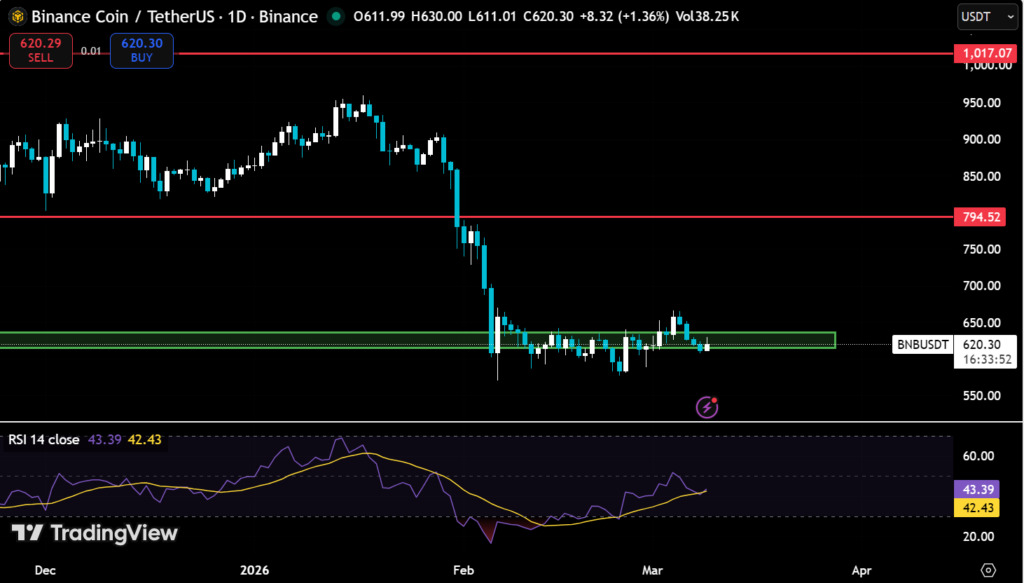
Binance Coin (BNB) was trading comfortably above $850 through December and into January, reaching intraday highs near $950 before the breakdown accelerated in early February. The daily candles from that period show a near-vertical descent, with price slicing through multiple levels before finding a floor just below $600.
Since then, the digital asset has not recovered meaningfully. The daily range on the current session sits between $611.01 and $630.00, with a close at $620.30, up just $8.32 (+1.36%) on the day. That 1.36% gain looks constructive in isolation, but it means little when BNB has been oscillating within the same $50 band for over a month.
The 30-day change confirms this: BNB is down 3.93% over that window and down 29.48% over 60 days. The YTD figure sits at -27.12%. These are not short-term noise numbers; they reflect a structural breakdown that has not been repaired.
The Two Resistance Levels That Matter
Two red horizontal lines on the daily chart define the overhead problem. The first sits at $794.52; this is the more immediate and arguably more important level. BNB has not traded above it since the February sell-off, and any recovery attempt will face this zone as a ceiling before anything else.
The second level is at $1,017.07, which represents a prior key zone from the broader range that stretched toward the all-time high of $1,370.55. At current prices, BNB is 38.5% below the $794.52 level and approximately 64% below its all-time high. These are not minor gaps; recovering them would require a sustained and significant trend reversal, not a bounce.
The green support box visible on the chart, spanning roughly $600 to $650, has been tested multiple times since February. Price dipped below $580 briefly at its lowest point but has since stabilized within the zone. For now, it is holding, but holding support inside a downtrend is not the same as a reversal.
RSI Adds Little Urgency in Either Direction
The RSI (relative strength index) reads at 43.39. Both figures sit below the neutral 50 level but well above the oversold threshold of 30. The RSI bottomed near the 20 level during the sharpest phase of the February drop visible on the chart and has since recovered to its current range.
What this reading communicates is straightforward: BNB is in buyers looking for a distressed entry and not strong enough to suggest momentum is building in either direction.
The RSI recovery from near 20 during the February flush to the current 43.39 is worth noting but context matters. That move from extreme oversold back to the mid-40s is a normalization, not a reversal signal. It is the kind of RSI behavior seen in assets that have stopped falling rather than assets that are preparing to rise. The difference is significant.
For RSI to support a bullish case, the market participants would need to observe the level to hold above 50, which would indicate that buying pressure is constantly outpacing selling pressure over the 14-day window. At 43.39, that threshold is close enough to be achievable but it has not been tested yet. Each time RSI has pushed toward the 50 level over the past several weeks, price has stalled. That pattern of RSI rejection near neutral is consistent with a market where sellers remain active on any show of strength.
What the indicator ultimately reflects is the same sideways reality the price action does: a market that absorbed the initial selling shock but has not generated new buying conviction. Six weeks of range-bound trading with RSI anchored in the low 40s is not accumulation; it is indecision. And in the context of a broader downtrend, indecision tends to resolve in the direction of least resistance.
What Traders Are Actually Watching
The immediate structure gives traders two clear scenarios. If BNB holds the $600 to $620 zone on any near-term pullback and volume picks up on upside sessions, the first target is $650, the upper boundary of the current consolidation box. Clearing $650 with conviction would then put $794.52 on the roadmap as the next meaningful test.
If $600 breaks on a daily close, the consolidation thesis fails. That level has absorbed selling for six weeks; losing it would signal that the floor is lower than current price action implies.
The 200-day SMA at $893.79 and EMA at $803.74 remain far above the current price. BNB trading that far beneath its long-term averages confirms that the macro trend is still down. Short-term traders may find opportunity within the range, but longer-term participants have no technical reason to call a bottom yet.
Forward Look
The consolidation range will likely determine BNB’s next directional move. The six-week compression following a near-30% drawdown is the kind of base that can resolve either way. The burden remains for the bulls with price levels of $650 and $794.52; these are the levels that need to be reclaimed before the trend narrative changes. Until then, $620.30 is a data point inside a range, not a turning point.

