





Enjin Coin (ENJ) achieved a 49.72% gain in a single 24-hour window, pushing the price from an intraday low of $0.02549 to a high of $0.04300 before settling at a close of $0.03033 on the daily chart. That single candle accomplished something structurally notable; it reclaimed a price range that ENJ had last occupied in March 2020, breaking above the lower boundary of a multi-month descending channel that had capped price action since October 2025.
The Price Structure: What the Chart Actually Shows
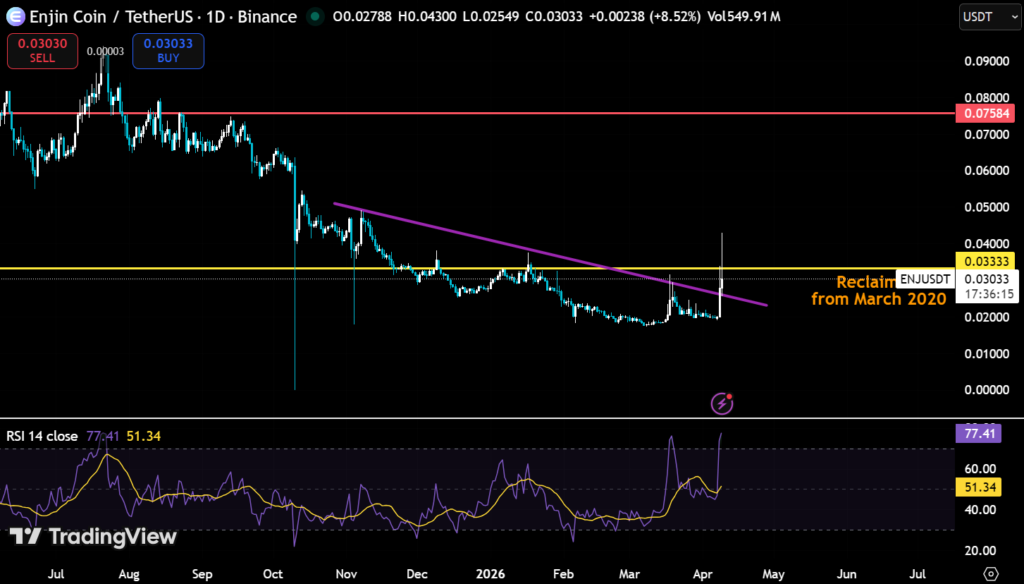
The daily chart of this digital asset shows that from approximately October 2025, ENJ was contained within a descending channel marked by two converging trendlines. Prices ground lower through November, December, and into early 2026, reaching levels near $0.02000 before the April move. The recent surge not only broke above the upper boundary of that descending channel but also reclaimed the $0.03033 level, a zone annotated on the chart as a reclaim “from March 2020”.
The yellow horizontal line sits at $0.03333, a level that now acts as an immediate resistance above the current price. ENJ traded at $0.03033, sitting just below that level. Above $0.03333, the next structurally significant resistance is the red horizontal line at $0.07584 a level from the prior macro range that represents roughly a 150% move from the current price. There is no meaningful charted structure between $0.03333 and $0.07584, which means if bulls defend the $0.03033 close and reclaim $0.03333 with conviction, the path higher has limited technical overhead until that upper zone.
The immediate support test is straightforward: ENJ needs to hold the $0.03033 close to the reclaimed channel breakout level. A failure to hold above the channel’s upper boundary would pull it back into the prior descending structure, invalidating the breakout thesis.
RSI Reading: Momentum Confirmation With a Clear Warning
At the time of the writing, the RSI (relative strength index) on the daily timeframe was 77.41, which is well above the overbought level. For context, the chart shows ENJ’s RSI has reached similar elevated levels only a handful of times in the visible price history, and in each prior instance, some degree of consolidation or retracement followed before the next directional leg.
The daily RSI printed at 77.41, placing ENJ in overbought territory on the session that produced the breakout candle. The more useful read, however, comes from the contrast with the yellow line at 51.34 on the same panel, which reflects the RSI on a higher timeframe. At 51.34, the higher timeframe RSI is sitting in neutral ground, nowhere near extended and nowhere near confirming what the daily just printed. That gap between timeframes tells a specific story: the daily move was sharp and compressed into a short window, but the broader momentum structure has not shifted to match it yet. A daily RSI at 77.41 with a weekly RSI at 51.34 means the move happened fast, not that it happened with broad and sustained participation across timeframes.
Neither outcome is predetermined. But a 77.41 RSI on the daily after a 49.72% single-day move is not a setup where fresh aggressive entries carry a favourable risk-reward. It is a setup where patience tends to be rewarded either by a clean pullback to a more attractive entry or by a period of sideways consolidation that resets the momentum indicator before the next move.
Volume and Market Cap Context
ENJ’s 24-hour trading volume of $240.94 million against a market cap of $59.72 million is a ratio that warrants attention on its own. For every $1 of market cap, there is roughly $4 in volume traded, a compression that typically appears during one of two conditions: a genuine demand shock where new capital enters across multiple participant types or a speculative flush where leverage and momentum chasers amplify a move far beyond what underlying buying pressure can sustain.
With a circulating supply of 1.95 billion ENJ and a total supply of 1.98 billion, meaning nearly the entire supply is already in circulation, there is no significant supply overhang from future unlocks to weigh on price. This is a structural positive and price discovery on ENJ is not competing against scheduled token releases.
Onchain Data: Participation Metrics That Add Context
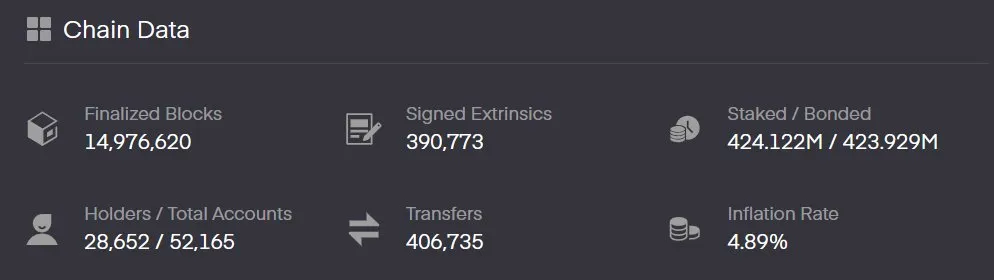
The Enjin chain has finalized 14,976,620 blocks and recorded 406,735 transfers across 390,773 signed extrinsics. Of the 52,165 total accounts on the network, 28,652 carry a balance, putting the holder-to-account ratio at approximately 55%.
The staking and bonding figures are particularly notable: 424.122M ENJ is staked, as compared to 423.929M ENJ bonded, a near 1:1 ratio. With a circulating supply of 1.95 billion ENJ, the staked amount accounts for about 21.7% of supply locked in staking. The network inflation rate of 4.89% determines the yield for stakers and simultaneously the annual dilution rate for non-stakers, making staking participation an economically rational behaviour rather than a purely speculative one.
Performance Data in Full Perspective
The performance table completes the picture with necessary context. The 30-day gain of 72.24% and 7-day gain of 47.66% confirm this is not an isolated daily anomaly; ENJ had been building momentum over the prior month. The 90-day figure of -1.29% shows the asset was effectively flat over a longer window before this run, which makes the move a recovery from consolidation rather than an acceleration from prior upward momentum.
The 1-year return of -52.67% and an all-time high of $4.85 placing the current price at a 99.37% drawdown from ATH situate ENJ firmly in the category of assets that have experienced severe long-term depreciation. The $0.03033 close is meaningful relative to the March 2020 reclaim noted on the chart, but it remains a fraction of prior peak valuations. The YTD gain of +4.32% reflects the fact that, despite the recent surge, the asset spent much of the year underwater before this move.
What This Setup Means Going Forward
Three price levels define the near-term structure. The close at $0.03033 is the key support to hold; losing this on a daily close would signal the breakout failed. The $0.03333 yellow resistance is the first target that needs to flip to support for bulls to gain structural control. Beyond that, $0.07584 is the macro resistance level where supply from prior distribution will likely become a factor.
The RSI at 77.41 on the daily is not an entry signal; it is a caution flag against chasing. The volume-to-market-cap ratio at roughly 4:1 leaves open the question of whether the buying behind this move was structural or opportunistic. On the supply side, with no scheduled token unlocks and approximately 21.7% of the circulating supply locked in staking, the immediate overhead from forced or incentivized selling is limited.
This is a technically significant break, but significance and durability are different things. The next 3 to 5 daily candles, and specifically whether ENJ can consolidate above $0.03033 without returning into the prior descending channel, will determine whether this reclaim holds or becomes a false breakout.


