





Ethereum is trading around $2,135 at the time of writing, registering a 4.36% gain in the past 24 hours and recovering from a multi-session base around $2,032. The move looks sharp on an intraday basis. But placed against the 90-day return of -33.78% and a year-to-date decline of -28.94%, it reads less like a trend reversal and more like a relief rally approaching a well-defined resistance ceiling.
The overnight acceleration was not gradual
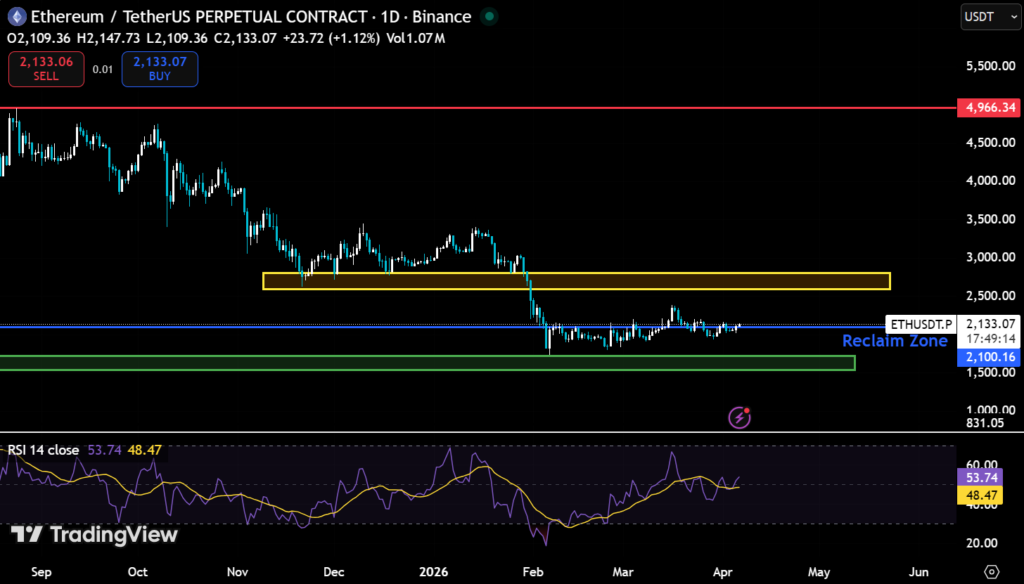
From April 5 at 06:15 UTC through 22:10 UTC, ETH moved sideways in a tight $30 band, oscillating between $2,032.39 and $2,066.01 with volume gradually climbing from $7.12 billion to $8.40 billion. The market was compressing, with the Buyers and sellers largely in balance, and nothing in that nine-hour window suggested a directional move was imminent.
Then, between 22:10 UTC and 00:45 UTC on April 6, the price jumped from $2,062.33 to $2,127.48 whcih is a $65 move in under three hours. Volume during that window surged to $10.96 billion, nearly 30% above the prior session’s close. That is a discrete event that signifies either a large buyer stepping in, short positions getting squeezed out, or both happening simultaneously.
By 03:25 UTC, ETH reached an intraday high of $2,134.80 with volume continuing to expand to $12.55 billion. It has since consolidated fractionally to $2,132.22, with volume climbing further to $12.99 billion. The pattern through the consolidation is constructive, showing price is holding near the session high rather than fading, and volume is confirming the hold rather than retreating. That behavior typically indicates the buyers from the overnight move have not exited.
What the RSI Shows
The RSI (relative strength index) on the short-term dataset climbed sharply during the overnight acceleration, pushing into the upper range as the $65 candle developed. At current levels just below $2,140, the momentum reading is elevated but not yet technically overextended on a higher timeframe basis. The dynamic to watch now is whether RSI consolidates sideways at current levels, which would allow price to absorb the move before another attempt at resistance, or whether it rolls over sharply, which would suggest the overnight move exhausted available buying pressure.
A sustained RSI reading above 60 during any consolidation period would be a meaningful signal. It would indicate that momentum is not being given back entirely and that buyers are holding their ground rather than taking profits into the first available exit. A rollback toward 50 based on declining volume, by contrast, would be an early warning that the rally lacks follow-through.
The $2,140 zone is the first real test
Current price sits approximately $8 below the $2,140 resistance zone. That level matters because it represents the first meaningful structural ceiling above the overnight consolidation range. It is not an arbitrary number. It reflects where sellers have previously stepped in with enough size to halt upward moves, and any attempt to breach it will be closely watched by both momentum traders and those positioned short from higher levels.
A clean daily close above $2,140 opens the path toward the next structural cluster around $2,200, a zone that would likely require sustained volume above $11 billion to clear convincingly. A single rejection at $2,140 proves little on its own, as price routinely compresses below resistance before breaking through. What would shift the short-term bias to the downside is a pattern of repeated failures at that level alongside progressively declining volume on each attempt. That combination signals supply absorbing demand rather than demand building pressure against supply, and it would bring the $2,030 support zone back into focus as the more decisive level to monitor.
The 24-hour volume figure of $13.16 billion represents a 93.14% increase over the prior period. That kind of volume expansion accompanying a price move carries more analytical weight than the price gain alone. When volume nearly doubles into a rally, it generally signals genuine participation rather than a thin-market drift. The 7-day volume of $76.72 billion and the 30-day total of $207.02 billion provide further context: this is not a quiet market starved of liquidity. Participants are active, which means both direction and reversals can be sharp.
The macro picture is harder to ignore
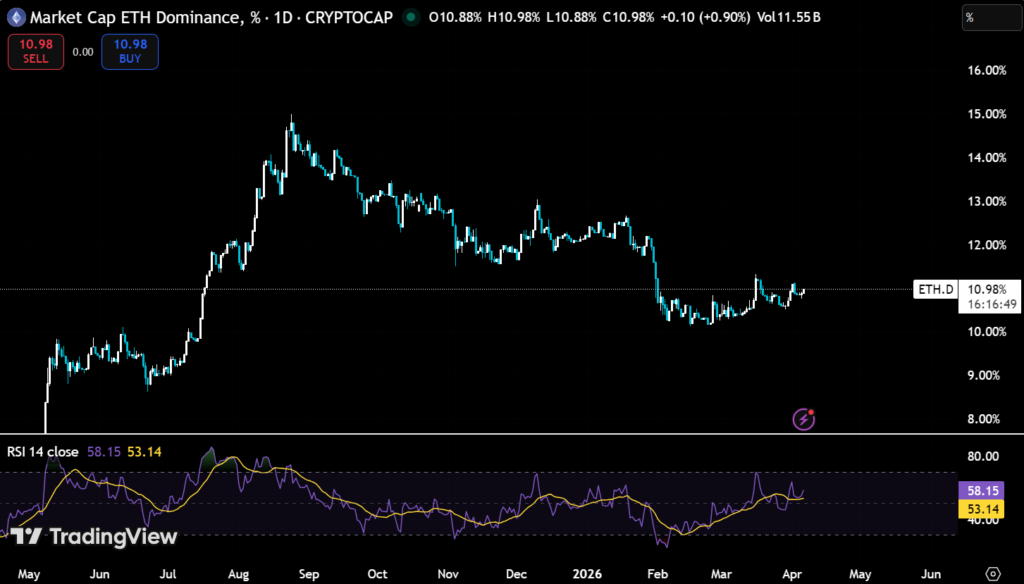
Despite the short-term setup, the broader data keeps the picture complicated. ETH is still 33.78% lower over 90 days, and the YTD figure of -28.94% means Ethereum has spent most of 2025 under sustained distribution. With a market cap dominance reading of 10.98%, ETH has also continued to lose ground to Bitcoin on a relative basis, a trend that has persisted through multiple attempted recoveries this cycle.
The ATH drawdown stands at 56.96% from the all-time high of $4,953.73. Recovering from that kind of structural damage does not happen on the back of a $100 overnight move. It requires a sequence of higher lows on weekly closes, recovering dominance, and volume profiles that suggest accumulation rather than rotation. None of those conditions are clearly in place yet, and one strong intraday session does not change that assessment.
Social sentiment at 4.95 on a 0 to 10 scale, where 5 represents neutral, is consistent with a market in transition rather than one with strong directional conviction. The near-neutral reading reflects what the price chart shows: participants are not euphoric, but they are not capitulating either. That kind of ambiguity tends to resolve with a decisive break above or below the nearest structural levels, which in this case are $2,140 and $2,030.
The $2,030 support zone now has a track record
The $2,030 support level was tested repeatedly across April 5 and held cleanly. It now functions as the first meaningful downside reference for any correction from current levels. A break below it on elevated volume would signal that the overnight move was a liquidity grab rather than sustained demand entering the market and would put $1,900 back in play as the next major structural zone. For traders long from the $2,030 base, that level now serves as a rational stop reference. For those watching from the sidelines, a retest and hold of $2,030 on lighter volume would represent a lower-risk entry point than chasing the move at current levels.
The path forward
If ETH can close a daily candle above $2,140 with volume holding above $11 billion, the short-term structure improves materially and shifts the immediate bias to the upside. A failure at that level on diminishing volume reinforces the view that the current rally is a technical rebound within a broader downtrend. Both outcomes are possible, and the data does not yet clearly favor one over the other.


