



Ethereum has slipped below the crucial psychological level of $2,000, that makes the short-term bearish structure stronger as downside pressure spreads out across the crypto market. The move occurred after several attempts to break beyond the $2,200 level, which had been a ceiling for recent recovery attempts and a point of trend continuation.
From a technical perspective, the fall of the second-largest cryptocurrency under $2,000 makes people feel defensive about the market. The price is now below the 100-hour simple moving average and it is experiencing trouble finding a stable base.
Breakdown Keeps Losses Going, But Relief Bounce Starts
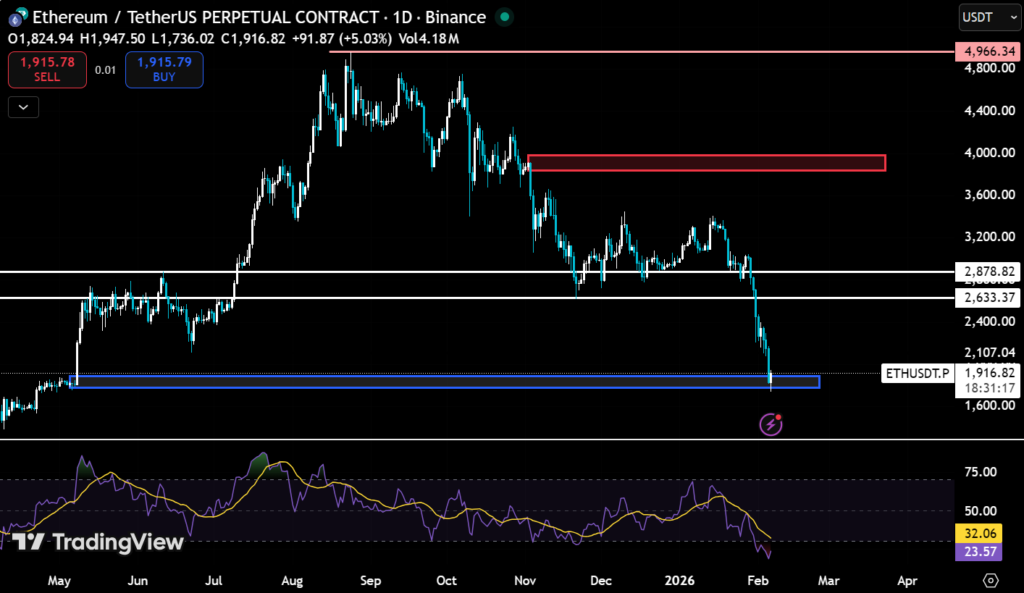
Ethereum started to fall again after failing to keep its momentum above $2,200. The decline sped up below $2,000 and $1,880, eventually reaching a local low near $1,744. The drop made the short-term structure much worse, putting ETH firmly in a corrective phase.
There has been a small rebound, with prices going back above $1,850 and testing early recovery levels. But the bounce seems more technical than a change in trend, and buyers still don’t seem very sure.
Resistance Cluster Limits Potential for Growth
Ethereum faces multiple resistance levels, meaning it will create a hurdle for all future recovery efforts. The price oscillates between two levels at $1,950 and $2,050, while the main obstacle remains at $2,200.
A clear break above this area would change people’s minds and open the way to higher resistance levels around $2,350 and maybe even the $2,550–$2,665 range. Until then, any upward moves are likely to be seen as short-term rallies in a larger downward trend.
Market Structure Remains Cautious
The most recent rise only goes back to a small part of the larger drop from the $2,341 swing high to the $1,744 low. The current price movement signifies that the tempo of the recovery remains slow and limited until macro conditions experience major changes. The market participants on the sell side continue to lead the market structure, particularly at a time when Ethereum is trading below its crucial moving averages and defined trend resistance levels. This market scenario dictates the short-lived nature of the upside retracement moves due to strong selling pressure. The result may only be short-term corrective rallies rather than a long-term reversal.
The $1,850 and $1,800 levels will likely serve as momentary support areas, which highlights the weakened structure of the digital asset. If Ethereum can’t stay above this range, the chances of testing the $1,750 level again go up. This scenario could also trigger a move toward deeper support zones close to $1,720 and $1,680. These lower levels would add to the bearish momentum, which means that the market is still in a corrective phase and that downward pressure could continue until there is more buying interest or a big reversal signal.
Open Interest Drops Sharply Amid Bearish Pressure
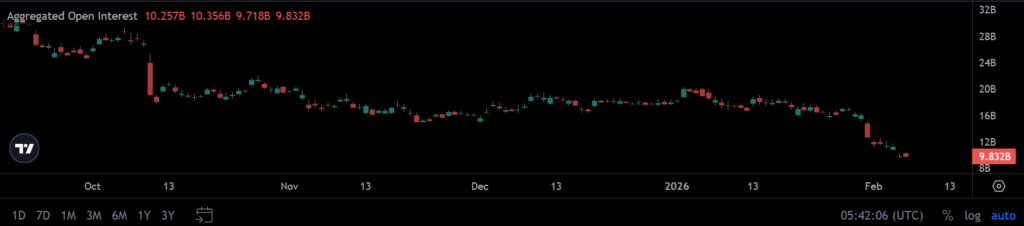
Ethereum’s futures open interest (OI) continues its downtrend, falling from over $30B to $23–26B, with 24-hour drops of -5% to -7%. This reduction in leverage aligns with the price breakdown below $2,000, as excessively leveraged longs are flushed out from the market. The decline indicate risk-off behavior and lower liquidation risk, usually prior to stabilization or relief bounces, yet short-term downside pressure may remain significant until bullish OI exhibit signs of recovery.
What’s Near-Term Outlook for Ethereum
Ethereum is at a crucial point right now. It could either stabilize and try to recover or keep going down. In the situation of the asset’s price hovering under the $2,200 price point, the broader market model implies cautious trading conditions followed up with support zones undergoing significant market stress and resistance overhead. This situation suggests short-term rallies to be limited and therefore likely to be rejected. Following this, it becomes important for the market participants to keep an eye out for possible moves down.
If this digital asset breaks above $2,200 in a significant directional way, it could mean that the market is changing, which could lead to new resistance levels and more users scaling in. On the other hand, if Ethereum doesn’t get back to this level, it will most likely persist in a trading range with a continuation of the downward trend in the near term, as sellers maintain their dominance and technical pressure stays strong. In this case, even small improvements may be seen as temporary or corrective, as the market waits for a stronger base before a real trend change can happen.


