





Ethereum, the second largest cryptocurrency by market cap, is changing hands near $2,070, with an intraday range of $2,058.00 to $2,092.39. The current volume of this digital asset is at $21.06 billion, with a drop of 37.7% in the past 24 hours, according to CoinMarketCap.
The number that actually matters right now is not the current price but the white band sitting directly above it: the Reclaim Zone at $2,075.02. Ethereum has spent the better part of four weeks attempting to hold and reclaim this level after one of the sharpest drops in its recent structure.
How ETH Got Here: A Drop That Changed the Structure
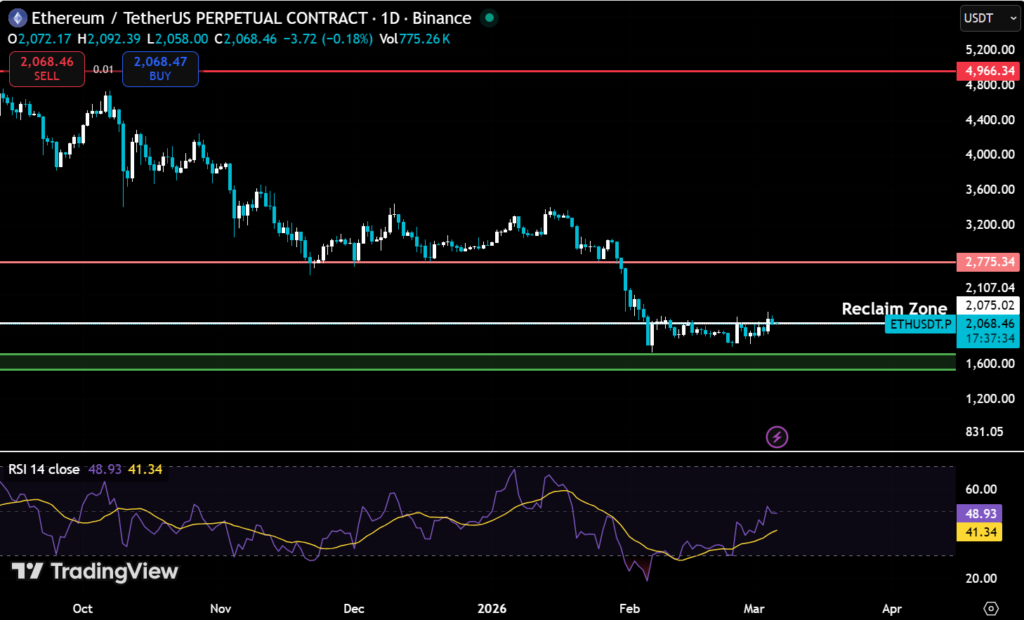
From October through late November 2025, Ethereum was trading in the $3,200 to $4,000 range. A sustained decline through December brought it below $3,000. The critical break came in late January 2026 when the price sliced through the $2,775.34 level with force. That pink horizontal line, now sitting more than $700 above the current price, was a significant support zone that held across multiple tests. Once it broke, the price dropped sharply toward the $1,700-$1,600 green support band before stabilizing around the $2,075 Reclaim Zone in early February.
That sequence matters because it tells you what this current consolidation actually is. This is not a base building after a subtle correction. It is a bounce attempt after a structural breakdown, taking place well below a former major support that has now flipped to resistance.
The Reclaim Zone
The Reclaim Zone marked on the chart centers around $2,075.02, with the current price at $2,068.46, sitting fractionally below it. The zone also aligns closely with the $2,107.04 level visible on the chart’s right-hand axis, suggesting the band of meaningful resistance extends from $2,075 up to approximately $2,107.
Ethereum has been oscillating through this zone since early February. The daily candles are short-bodied, volume is not expanding aggressively, and there has been no clean daily close well above $2,107. That is the problem with calling this a confirmed reclaim. Price is in the zone, but it has not yet closed above it convincingly on elevated volume.
A confirmed daily close above $2,107 opens the path toward $2,775.34, which is the next meaningful resistance from the former breakdown level. That is a potential 34% move from the current price, but it first requires clearing and holding a zone that has acted as a ceiling for four consecutive weeks.
On the downside, the $1,600 green support band is the next structural reference. That level appears as a broader horizontal zone on the chart and represents a roughly 22.6% drawdown from the current price. It is not a nearby risk but it is the level that defines the lower boundary of the current macro range.
RSI: What Does it Signify?
The RSI panel is showing two lines: the RSI itself at 48.93 (purple) and what appears to be a signal or smoothed average at 41.34 (yellow). The purple line has crossed above the yellow line and is moving upward toward the 50 midpoint.
This is a classic signal of momentum recoveryf the broader chart. RSI reached deeply oversold territory in early February, printing below 20 based on the chart’s visual depth during the capitulation low. The subsequent recovery from those levels to the current 48.93 reading represents a significant momentum rebuilding cycle. Critically, the purple line has not yet crossed above 50. Until it does, the daily momentum remains technically in bearish territory even as it recovers.
The yellow signal line at 41.34 lagging well behind the faster RSI line confirms that the recovery is real and not a noise blip. The gap between the two lines (7.59 points) reflects sustained buying pressure over the past several weeks, not a one-day spike.
The RSI cross from below is a credible early signal. It is not a confirmation of a new uptrend. It is confirmation that the worst of the selling pressure, at least for this cycle, has passed.
The Macro Resistance Problem: $2,775 and $4,966
Two resistance levels dominate the larger picture. The pink line at $2,775.34 is the more immediate target and the more instructive data point. This was a support level that held from at least November through January before breaking. Recaptured supports often require significant time and volume to flip back bullish, and the current price is 34% below that line.
Above that sits the major red resistance at $4,966.34. That level appears to correspond with a prior range high or significant structural peak from the October period. At the momentary price, that level is 140% away. It is not relevant to short- or medium-term positioning, but it defines the full macro recovery picture.
The structure between $2,068 and $2,775 is effectively dead air, characterized by the rapid waterfall decline through that zone in late January. Markets tend to move quickly through zones where price previously fell fast, because there is minimal horizontal volume built up at those levels to provide natural resistance. That is a two-edged point: it means recovery to $2,775 could happen faster than expected if buyers return, but it also means there is little structural support to slow a breakdown if the Reclaim Zone fails.
Derivatives Context: Small Positive Funding, No Conviction Either Way
The broader derivatives data shows perpetuals open interest near $399.85 billion with a funding rate of +0.00397%, almost perfectly flat. The market is not leaning aggressively long or short in size. Combined with the compressed daily volume on the chart (775.26K on a 1D bar, with no visible volume surge), this is a market in wait mode.
Low funding with rising RSI and price consolidating near a key level is a setup where the next directional move, whichever way it breaks, tends to see rapid positioning additions. The absence of conviction now amplifies the move that comes next.
What Traders Should Watch
The daily close is the only timeframe that matters at this Reclaim Zone. Intraday wicks above $2,107 are noise. A closing candle above $2,107 with volume expansion above recent daily averages is the trigger for the next phase of the setup.
Below $2,058 (today’s daily low at the time of writing) on a closing basis puts the price back below the Reclaim Zone floor and reopens the $1,955 Fibonacci level identified from the CMC data, and below that, the $1,748 swing low. The $1,600 support band on the chart is the structural backstop if those intermediate levels fail.
The 48-72 hour window is critical. The RSI cross is in progress, the price is at the zone, and derivatives are sitting flat. Something will resolve this consolidation, and the chart’s structure means the resolution will likely be sharp in whichever direction it breaks.


