





Ethereum continues its bearish trend and is changing hands at $1,821 at the time of writing. This is about 25% lower than its opening price of $2,449. This decline puts the asset in a bad place below major resistance levels and continues a pattern of weakness that reminds me of the hard bear market of 2018.
Current Price Action and Immediate Setup
Ethereum couldn’t hold the $1,900 level after a short attempt to stabilize after falling from highs near $1,995. The price fell to a recent low of $1,811 before making a small recovery that stopped just below the 23.6% Fibonacci retracement of the most recent leg down. It is now below the 100-hour SMA (simple moving average) and continues to drop off, marking resistance at $1,920.
Momentum indicators make the bearish bias stronger. The short-term (hourly) RSI is under 30 and is now progressing in the oversold region. It could trigger a small bounce for this digital asset.
Considering the monthly picture, metrics like Bull Bear Power (BBP 13) display a reading of -1,559, reflecting strong bear dominance, as the indicator measures the gap between price extremes and a moving average consensus, with negative values showing sellers pushing lows farther from fair value than buyers can lift highs.
Monthly Streak in the Past
The month-long time frame has a lot of historical meaning. During the post-ICO collapse, which lasted from March to November 2018, Ethereum had seven straight months of red closes. During this time, the asset lost more than 90% of its all-time high as narratives and liquidity dried up.
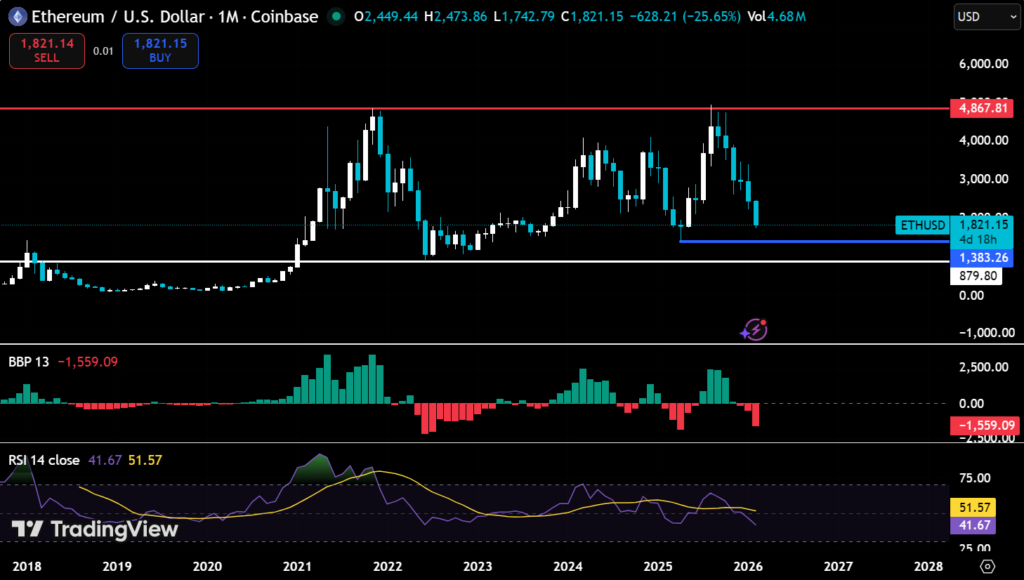
Fast forward to the current cycle. Ethereum has already had nine negative months in 2025, making it the worst year since the bear market in 2018. If February 2026 ends in the red, it will be the sixth month in a row. This progression is not the same in terms of severity, since today’s ecosystem is more developed and has live layer-2 scaling, institutional ETF exposure, and a larger DeFi infrastructure. However, the persistence of red candles is unusual. This trend suggests that macro and sentiment factors are more important than fundamentals right now.
More Information: Compression Between Eras
The difference between this drawdown and a simple repeat of 2018 lies in the infrastructure. Ethereum didn’t have much real use back then, other than speculative ICOs, and the bear market wiped out almost everything. The network processes billions of dollars in transactions every month, has active developer communities, and benefits from staking yields that help some holders. Even with these improvements, the price won’t separate from the larger risk-off flows. The disconnect is probably because of macro rotations, ETF outflows in the past few months, or people taking profits after the volatile swings of 2025, which saw peaks near $5,000 before sharp reversals.
This disconnect makes the setup tighter. Long periods of downward pressure without a fundamental collapse often come before sharp reversals when a catalyst appears, as has happened in past cycles after similar multi-month red streaks. If the price doesn’t get back to $1,900 soon, it could lead to more selling, which could push the price down to deeper support levels and test whether this cycle can avoid lasting as long as the one in 2018.
Important Levels to Watch
The first level of resistance is $1,870, and the second level is the important $1,900 area, which is where the 50% Fibonacci retracement from the $1,995 high to the $1,811 low meets. If the price goes above $1,920, it will break the downward trend line and make it possible for the price to go up to $1,965 and maybe even $2,000 or more in a relief rally.
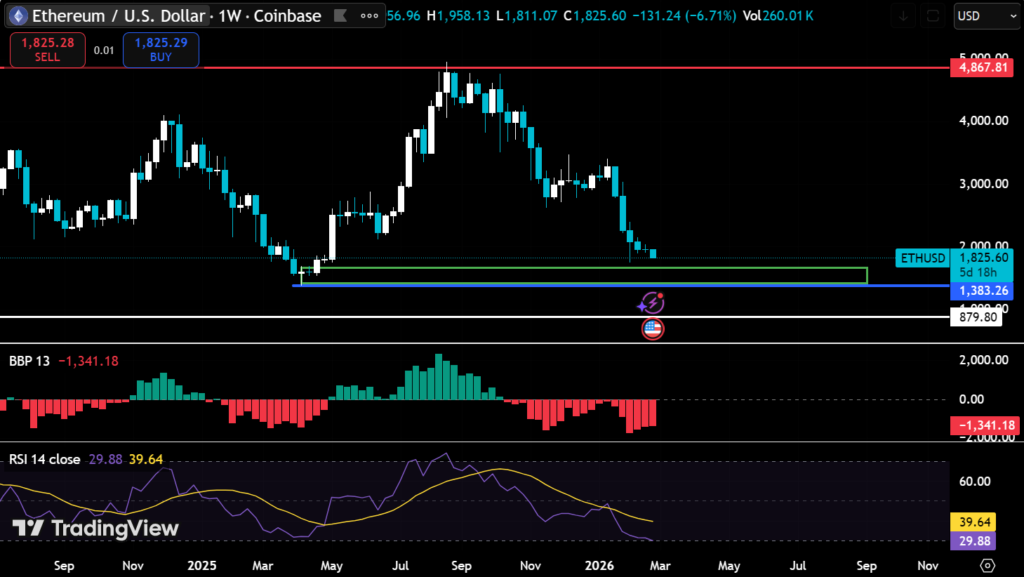
The first real support band is between $1,820 and $1,835 on the downside. In the case of this digital asset dropping below $1820, it may open room for more downside followed by high selling pressure, making its next stops near $1,780 and then $1,740, with $1,720 acting as a psychological floor. The monthly chart shows a volume of 4.68 million, which means that people are still participating, but since there is no bullish divergence in the indicators, the downside conviction is still stronger for now.
What This Means for Traders and Investors
Traders who work on shorter timeframes should respect the bearish structure below $1,900 and prefer fades or shorts with tight stops above $1,920 to keep their risk low. Position sizing needs to take into account the spikes in volatility that happen a lot during these consolidation phases. A clean break higher would quickly change the momentum, especially since there is a growing historical story around the streak.
Long-term investors are in a familiar situation: capitulation phases like this one have historically been good times to scale in once the streak breaks. If macro conditions stabilize, prices below $1,820 could be a favorable deal. But the six-month red risk means that the market participants should be careful and build up their position slowly instead of going all in. The fundamentals are still there, but the price action determines when to act.
Ethereum is at a crucial point right now. If it can get back to $1,900, it could stop the monthly drop and boost confidence. If February closes in the red, the losing streak will get closer to the record set in 2018. Such an outcome will make people question whether the current strength of the infrastructure is enough to stop the losses from getting worse or if more pain is coming before any real change happens.


