





Ethereum is the second largest crypto asset by market cap, and right now it is behaving like one that has lost its narrative. At $246.33 billion in market cap and 10.51% dominance, ETH is sitting at a fraction of Bitcoin’s 58.30% share of the total $2.35 trillion crypto market. That gap is not new, but it has widened meaningfully over the past year. Investors who allocated to ETH over BTC in that window are sitting on a -31.98% year-to-date return against Bitcoin’s more contained drawdown. The 90-day number is -31.06% and the 60-day is -32.12%. That is a sustained repricing of how the market values Ethereum relative to its alternatives.
The 24-hour volume of $15.14 billion is active enough to confirm ETH still commands institutional attention. But volume without directional commitment is just churn, and that is largely what the past several weeks have produced.
The Current Structure
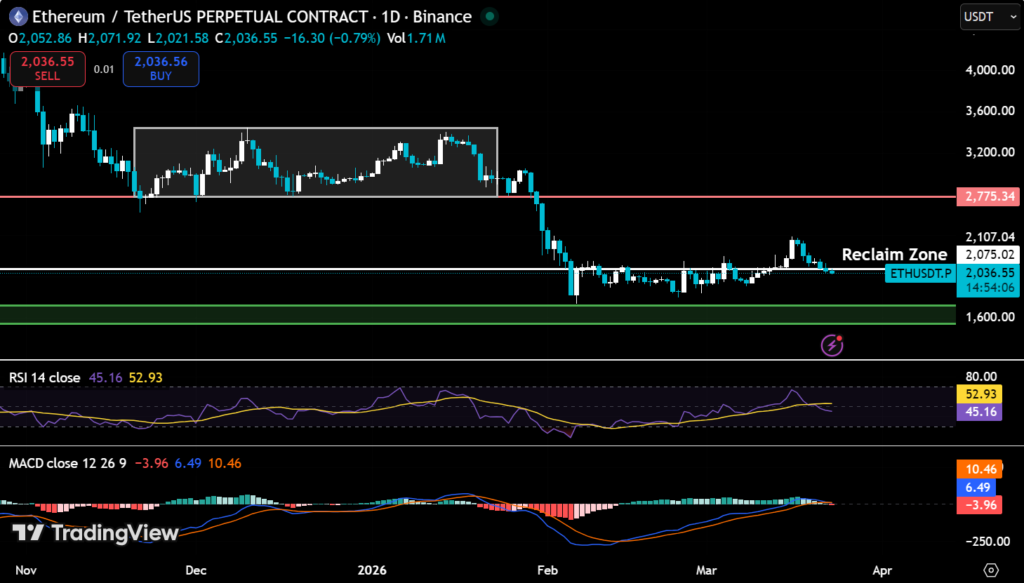
For roughly three months, from November through late January, ETH built a consolidation range between approximately $3,000 and $3,400. That range was not sloppy sideways action. It was a structured base that the market spent significant time establishing. When it broke, it dropped through multiple support levels across a handful of sessions, eventually finding a floor near the $1,600 zone visible as the green band on the chart.
Price climbed from the $1,600 flush low back to $2,036, landing squarely inside the zone the chart labels as the Reclaim Zone, bounded between $2,036 and $2,107. This zone sits below the prior consolidation base, below every meaningful moving average, and well below the red resistance line at $2,775.34 that now marks the ceiling of the old broken range. ETH has covered ground since February, and additionally this digital asset has not restored structure. There is a difference between the two, and that difference is exactly what the next few daily closes will clarify.
What do the indicators highlight?
The daily RSI now stands at 45.16, below the neutral 50 line. The short RSI signal sits at 52.93, marginally above neutral. That split is worth understanding correctly. It does not signal a bullish divergence brewing. What it reflects is a market where short-duration bounces are possible, even likely, without the primary trend bias having shifted. For RSI to matter on the upside, it needs to cross 50 and hold there across multiple daily closes.
The MACD sits at +6.49 and the signal line at -3.96, with the histogram printing +10.46 and expanding over consecutive bars. Critically, both lines have crossed into positive territory. Compare that to Bitcoin’s current MACD, where both lines are still deep in negative territory at -166.8 and -223.7, respectively. ETH’s momentum recovery is structurally more advanced and does not mean ETH is a stronger asset right now. It means the internal momentum mechanics have done more repair work, and if price can hold the reclaim zone, the MACD expansion gives that hold more credibility than chart structure alone would provide.
The moving average picture is straightforward and uniformly bearish. The SMA7 currently stands at $2,183, the SMA30 at $2,048, and the 200-day SMA at $3,159. There is no moving average providing dynamic support or acting as a tailwind. They are a stacked sequence of overhead resistance that ETH would need to work through for any meaningful recovery.
Key Levels
The 61.8% Fibonacci retracement of the $1,804 to $2,384 swing lands at $2,025.81, eleven dollars below the current close. That proximity is not coincidental. Price is resting directly on top of this level, which makes the next daily close particularly significant. The daily pivot at $2,068 is above the current price, which keeps the intraday session bias mildly bearish. The base of the Reclaim Zone at $2,075 is the level a daily close needs to clear to shift the short-term narrative. Above that, the 50% Fibonacci at $2,094 and the upper Reclaim Zone boundary at $2,107 form a tight resistance cluster. The 38.2% retracement at $2,162 is the next meaningful target beyond that cluster.
On the downside, a daily close below $2,025 would change the conversation entirely. It flips the 61.8% Fibonacci from support to resistance and removes the technical floor that the current recovery is resting on. From there, $1,800 to $1,900 is the next logical support destination, with the $1,600 structural base as the floor below that.
The Tradeoff
The upside case is not complicated. A daily close above $2,075 with expanding volume and a continuing MACD histogram build gives the Reclaim Zone legitimate standing as a base. The social sentiment data, rated at 4.73 out of 10, suggests discussions about whale accumulation activity on the bullish side.
The bearish social posts flagging exploit-driven selling and liquidation risk are not background noise. Options positioning with elevated put premiums implies that advanced participants are hedging against a sharper move lower, not just routine volatility. A macro shock, rising yields, or a geopolitical risk-off move would possibly compress the timeline on the downside scenario considerably. Losing $2,025 on a close would be a sudden drop and according to the positioning data, it would likely accelerate.
Conclusion
Ethereum is at a technically credible recovery point with one genuinely constructive signal in the MACD, one critical floor at $2,025, and one confirmation level at $2,075 that the market has not yet delivered. The structure of the breakdown, the distance of every moving average overhead, and an RSI-14 stuck below 50 all argue for patience. The MACD expansion argues for attention.
Those two things are not in conflict. They are telling the same story from different angles: the conditions for a recovery attempt exist, but the confirmation does not. A daily close above $2,075 changes the short-term playbook. Everything before that close is the market deciding, not signaling.


