





Arbitrum saw a sharp gain of 11.09% in the past 24 hours. At the time of writing, the asset is changing hands at $0.1112. The highest point of the session was $0.1130, and the lowest point was $0.0992. Trading volume shot up to $184.2M, making a jump of 23.3% (24 hours).
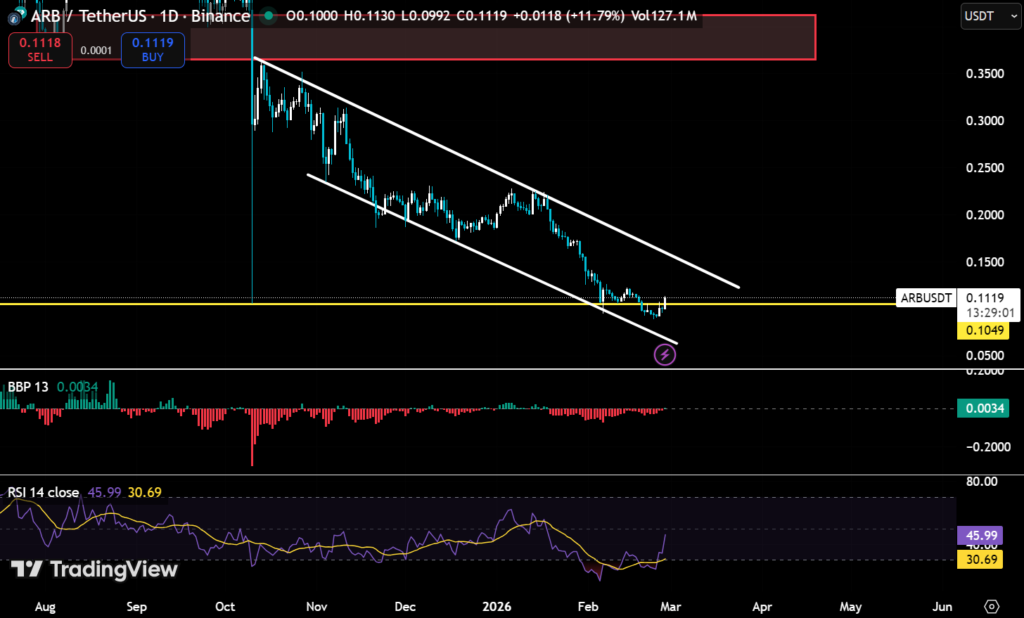
This move is important because it comes after a decisive close above the multi-month descending channel that has kept prices down since late 2025. The trendline channel that goes down and has been tested as resistance during failed rallies is no longer holding back the upside. On a daily close basis, the asset’s price is showing some strength.
The Downtrend’s Background
For more than a year, Arbitrum has been in a bearish trend, dropping from levels of about $0.35–$0.40 in late 2025 to the $0.10 region. The token is about 95% below its cycle high of $2.42, which it recorded earlier in the cycle. Long drawdowns like this kind often lead to exhaustion phases, when selling pressure eases off. However, the current situation goes beyond just stabilization.
The chart shows a pattern of lower highs and lower lows until this session’s vertical impulse. The previous candles repeatedly tested the channel floor, creating long lower wicks that indicated demand was coming in at the extremes. The most recent candle, on the other hand, expands up instead of sideways.
Important Technical Metrics from the Session
The RSI’s quick recovery, from below 31 to the mid-40s in one session, is noteworthy. Slow rises in momentum indicators often come before failed bounces during long downtrends. Here, the quick change and price-breaking structure suggest that buyers are not just defending but also actively overpowering leftover sellers.
What the Channel Break Really Means
When altcoins go down, they often trap people on both sides. During rallies, sellers protect the upper boundary, and buyers build up near the lower rail. When the price finally closes above the upper trendline after failing to do so many times, it usually means that sellers are out of steam at those levels. Late shorts who got in after previous rejections may now have to cover their positions.
The data shows that the breakout is not happening from a classic rounded bottom or a long base, but directly from the channel’s lower boundary after a capitulation wick lower (which can be seen in earlier sessions). The impulse has broken the bearish structure faster than usual accumulation patterns would suggest. The chart shows volatility compressing and then releasing upward in one big candle, rather than weeks of sideways grind before expansion. This means that there is a chance of a fakeout, but the combination of volume confirmation and RSI snap-back makes it less likely that the trade will be rejected right away.
What this means for traders and investors
For spot holders and swing traders, the close at $0.1112 puts the price in a better structural position. The downside is now being held back by the recent low of $0.0992 and the previous demand area near $0.10.
In the case of price sustaining above the crucial zone of $0.1049, it would confirm the market structure change with the deviation setup below the marked yellow zone. If the momentum continues with sustained volume, it may open up targets toward the previous swing highs, like the $0.15–$0.20 where the channel initially started to form.
It is still clear that invalidation is in effect. If the price stays below $0.0992–$0.10 for a long time, it would mean that the breakout was just a way for weak hands to get out of the market, not a real shift in demand. This would open up the risk of deeper lows near $0.06–$0.09.
The uneven setup makes it better to be careful about shorts at these levels. With the descending channel now invalidated and momentum indicators turning upward, downside conviction is weakening while upside confidence is building. Traders looking for continuation should monitor whether upcoming sessions establish higher lows and maintain above-average volume, as these factors would confirm sustained bullish follow-through.
A Look Ahead
If the overall market mood stays neutral to positive and ARB holds the new breakout level over the next few days, the structure could change from channel invalidation to the beginning of a higher-low formation. This would mean a change in the regime from a steady decline to a possible range-building or trend reversal. The data right now suggests that this is more than just a normal oversold bounce.


