





Hyperliquid is currently trading close to $29.3 on the daily timeframe. It is holding above the strong higher-timeframe support level near $20–$22 and a major resistance zone of $48–$50. The overall structure is still bearish, since the price has been making lower highs and lower lows since it peaked around $50.
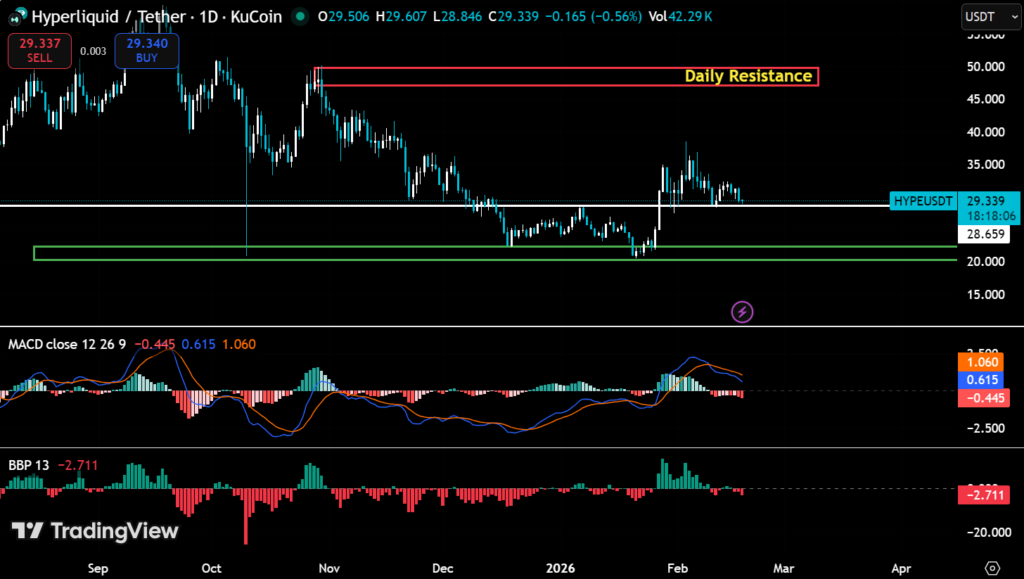
The rejection from the $50 area started a phase of price drops. Since then, every time the market has tried to rally, it has failed to reach previous swing highs. This pattern shows that there is still selling pressure and distribution at higher levels. This scenario means that the macro trend is bearish until positive on-chain metrics undergo significant change.
The sharp, impulsive bounce off the $20–$21 support, on the other hand, opens up the possibility of a transitional phase. How price reacts at current resistance will determine whether this move turns into early accumulation or stays a corrective rally in a downtrend.
Significant Resistance & Support Area
The price is now holding steady below the $30–$32 range, with the important short-term level of $28.6. This is a classic support-to-resistance flip from a structural perspective. Before deciding whether to continue or reverse, markets often test breakdown levels again. The daily closing levels will decide the digital asset’s next move. If the price stays above $32 on strong daily closes, it would show strength and make it more likely that the price will continue toward the $35–$38 liquidity area. If this zone doesn’t break, it will show that sellers are still defending the previous structure, which makes it more likely that the price will move back toward the range low.
The market reaction is key, as it will demonstrate whether the recent trend was solely short covering or if there is growing accumulation in the backend.
A lot of demand sits in the horizontal zone of $20 to $22, making it a crucial support area. The recent growth came from this area, which suggests that a lot of liquidity was absorbed there. As long as the price stays above $23 at the end of the day, the chance of making a higher low structure stays open. If the price drops below $20, it would invalidate the short-term bullish case and probably start another drop, continuing the macro downtrend.
This level is the most important point for invalidating the structure.
MACD Analysis of Momentum
The MACD indicator shows a mixed to slightly bearish short-term trend with some recovery signs. The MACD line (blue) currently sits at 0.615 and remains above the signal line (orange) at roughly 1.060, producing a positive MACD histogram (teal bars above zero), which indicates that bullish momentum is still present but weakening. However, both lines have rolled over from higher levels and are trending downward overall, although the histogram has shrunk significantly from earlier peaks, suggesting fading upward momentum and a potential bearish crossover forming soon if the MACD line drops below the signal line. Price action is likely in a corrective or consolidation phase after a prior decline, with the indicator hovering close to (but still above) the zero level.
Bear and Bull Power (BBP)
The BBP indicator showed strong positive readings as the price moved away from $20, which meant that there was a lot of buying pressure. The indicator has recently gone back into the negative range, which means that sellers are coming back into the market near resistance.
When bullish pressure goes away at resistance, markets usually either hold steady before breaking out or go back in the range. The fact that there hasn’t been any sustained positive growth suggests that buyers don’t yet have full control of the structure.
For a breakout to happen, the green BBP readings would have to go back up to strong levels.
Market Behavior and Liquidity
According to the market structure, the major liquidity zones stand below the equal lows, close to $20, and the swing high zone is around $38–$40. Markets usually move from one pool of liquidity to another. The current range between $21 support and $32 resistance shows that energy is building for a bigger move in one direction.
If the price doesn’t break through resistance, a sweep of liquidity toward the $20 area becomes more likely. If the price of the asset rises to $32 with significant volume, it can touch its recent high of $38, where additional supply may get triggered.
The market is basically coiling between two clear horizontal lines.
A Look at the Market Cycle
From a market cycle perspective, Hyperliquid seems to be moving from markdown to either early accumulation or redistribution. The sharp bounce shows that there is demand at lower prices, but real accumulation needs higher lows and breaks for important lower highs. For the macro trend to turn bullish, the price needs to get back above the $48–$50 range and stay there. Until that happens, rallies are still technically corrective within a larger bearish framework.
For a confirmed move into expansion, there would need to be higher highs over the daily timeframe, with volume and momentum continuing to rise.
Looking Ahead Based on Structure
If the price breaks through and stays above $32, it is likely that it will keep going up to $35–$38. If it stays strong beyond that zone, the medium-term bias would shift toward recovery. The price needs to stay above $28, considering a drop through this support level will increase the probability of retesting both $22 and $20. The market will likely signal a macro downtrend when it closes below $20 on a daily basis since such a pattern invalidates the higher low structure, which is currently developing.


