




Hyperliquid’s native token is sitting 47% below its all-time high. Its platform just recorded all-time high trading volume and all-time high transaction fees. The protocol is approaching $1 billion in cumulative revenue. That gap is not a contradiction; it is the trade.
Where the Price Actually Stands
HYPE hit its all-time high of $59.30 on September 18, 2025, as per the data from coinmarketcap. What followed was a sustained correction that brought the token down to a cycle low near $21 before a partial recovery pushed it back toward the $38 zone in early February 2026. That rally failed. Price has since pulled back to close to $31, sitting roughly 30% below the February high and consolidating inside a falling wedge that has been tightening since late 2025.
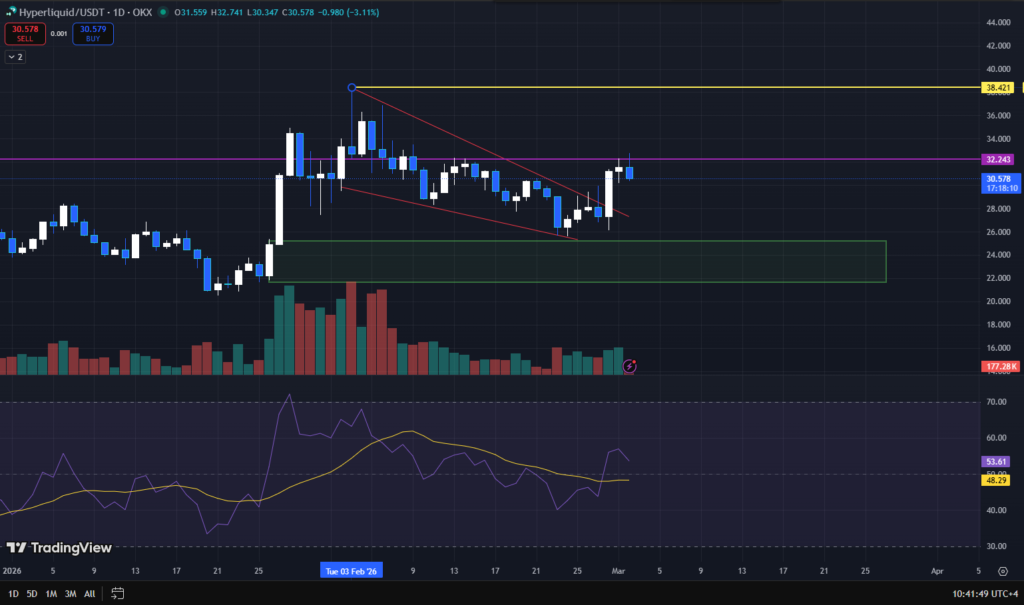
The wedge tells the near-term story. The upper boundary, currently acting as dynamic resistance, sits around $32. A daily close above that level is the first technical requirement for any meaningful recovery. If that happens, $44 becomes the next logical target, with the February high of $38 acting as an intermediate test. Rejection at $32 puts the $21 support back in focus, and a failure there opens a path toward $18.
The daily RSI is sitting near 53, which is technically the neutral zone for the asset. The first major uptrend resistance sits at $32.24, and bottom support is at $25.2-$21.7. A close below this crucial support zone before $32 is reclaimed would be a structural deterioration signal worth watching.
Protocol Metrics Are at All-Time Highs Across the Board
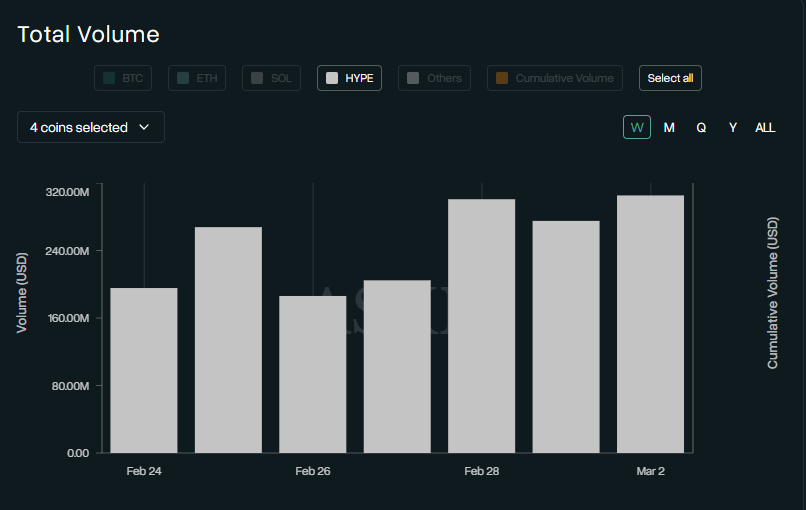
While the token went into a correction phase, the operation behind it did not slow. The total volume on Hyperliquid currently stands at $305.28 million. According to the data from hyperevmscan, HyperEVM total transaction fees have surpassed 335,329. Following the metric, the highest number of 735,541 transactions was on Tuesday, November 4, 2025. Cumulative platform revenue is approaching $905 million, with annualized revenue sitting at $833.1 million based on current fee run rates.
In the past 24 hours alone, the protocol recorded average daily network fees with a value of $26.74K. The other relative metrics, like Average Transaction Count and Daily Token Burn, stand at 327.54K and
$23.30K, respectively.
On the exchange side, Hyperliquid’s futures arm is reporting a 24-hour trading volume of $5.4 billion (-16.4%) with open interest at $5.5 billion, according to CoinGecko data. The platform currently lists 302 trading pairs. The most active single pair, BTC/USD, printed $2.1 billion in 24-hour volume. The user growth number adds context to the volume. Hyperliquid transacting users now stand at 56.8K, as per Artemis, a blockchain analytics platform.
The Buyback Math and Why It Matters Now
At $9.22 million in HYPE burned over the past seven days, the annualized buyback rate at current fee levels runs well above $400 million per year. Total supply is capped at 1 billion tokens. Circulating supply stands at approximately 405.4 million HYPE, with a further 205.7 million locked under vesting. That means the buyback mechanism is working against a circulating supply that is itself being gradually expanded by unlocks.
Which brings us to March 6, which is set to experience 9.92 million HYPE tokens unlock, valued at approximately $316.64 million at current prices, which will unlock for core contributors. This is roughly 2.72% of the released supply and represents the monthly tranche in a structured vesting schedule running through 2027 or 2028. The unlock was already on the market’s radar. HYPE is trading approximately 2.12% down today, followed by the high volatility of Bitcoin, which fell back to $66,700, and broader crypto declined.
The market’s interpretation appears to be that net circulating supply will not expand meaningfully. Historical unlock tranches have often resulted in smaller-than-projected actual releases, and the $9.22 million in weekly burns provides real offset to the incoming supply. Whether that offset is sufficient depends on how much of the unlocked allocation is sold versus held or re-staked.
The Competitive Picture
Hyperliquid’s position as the leading perpetual DEX by volume did not come by accident, and it is not going unchallenged. The platform leads all decentralized perpetual exchanges with $35.4 billion in weekly trading volume, ahead of Lighter at $17.0 billion and Aster at $16.4 billion. Both competitors have grown meaningfully. Aster now holds over $1.0 billion in TVL and offers up to 1001x leverage with 24/7 stock perpetuals, while Lighter has built a reputation for low-latency execution.
What Hyperliquid still holds that competitors do not is depth. The platform supports up to 200,000 orders per second with latency near 0.2 seconds and 99.99% uptime. Its fee model that doesn’t require gas fees and a full on-chain order book makes it structurally differentiated from both centralized exchanges and rival DEXs. That infrastructure gap is what keeps traders from migrating despite the competitive pressure on market share.


