





Keeta (KTA) posted one of its strongest single-session moves in recent months, printing a 38.34% gain that pushed the asset from deeply oversold territory back toward a technically significant resistance cluster. The move took place, followed by decent volume, then structure shifted, and momentum indicators confirmed the move had substance. But substance in a single session is not a trend, and the chart tells a more measured story than the price tag suggests.
Where Price Is Coming From
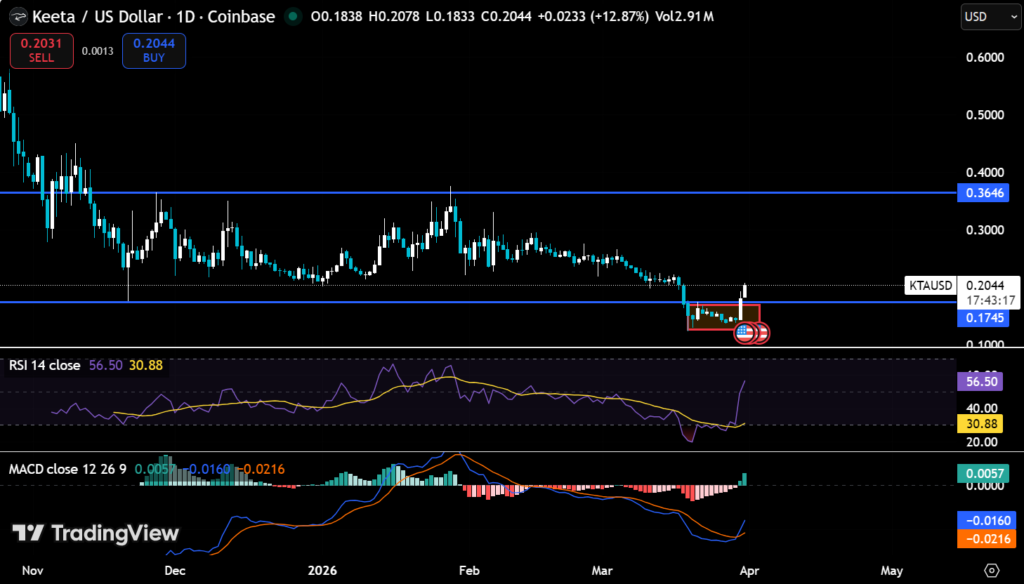
The daily chart on Coinbase shows KTA had been grinding lower since early November 2025, forming a prolonged descending structure that eventually saw the asset compress into a tight consolidation range just above the $0.1745 support level visible on the chart. That compression, marked by a cluster of red candles in the March-to-April period, preceded the breakout candle that now defines the current session.
Before this move, KTA was sitting on 60-day losses of -30.00% and 30-day losses of -19.30%. The asset had bled from an all-time high of $1.69 to a range barely above its all-time low of $0.08, representing an 87.92% peak-to-trough drawdown. The current price of $0.2044 is not a recovery story yet. It is the first credible technical signal that the selling pressure may be exhausting.
What the Indicators Are Actually Saying
RSI: The RSI on the daily chart has moved to 56.50, confirming momentum without signaling overbought conditions. During the prior consolidation phase, RSI had compressed deep into oversold territory before this session’s recovery. The distance traveled in momentum terms provides context for the 56.50 reading. It is not an arbitrary number printed mid-range. It is a recovery from exhaustion.
MACD: The MACD line (blue) sits at -0.0160 and the signal line (red) at -0.0216, with the histogram (green) now printing positive at +0.0057 in the current session. For weeks prior, the histogram was firmly negative and deepening. The blue MACD line crossing above the red signal line, confirmed by the histogram flipping green, is an early-stage momentum crossover. It is not confirmation of a sustained trend, but it is the first structural change the MACD has shown since the prolonged downtrend began.
Moving Averages: SMA 7 is at $0.15, SMA 30 at $0.20, and SMA 200 at $0.35. Price at $0.2044 has cleared the SMA 30 in this session, which is notable. The SMA 200 at $0.35, however, represents a 71% premium to the current price, framing just how much technical overhead remains even if short-term momentum continues.
The Fibonacci Cluster That Matters
The swing structure from the recent low of $0.12554 to the swing high of $0.26232 generates a Fibonacci retracement map that places the most critical decision zone between $0.1939 (50% retracement) and $0.2101 (38.2% retracement). The current price at $0.2044 is trading directly inside this zone.
This is where the article’s central question sits. A sustained close above $0.2101 would confirm that the 38.2% level has flipped from resistance to support, opening a path toward the 23.6% level at $0.2300. Failure to hold $0.1939 on any pullback would indicate the session’s move was absorption of supply rather than genuine demand entering the structure.
The daily pivot point at $0.17226 now sits well below the current price, providing a reference: any retest of that level would represent a full give-back of the breakout and would invalidate the short-term bullish reading across all indicators.
Volume Confirms Participation, But Context Is Required
24-hour volume came in at $6.29 million, a 295.75% surge versus the prior period. Seven-day cumulative volume stands at $43.35 million. The turnover ratio of 0.05997 reflects that, relative to market cap, daily turnover remains modest even with the spike, meaning this is not a fully liquid, deep-order-book asset.
A 295.75% volume surge on a sub-$105 million market cap asset warrants scrutiny before it warrants confidence. KTA’s order book depth on most venues is thin enough that a single large participant can move both price and volume metrics significantly in one session. The spike is real, the candle is real, but neither confirms the source of demand. Traders entering on the back of this move should treat exit liquidity as a primary risk variable, not an afterthought.
Structural Risk Factors That Do Not Disappear on Green Days
Two structural risks remain regardless of short-term price action. First, only 512.93 million of the 1 billion maximum supply is currently circulating, meaning roughly 48.7% of total supply remains outside the market. No upcoming unlocks are listed in available data, but the gap between circulating and total supply is a long-term overhang that any sustained rally will eventually have to absorb.
Second, KTA currently has zero publicly listed audit reports. For a Layer 1 protocol built on Base, the absence of a public audit increases smart contract and protocol risk in a way that a strong price day does not offset. That is not a disqualifier, but it is a risk factor that should be reflected in position sizing.
What the Next 48–72 Hours Will Clarify
Three things will determine whether this move has follow-through or fades:
Price needs to hold above the $0.1939 Fibonacci 50% level on any intraday retest. A clean reclaim of $0.2101 on a closing basis would shift the technical picture further in favor of continuation toward $0.2300. The MACD histogram needs to remain positive across the next one to two daily closes, confirming the momentum shift is not a single-session event. RSI on the daily time frame crossing and sustaining above 60 would add further confirmation that medium-term momentum has rotated.
A rejection at current levels combined with a return to a negative MACD histogram would bring the $0.1745 support level back into play as the range’s lower boundary.


