





The ever-growing crypto space is still under a lot of pressure. The Fear and Greed Index is at 11, which is a level that has historically been linked to capitulation phases. Most large-cap assets are experiencing a downside in this risk-off environment. Bitcoin is exchanging hands close to $67,360, down 3.29% in the past 24 hours, with Ethereum at $1975 (-3.86%).
Monero has increased its value by 3% during the past 24-hour period to reach a price of $344.73. The deviation from the broader market shows a shift in relative strength, which indicates that investors will seek privacy-focused assets during times of uncertainty.
Where The Asset Stands In The Bigger Crypto Market
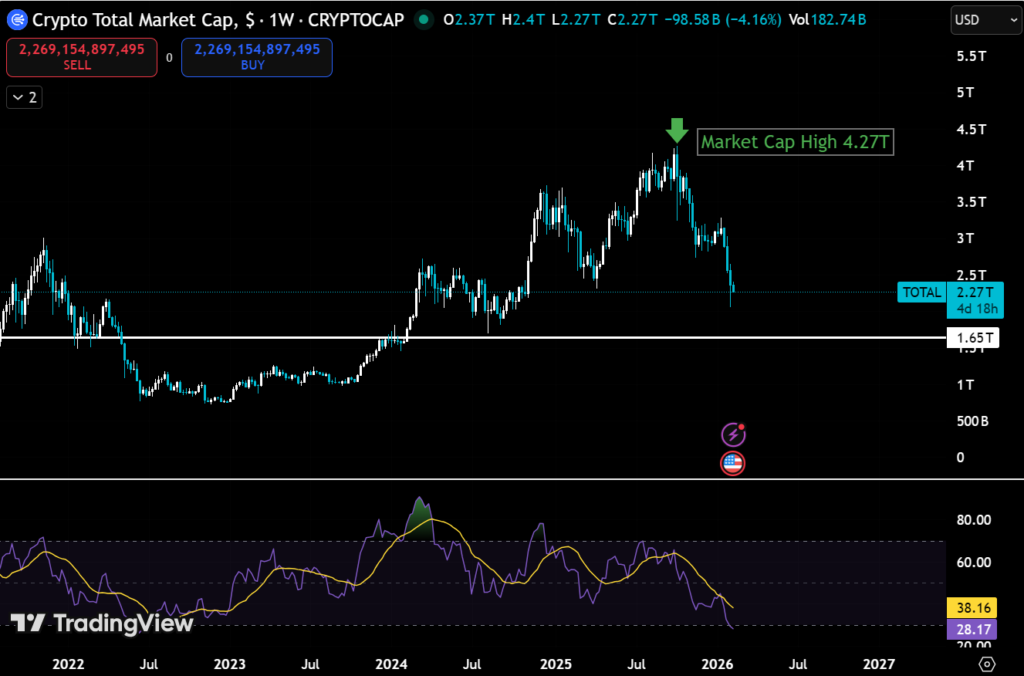
Monero’s current market cap stands at $6.34B, which is close to 0.28% of the total crypto market cap of 2.27 trillion. This means that it is in a niche position compared to major assets, but it also means that it can move more quickly when sentiment changes. In the past, there have been times of extreme fear in crypto cycles, like in 2018 and 2022, before strong rebounds in some altcoins.
In this case, technical analysis is important to find out if Monero’s current move is the start of a trend reversal or just a short-term response to being too sold off.
Momentum indicators show a positive neutrality.
The daily Relative Strength Index (RSI) for the privacy leader, Monero, stands at 28.17. This level puts the asset in an oversold position. arising chances for a rebound. Bitcoin’s RSI is closer to 30, which means that the momentum is weaker. On the other hand, Ethereum’s MACD shows bearish divergence, which means that there is still a risk of going down. Monero’s lack of negative divergence makes it more stable and may draw short-term flows from weaker assets.
Volume Trends Point to Accumulation
The current trading activity of Monero has increased since its price has recently risen, which indicates that the price movement has strong momentum. The market experiences actual demand from buyers when prices rise; therefore, it leads to higher trading volume, which has seen a rise of 6.8% in the past 24 hours.
Monero’s average daily trading volume has been around $100 million, based on historical data. Current levels seem to be much higher, maybe 20–30% higher than the baseline. This pattern fits better with accumulation than with distribution. At the same time, the price of Bitcoin has been going down, but the volume hasn’t experienced significant change, which shows that neither buyers nor sellers are scaling into major positions.
Moving Average Structure
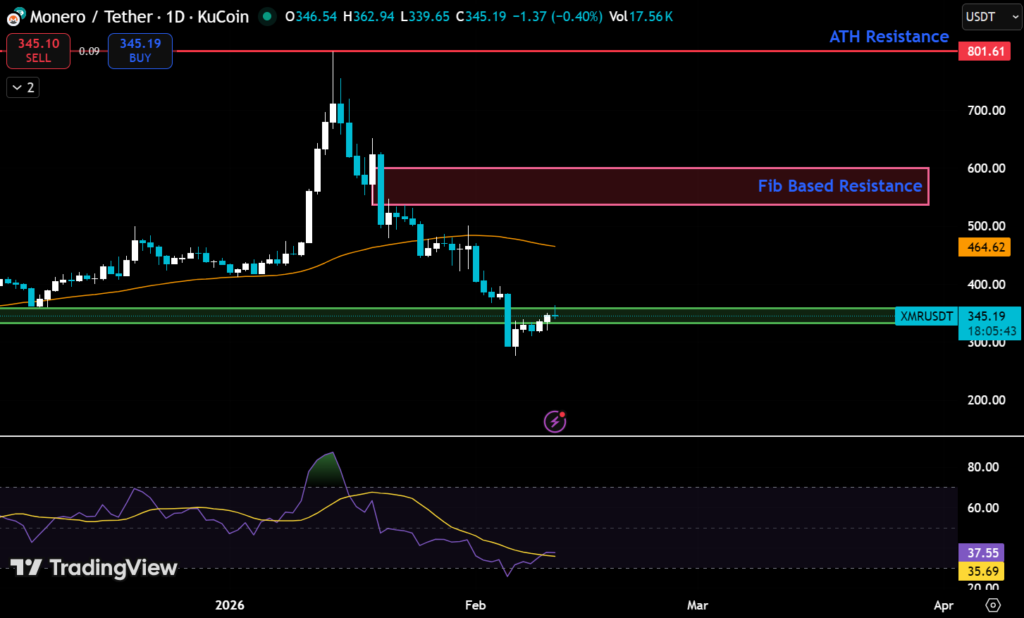
Monero has recently tested its 50-day simple moving average but failed to hold above it. The current value of the 50 EMA of the asset is at 464.62. This technical change often marks a bearish phase, especially when volume is rising. To flip it to a bullish structure, the asset needs to reclaim the levels close to $360 and test above the relative moving averages.
If the asset stays above this level of support, the focus will move to the 200-day moving average, which is at $363. Ethereum, on the other hand, is still below both its 50-day and 200-day averages, which demonstrates that its trend is weaker. Bitcoin, on the other hand, is trading close to its short-term average but is still under pressure.
Important Support and Resistance Areas
The immediate support level for Monero is $340, which is the same as the 50-day moving average that was not respected. If prices drop below this level, selling could speed up toward the $300 area, which is a historical consolidation zone that could mean a 12.5% drop from current prices.
On the upside, the major resistance is close to $540, and then there is the psychological level of $400. If the price manages to break through levels close to $360, it will likely attract momentum traders and make the market more volatile, especially when it comes to options trading and derivative positioning.
Cross-Asset Comparison
Monero’s technical position demonstrates its dominance when compared to other major cryptocurrencies. The largest cryptocurrency has difficulty maintaining its rising trend, while Ethereum faces ongoing structural challenges and Solana continues to trade below key market averages.
In contrast, Monero has a neutral-to-bullish RSI profile and has regained a key trend indicator, making it a relative outperformer in the current cycle.
What to Expect in the Next Few Months
If people keep buying Monero and it breaks out above $380, it could go up to the $500 range over time, which would be about a 40% gain. This result would probably depend on a continued need for privacy solutions and a recovery in the overall market.
If the market experiences another capitulation and breaks below the $340 support level, the asset price will drop to $300. Privacy coins face increased regulatory pressure, which will raise the potential financial loss risks. The base case suggests that the market may settle between $340 and $400 as it processes macroeconomic uncertainty and gradually stabilizes.
Things to Consider When It Comes to High-Risk
As Monero doesn’t have a lot of market power, changes in the market sentiment and liquidity can have a considerable effect on its price. Changes in regulations that affect assets that protect privacy are also a constant risk.
So, sizing position becomes crucial. Exposure should stay low compared to the size of the portfolio, and stop-loss strategies are supposed to be based on key technical supports. Including larger assets like Bitcoin can reduce the volatility coming up from the mid-cap coins.


