





ONDO is up 10% in 24 hours, 10.21% over seven days, and 13.99% over thirty days. On the surface, that looks like a token finding its footing. The token is trading at $0.2883 at the time of writing, sitting at the upper boundary of a consolidation range that has contained price action since early February. That range, visible on the daily chart between roughly $0.2477 and $0.2990, has now been tested on both sides multiple times. The current candle is pushing directly into the $0.30 zone, which has acted as resistance on at least three distinct occasions since late January. Price is not through it yet.
The Technical Setup
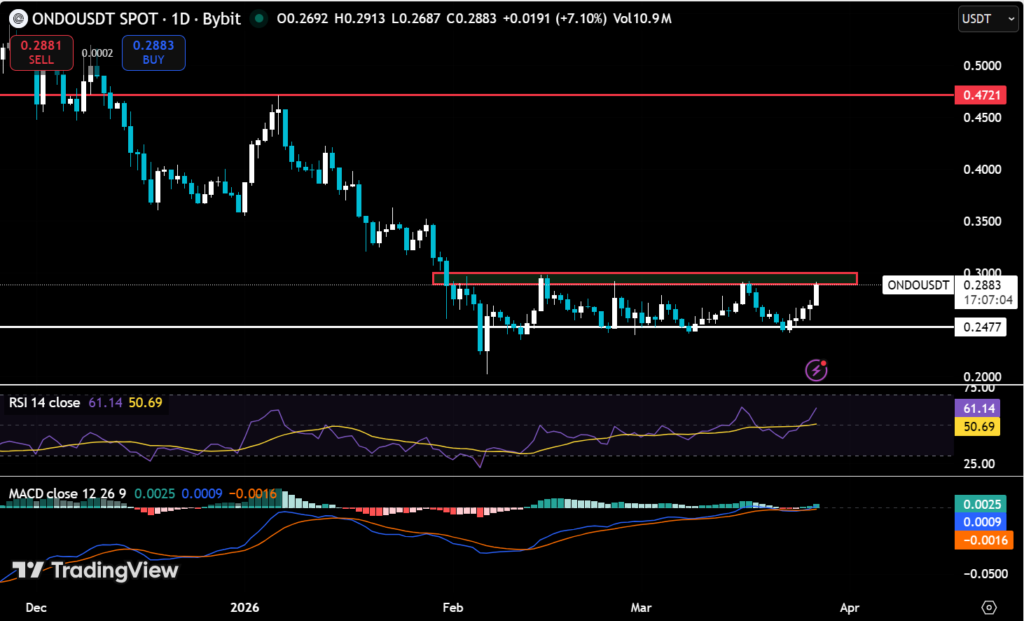
The daily RSI is reading 61.14, with the signal line at 50.69. That spread matters and with the RSI crossing above its signal from below while sitting in the 55-65 range, it is a classically constructive setup. It points out that momentum is building without entering overbought territory. There is room to run before RSI becomes a headwind.
The MACD line (blue) is reading 0.0009, having crossed above the signal line (orange) at -0.0016 in mid-March. That gap between the two lines, 0.0025 points, is reflected in the histogram printing a positive 0.0025. Both lines remain at low absolute values after spending most of February compressed near zero, mirroring the price chart’s range-bound structure through that same period.
The histogram turning positive and holding that reading over the past two weeks is the more meaningful signal here. It confirms the crossover is not a one-candle event but a sustained momentum shift. The signal line still sitting in negative territory at -0.0016 tells the market participants how weak the prior trend was and how early this recovery actually is.
A pullback toward $0.27 would not negate the structure. Only a reversal where the MACD line crosses back below the signal line and the histogram returns negative would invalidate the current bullish momentum read.
What the chart also shows is the overhead structure of this RWA (real-world asset) narrative asset. The $0.4721 level, marked on the chart as a key resistance zone, is 63.8% above the current price. Getting there requires first clearing $0.30, then working through the $0.35 area where price consolidated briefly in November 2025 before the larger breakdown. These are not trivial gaps to close in a single move.
The low from February 13, 2026, at approximately $0.25, represents the structural floor. The price dipped below $0.25 intraday as a wick to around $0.20, then showed recovery. That low wick is now the support reference. As long as the $0.2477 level holds, the range structure remains intact and the current bounce has a valid technical basis.
What Drove the Move
The Franklin Templeton partnership announced on March 25, 2026, two days before this writing, is the clearest fundamental catalyst for the current price action. The partnership involves tokenizing five Franklin Templeton-managed ETFs for 24/7 wallet-based trading on Ondo’s infrastructure. For a protocol that positions itself at the intersection of traditional finance and blockchain, this move is not a minor integration. Franklin Templeton manages hundreds of billions in assets and the association alone shifts the institutional credibility of the Ondo Global Markets platform.
ONDO peaked at $1.04 on July 27, 2025, with a market cap of $3.29 billion and daily volume of $183.68 million. By February 13, 2026, the market cap had compressed to $1.22 billion based on a volume of just $40.63 million. The February low was a market in full capitulation mode. The March 26 data point, with price at $0.26546, volume $100.56 million, and market cap $1.29 billion, shows volume nearly tripling from the February trough. That volume recovery coinciding with the Franklin Templeton announcement is not coincidental.
The SEC inquiry closure in late 2025, which concluded with no charges against Ondo, removed a regulatory risk that had likely suppressed institutional interest throughout the second half of 2025. That was the clearing of the runway, and with the Franklin Templeton deal, maybe the engine is operating.
The Risk That Doesn’t Show Up on the Chart
The token unlock schedule presents a structural headwind that technical indicators cannot capture. Upcoming vesting tranches are listed at approximately 1.71 billion tokens each, spread across Ecosystem Growth (792.17 million), Protocol Development (660 million), and Equity Investors (258.05 million) allocations. At current prices, a 1.71 billion token tranche hitting open markets represents potential sell-side pressure measured in hundreds of millions of dollars against a market cap of just $1.4 billion.
Linear vesting means supply enters gradually rather than in a single event. That sounds manageable until considering that ONDO averaged just $40.63 million in daily volume at the February lows. Even at the current recovering volume of $145.13 million, sustained absorption of these tranches requires either a significant expansion in buyer participation or a meaningful price increase to shrink the token-denominated pressure in dollar terms.
Equity investor tranches carry the sharpest liquidation risk. Holders who entered near the $1.04 July 2025 peak are still deeply underwater at $0.29, but a 20% recovery from February lows creates a rational incentive for partial exits at technical resistance. The on-chain behavior over the past seven days reinforces this concern. Large wallet deposits to centralized exchanges have been flagged, even as overall social sentiment sits at a mildly bullish 5.01 out of 10. Exchange deposits from large wallets coinciding with a rally into known resistance are worth monitoring closely. Watching wallet movements around actual unlock dates will tell traders more than any price indicator in the near term.
What’s to Consider Next?
The immediate technical question is binary: does ONDO close above $0.30 on meaningful volume, or does it get rejected again? Three prior rejections at this level make a fourth attempt statistically meaningful. A daily close above $0.30 with volume above the 30-day average would be the first clean structural break of the current range. The next target after that is $0.35, followed by the $0.4721 resistance level marked on the chart.
On the downside, $0.2477 is the level to watch. A breakdown below that figure on volume would negate the current recovery structure and bring the February wick lows back into play. Thirty-day performance of 13.99% sounds strong. Against a one-year return of -68.73%, it is the beginning of a potential recovery and this figure is not evidence that one has already occurred.


