





Over the 90 days ending April 8, 2026, SIREN delivered a return of +502.53%, making it one of the stronger-performing tokens in the BNB Chain ecosystem over that window. The one-year figure stands at +1,232.95%, with the all-time high recorded at $3.83. The current price of $0.51903 represents an 86.12% drawdown from that peak. That combination of extraordinary multi-period gains sitting alongside deep single-asset drawdown is the defining context for reading the below chart. The token is not recovering from a bear market; it is recovering from its own distribution phase.
Price structure
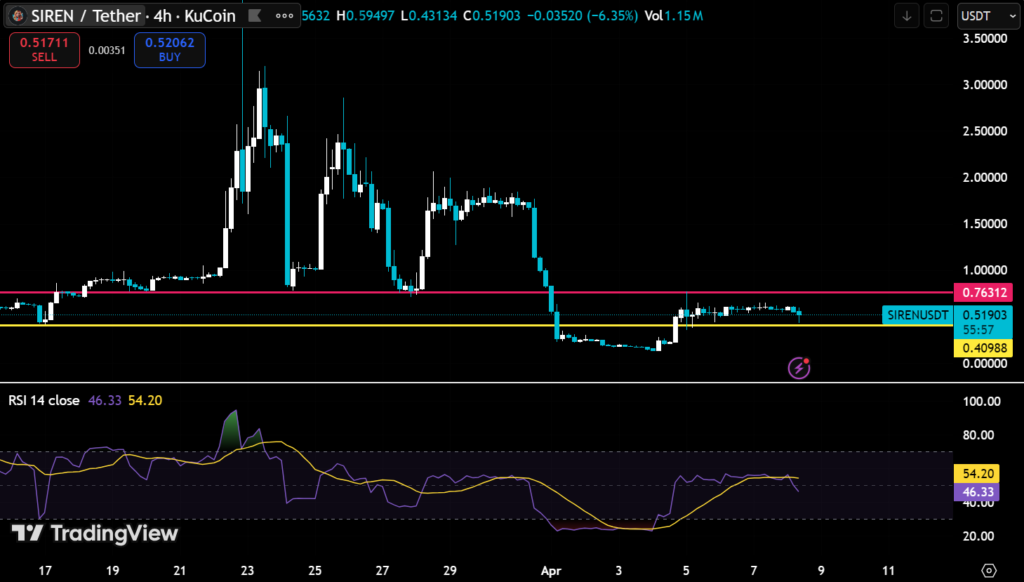
The 4-hour chart shows a clear two-peak formation through mid-to-late March. The first spike reached near $3.00 around March 23 before a sharp rejection. A second rally attempt, reaching approximately $2.00 around March 27 through 29, was equally distributed. From that second peak, price declined steeply through the $0.76312 level, which now acts as overhead resistance, before finding a floor in the $0.43 to $0.44 zone. The recovery from that low brought the price back above $0.50 in early April, and the token is currently consolidating between the $0.40988 support line (yellow horizontal) and the $0.76312 resistance level (pink horizontal).
The 4-hour high on the session is $0.59497 and the low is $0.43134, with a close at $0.51903. That intraday range of roughly 38% on a single 4-hour session reflects the volatility profile of this asset. The 24-hour price series shows a consistent drift lower: $0.59996 at 22:50 UTC on April 7, $0.58319 at 01:25 UTC, $0.54813 at 04:05 UTC, and $0.53203 at 06:50 UTC.
RSI reading
The RSI on the 4-hour chart is showing a reading that warrants attention. The signal line (yellow) sits at 54.20, clearing the 50 neutral level for the first time since the token’s decline off the second peak in late March. The RSI line (purple) remains at 46.33, still below neutral. The 7.87-point spread between the two is the structural setup traders should be watching, not the absolute values in isolation.
When the signal line leads the RSI line higher by this margin while price is consolidating within a defined range rather than trending lower, it has historically preceded a directional resolution on this chart. The March 23 rally and the subsequent late March recovery both showed this same sequencing: signal line crossing above 50 first, RSI line following within two to three candles, price then making its move. The difference in those setups was the floor they were building from. Both prior recoveries launched with the signal line in the low-to-mid 20s, meaning RSI was deeply compressed before the expansion. The current setup is building from a higher base, with the signal line recovering from approximately 30 to 35 before reaching today’s 54.20 reading.
The current setup does not have that compressed starting point, which suggests that if the RSI line at 46.33 does cross above 50 and confirm the signal line’s lead, the resulting move toward $0.76312 resistance is more likely to be measured and testable rather than the kind of vertical acceleration seen on March 23. Traders positioning for the breakout scenario should factor that into their expectation for how quickly the $0.76312 level is approached.
The Technical Key Notes
The structure here is a defined range trade with an asymmetric RSI setup. The price is sitting at $0.51903, which is approximately the midpoint between $0.40988 and $0.76312, a range width of $0.35324. A clean 4-hour close above $0.76312 would be the first meaningful structural reclaim since the token’s collapse off the $2.00 level and would open roughly 47% upside from the current price to that level alone. A failure to hold $0.51903 and a rejection back toward $0.40988 represents approximately a 21% downside to the range floor.
Volume context matters here. The 24-hour volume of $47.08M against a $387.06M market cap gives a turnover ratio of roughly 12.2%. That level of volume relative to market cap indicates active participation rather than thin price discovery. It does not, however, confirm directional intent; high turnover in a consolidation zone can mean distribution as readily as accumulation.
Forward-looking perspective
SIREN’s next meaningful move will be decided at $0.76312. That level has not been approached since price broke below it during the steep April decline. A reclaim of that zone on sustained volume would shift the short-term structure from consolidation to potential trend recovery. Until that reclaim is confirmed on a 4-hour close, the token remains in a range that has clear boundaries and a momentum indicator that is signaling early but unconfirmed bullish intent. The RSI divergence between the fast and slow lines is the most actionable data point on this chart right now; it has not resolved yet, which means the most important candles have not printed yet.
The quoted spread on the chart is $0.00351, or roughly 0.68% at the current price of $0.51903. At $47.08M in daily volume across a 727.51M circulating supply, liquidity is active by most measures. The spread width is a function of volatility, not the absence of participation. That reading is consistent with what the RSI and price structure already suggest: this is an asset in an unresolved consolidation, and the order book is reflecting that uncertainty in real time. A tighter spread would imply market makers have more conviction about near-term direction than the current chart structure justifies. At this stage, they do not, and the 0.68% quote is priced accordingly.


