





Solana is trading at $79.05 on the daily chart, down 2.62% on the session with a high of $81.77 and a low of $78.30, continuing a broader 7-day decline of approximately 11.3% from the $83–86 range where price had consolidated through late March. The more telling detail is not the percentage loss itself but where the price has landed: directly on a clearly defined order block zone that has held as a demand area since the February lows. That confluence is now the single most important technical reference for anyone managing SOL exposure.
The Order Block Zone: Revisit or Breakdown
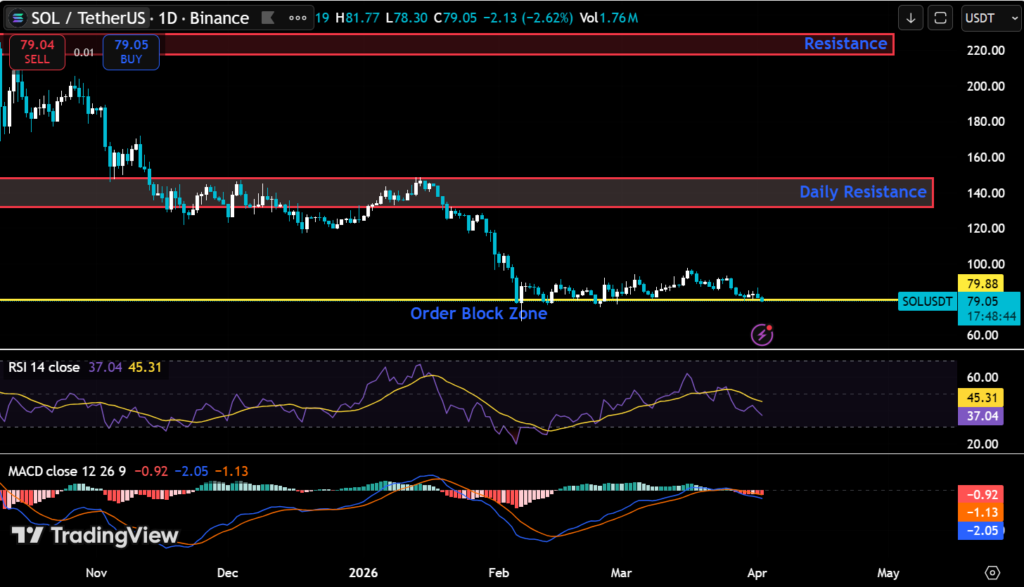
The daily chart marks the Order Block Zone around the $79 level, a region that previously absorbed heavy selling in February and produced a meaningful recovery attempt toward $100. Price is revisiting that exact zone now, and the quality of this test matters considerably more than the test itself.
The current daily candle is closing near $79.05, with the session printing a low of $78.30. That $78.30 level now functions as the order block’s lower boundary, and a daily close beneath it would shift the structural read from a demand retest to a confirmed breakdown. What sharpens the significance of this zone further is the Fibonacci swing low sitting at $79.58, just above the current price. Three reference points converging within a $1.28 range, the order block boundary, the Fibonacci swing low, and the current close, is not a coincidence. It is a compression of decision-relevant levels that makes the $78.30 to $79.58 band the most watched technical cluster on the SOL daily chart right now.
Below that level, there is limited identifiable support structure on this chart until the $60–70 congestion zone, representing potential additional downside of 13–25% from current levels if the order block fails to hold.
Momentum Indicators Confirm Distribution, Not Accumulation
The RSI 14 is reading 37.04 against a signal line of 45.31, an 8.27-point spread that carries more analytical weight than the absolute reading alone. When the RSI line trades that far below its own smoothed average, it indicates momentum is not just weak but actively deteriorating, a condition that separates genuine trend pressure from routine consolidation noise.
At 37.04, SOL is approaching oversold territory, but that framing requires context. The February sell-off on this same chart saw RSI push below 30 before any credible demand response emerged, and that recovery only materialized after several sessions of RSI compression near those lows. The current reading at 37.04 has not reached that threshold yet. Traders positioning on oversold proximity alone are getting in front of a signal that, by this chart’s own history, has not fully played out.
The MACD structure on the daily chart reinforces the same bearish read the RSI is delivering, but with an additional layer of concern. The MACD line sits at -2.05, the signal line at -1.13, and the histogram is printing -0.92. The sequence matters here: the MACD line trading 0.92 points below the signal line means momentum is not just negative but running ahead of its average to the downside. The histogram at -0.92 reflects that gap visually, and it has not shown meaningful compression in recent sessions. Looking at the current setup compared to February, the MACD line went much lower before the histogram started to shrink and a recovery began. By that reference, the current MACD position does not yet represent an exhausted bearish move. There is room for the spread between the MACD line and signal line to widen further before this indicator gives traders anything resembling a constructive signal.
According to the moving average structure, SMA7 sits at $82.81 and SMA30 at $87.19, both above the current price. The SMA200 is at $138.87, a level that underscores how far SOL has traveled from its prior macro structure. The short-term average sits below the medium-term average, which in turn sits below the long-term average, creating a bearish alignment across multiple timeframes.
What Traders Should Watch
Two price levels define the near-term decision tree for SOL. On the downside, $78.30 is the line that needs to hold on a daily close basis. A breach there transitions the order block from the demand zone to the broken structure. On the upside, the first meaningful checkpoint is $82.81, where the SMA7 sits. Reclaiming that level on a close is the minimum requirement to suggest selling pressure is easing, but it does not confirm a structural shift. That confirmation only becomes relevant in the $86.39 to $87.19 zone, where the 61.8% Fibonacci retracement and SMA30 converge within an 80-cent range. Any bounce between $78.30 and $86 before reaching that cluster is relief within a downtrend, not the start of a recovery.
Failure to hold the order block and a confirmed daily close below $78.30 shifts the base case toward the $60–70 range, which is the next significant area of historical price structure visible on the broader chart.
The daily resistance zone marked clearly on the chart near $140 remains a distant reference and is not relevant to near-term tactical positioning.
Fundamental Risk Builds
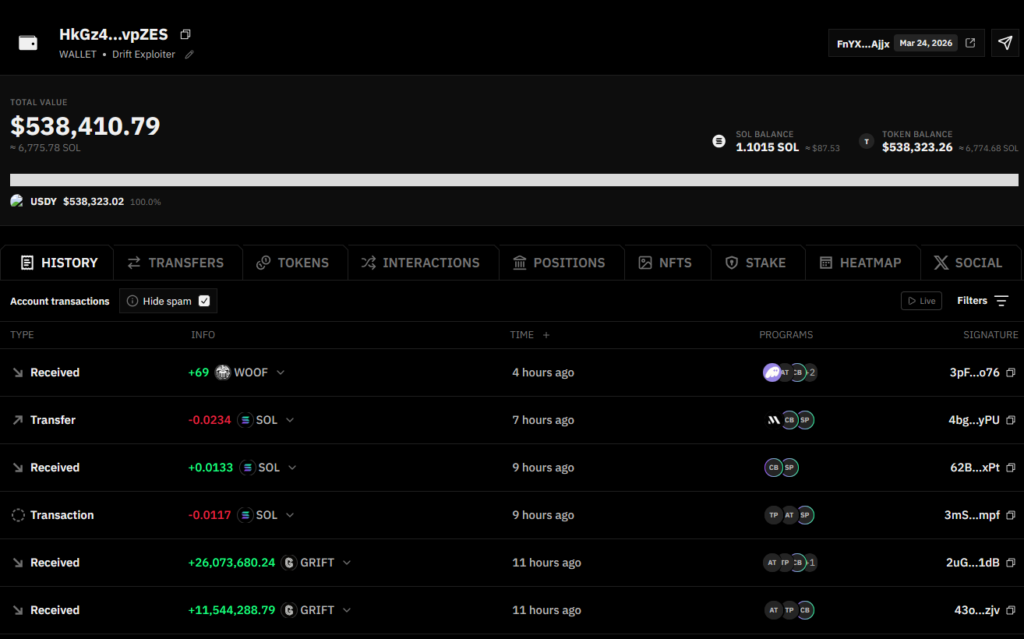
The chart pattern has a catalyst behind it, and attributing SOL’s current position solely to broad market rotation would be an incomplete read. A reported exploit targeting Drift, a derivatives and DeFi protocol operating within the Solana ecosystem, has introduced direct fundamental pressure on top of an already weakened technical structure. The scale of the incident, with estimates placing the figure in the hundreds of millions of dollars, moves it out of the category of routine protocol risk and into the territory of an ecosystem-level confidence event. That distinction matters because the market does not price a minor bug fix and a nine-figure exploit the same way. One is noise; the other forces a reassessment of risk premiums across everything connected to the same underlying network.
The practical effect of a large exploit on an ecosystem asset like SOL is multi-layered. Liquidity providers and institutional custodians reassess counterparty risk. DeFi TVL contractions reduce organic demand for SOL as gas and collateral.
The 24-hour volume of $5.92 billion against a market cap of $45.31 billion reflects a volume-to-market cap ratio of approximately 13%, which is elevated. High volume on a down move is a distribution signal, not a capitulation signal, and distinguishes this decline from low-liquidity drift lower.
Conclusion
SOL is defending a structurally significant demand zone at $79 while carrying deteriorating momentum across RSI, MACD, and moving average alignment. The Drift exploit has introduced a fundamental dimension to what might otherwise be read as a routine technical pullback, and the elevated volume on the decline suggests institutional-level repositioning is occurring. Until the price reclaims $82.81 at minimum and ideally tests $86–89, the technical and fundamental evidence does not support a recovery thesis.


