





Solana (SOL) broke below the important $100 mark on Sunday, which analysts consider to be an important psychological mark for investors. It has stayed above that mark for more than ten months. The asset reached its lowest point at $95.95 before it recovered to $103.19, at the time of writing. The asset experienced a 4.2% decline over that period. The market movement reveals a major market correction because SOL has experienced a fall of ~19% during the previous week and 25% during the past month while investors are more cautious toward digital currencies, which is impacting Solana as a result.
The trading volumes have witnessed a drop of 26% during the last 24 hours since traders have chosen to close their trading positions instead of increasing their short-selling activities. The respective trend also aligns with the aggregated open interest for the asset. Solana is demonstrating technical weaknesses, while its on-chain performance shows strength, considering institutional investors and network development boost its market value.
Macroeconomic and Market Context
The current decline in SOL arises from multiple global economic challenges that affect all forms of risky investments. The market started to experience liquidity problems considering investors anticipated that the U.S. central bank would implement strict monetary policies, which included raising interest rates to combat ongoing inflation. The situation worsens since rising geopolitical conflicts in important areas have created conditions that make investors less willing to take risks, resulting in heavy losses for altcoin markets. Bitcoin’s price range below $70000 has created a negative impact on the asset, yet its market connection to Bitcoin remains strong, according to the latest market analysis.

In the past month, Solana’s network processed more than 2.34 billion transactions. The improved on-chain metrics highlight its scalability and strong application across decentralized apps and DeFi protocols. According to the data from Sosovalue, U.S.-listed Solana spot ETFs witnessed $104 million in net inflows. In the month of December 2025, the monthly inflow for the same was $147.6 million with AUM at $950.82 million. Meanwhile, Solana’s DeFi TVL holds steady at $7.805 billion (data source: defillama), expressing sustained demand that could provide support during market downturns.
Technical Analysis
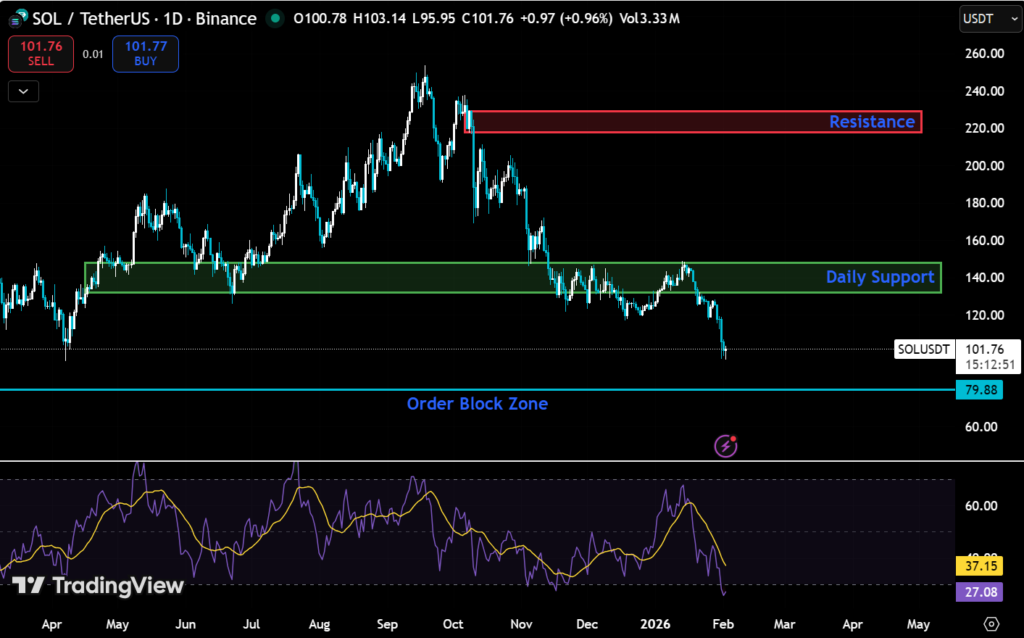
The daily chart for the asset shows a classic downtrend characterized by a series of lower highs and lower lows since peaking near $260 in November 2025. The price action has decisively broken below the support zone between $135 and $145. The price needs to reclaim the $135 to $145 range to reverse the current bearish structure. The on-balance volume trend is drifting lower, suggesting that heavy selling is starting to cool rather than intensify. On the daily chart, a key order block zone stands near $79.88, an area that previously drove strong buying, making it a meaningful support to hold if the price revisits it. After testing the $95 range, the asset may experience a bounce back, but as long as daily candle closes stay below $100, the move could result in a false breakout instead of a high-volume, sustainable bullish price.
The Relative Strength Index shows a value of 27.08, which indicates that the asset has entered oversold territory. The daily RSI has been under 30, and it creates a possibility of a relief rally if the RSI drops further. The common pattern form is like a “dead cat bounce.” This momentum indicator has established a weak divergence pattern with price movement because the indicator shows lower levels after price reaches new lows, which suggests that the bears are losing dominance.
Key Support and Resistance Levels
Resistance remains stacked overhead and currently sits at $240, aligned with the 2025 cycle highs. The immediate near-term resistance is clustered at $140, which is not acting as a resistance but instead as a support after the breakdown, followed by the 50-day EMA near $130. Bulls would need to reclaim the zone of $110–$115 to absorb the immediate downside pressure.
Support is concentrated below current levels. The $92–$90 zone is the first area to watch, followed by $85 and $80, which align with Fibonacci support, order-block demand, and psychological levels. A daily close above $105 would invalidate the bearish setup, while a sustained move below $95 would keep pressure tilted toward the $80–$85 range.
Risk Factors and Price Targets
The main risks for the project arise from two specific events, which include simultaneous sell-offs of Ethereum and all its layer-1 networks and the legal developments about stablecoins that affect SOL’s tether connection. Following this, it creates a possibility that network traffic may overload the system because users increase their transactions without any system improvements.
In the base case, Solana is expected to consolidate in the $95–$110 range over the next 1–2 weeks. It makes up a 60% probability of a relief rally to $120 if RSI divergences get in the confirmation. Followed by the bear case, the asset may approach the price target of $80, which is 20% further downside from the current price. On the other hand, the bullish case targets $140 (35% upside) in the case of improved market sentiment and macroeconomic conditions.


