





Bittensor (TAO) was trading at $335.48 as recently as April 8. By April 10, it had printed an intraday low of $248.9 on the daily chart, a range of over $86 in a single session, before settling around $268.3. That 12.06% daily close decline sitting on top of a broader 16.33% drawdown in 24 hours was not the product of macro pressure or a general crypto risk-off move. It was the result of a concentrated governance shock that found a market already sitting at a technically fragile level.
Understanding what happened requires separating two distinct narratives that have been running simultaneously inside TAO’s price action: a legitimate fundamental catalyst that drove the March-April rally, and an internal dispute that reversed a meaningful portion of those gains in a single trading session.
The Rally That Built the Risk
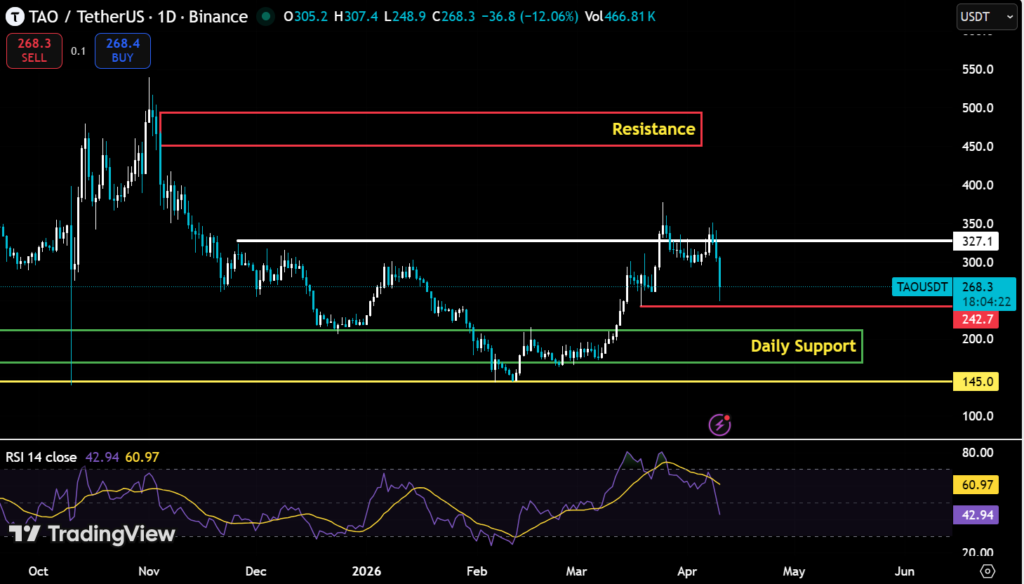
Between late February and early April, TAO climbed from the low of $200s into the $335 range, a move of approximately 50% in roughly six weeks. The primary catalyst was the Covenant-72B milestone, a 72.7-billion parameter model trained across 70+ distributed nodes on the Bittensor network, which represented a credible proof-of-concept for large-scale decentralized AI training. That milestone, combined with Grayscale raising TAO’s weighting to approximately 43% in its AI fund and concurrent reports of a Spot TAO ETF S-1 amendment filing, constructed a narrative with genuine institutional legs.
Price broke decisively above the horizontal consolidation band that had contained TAO throughout December 2025 and January-February 2026, with the upper boundary of that range sitting at $327.10. Volume on the daily during that breakout period was substantial, and the RSI signal line (yellow, 60.97) had climbed into the upper range alongside price, reflecting sustained buying pressure rather than a single-day spike.
That breakout above $327.1 is now the critical context for what happened next.
The Covenant AI Exit and What It Actually Means
On April 10, Covenant AI the operator of subnets SN3, SN81, and SN39 on the Bittensor network, publicly announced its departure from the ecosystem. The founder, Sam Dare, disclosed selling approximately 37,000 TAO as part of the exit and levelled direct accusations at Bittensor leadership: alleged unilateral suspension of subnet emissions, moderation revokes, and subnet deprecations. The language was not vague. Covenant AI named specific governance actions and framed the exit as a response to centralization concerns within a protocol whose core value proposition is decentralization.
The market response was immediate and the digital asset opened the session at $305.2, tagged a high of $307.4, and then dropped to an intraday low of $248.9 before partially recovering to close around $268.3. Volume on the session came in at 466.81K, elevated relative to the prior week’s daily prints, indicating that the sell pressure was not thin-market noise but active distribution or liquidation.
The 37,000 TAO sold by Covenant represents roughly 0.34% of circulating supply (10,820,000 TAO). Taken in isolation, that is not a number that should mechanically produce a 16% drop. What it produced was a confidence shock in a leveraged market. Open interest in TAO derivatives had built up during the rally, and when a large, named contributor publicly exited with governance allegations attached, the liquidation cascade did the rest of the price work.
Technical Structure: Where TAO Stands Now
The $327.1 level, which was the ceiling of the multi-month consolidation range and had briefly acted as support during the breakout, was decisively breached to the downside on today’s candle. Price is now trading at $268.30, back inside the prior consolidation range.
The next material liquidity-based support level from the chart is $242.70, marked explicitly on the daily. Below that, the broader daily support zone (green band) stretches down toward the $200 area, a zone that contained multiple tests throughout the December-February period. A confirmed close below $242.70 on elevated volume would open a technical path toward retesting that green support zone, with $200 as the structural floor within that band.
To the upside, reclaiming $327.1 on a daily close basis is the minimum requirement for the bullish breakout thesis to remain intact. Until that level is recovered, today’s price action has to be classified as a failed breakout rather than a pullback within an uptrend.
The RSI reading adds important context without being the lead signal. The purple RSI line has dropped to 42.94, which places it below the midline and in territory consistent with weakening momentum. It is not at oversold extremes, which means there is no mechanical RSI floor argument available to bulls at current levels. The signal line at 60.97 is now well above the RSI line, reflecting the speed of the recent deterioration. That divergence between signal and RSI is not a reversal signal on its own, but it confirms the momentum shift is real and not a brief noise event.
Trading Perspective
The immediate variable is not price but more of governance. Bittensor’s leadership has not issued a public response to Covenant AI’s specific allegations as of this writing. The affected subnets (SN3, SN39, and SN81) represent active network contributors, and whether they continue to operate under new management or go offline will directly affect network utility metrics visible on taostats.io.
The secondary variable is the Grayscale and ETF pipeline. The institutional demand argument that supported the rally relies on regulatory progress for a Spot TAO ETF and continued Grayscale weighting. Neither of those developments has been negated by today’s governance event, but a prolonged narrative dispute around centralization creates friction for institutional positioning.
The $242.7 level is the near-term level that can be tested again. A daily close above that level keeps the broader structure constructive and frames the current move as an event-driven shakeout within a recovering asset. A close below it shifts the technical bias decisively back toward the $200 daily support zone.


